All animations · In the chapter · Open full MP4
Animation 21
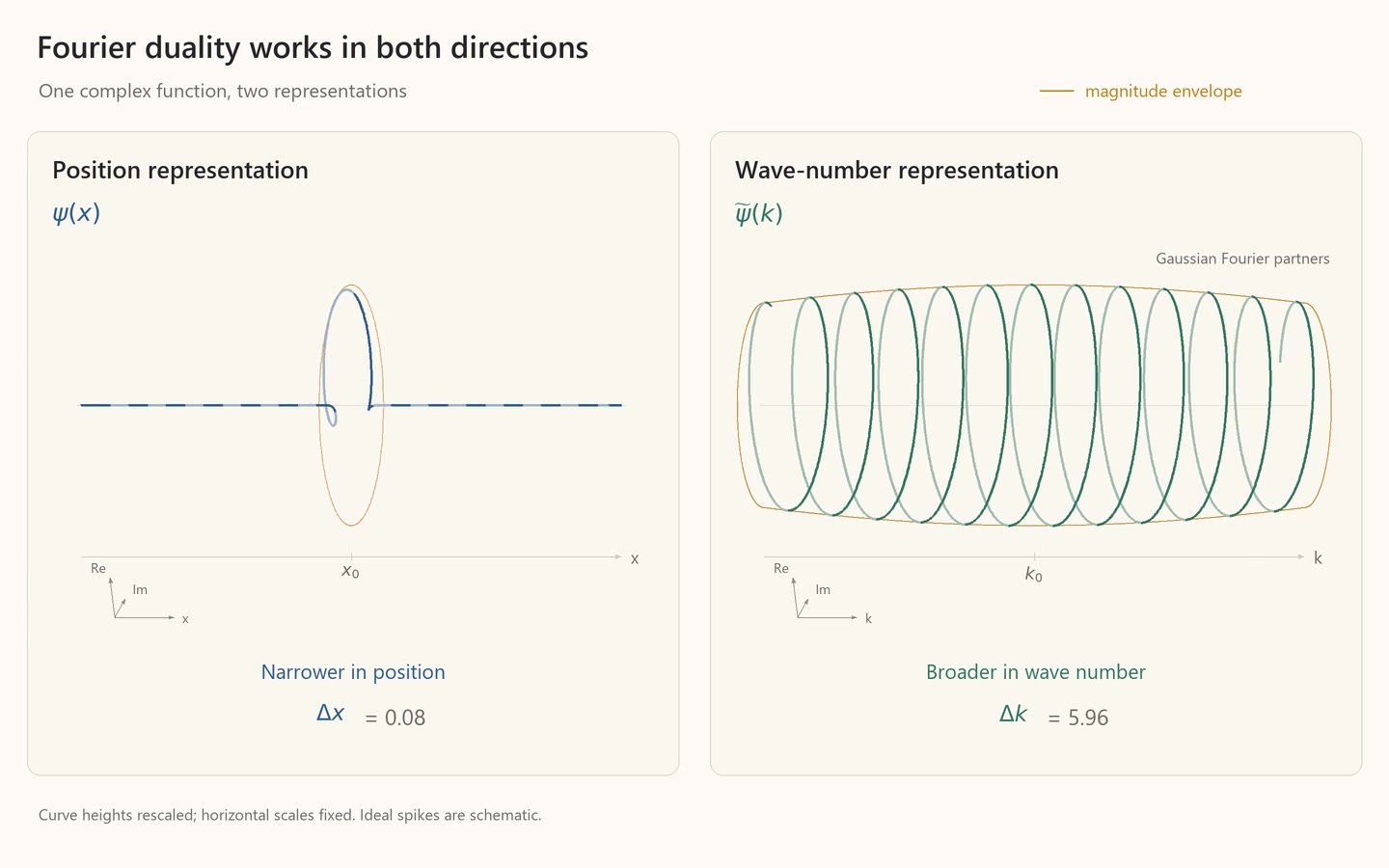
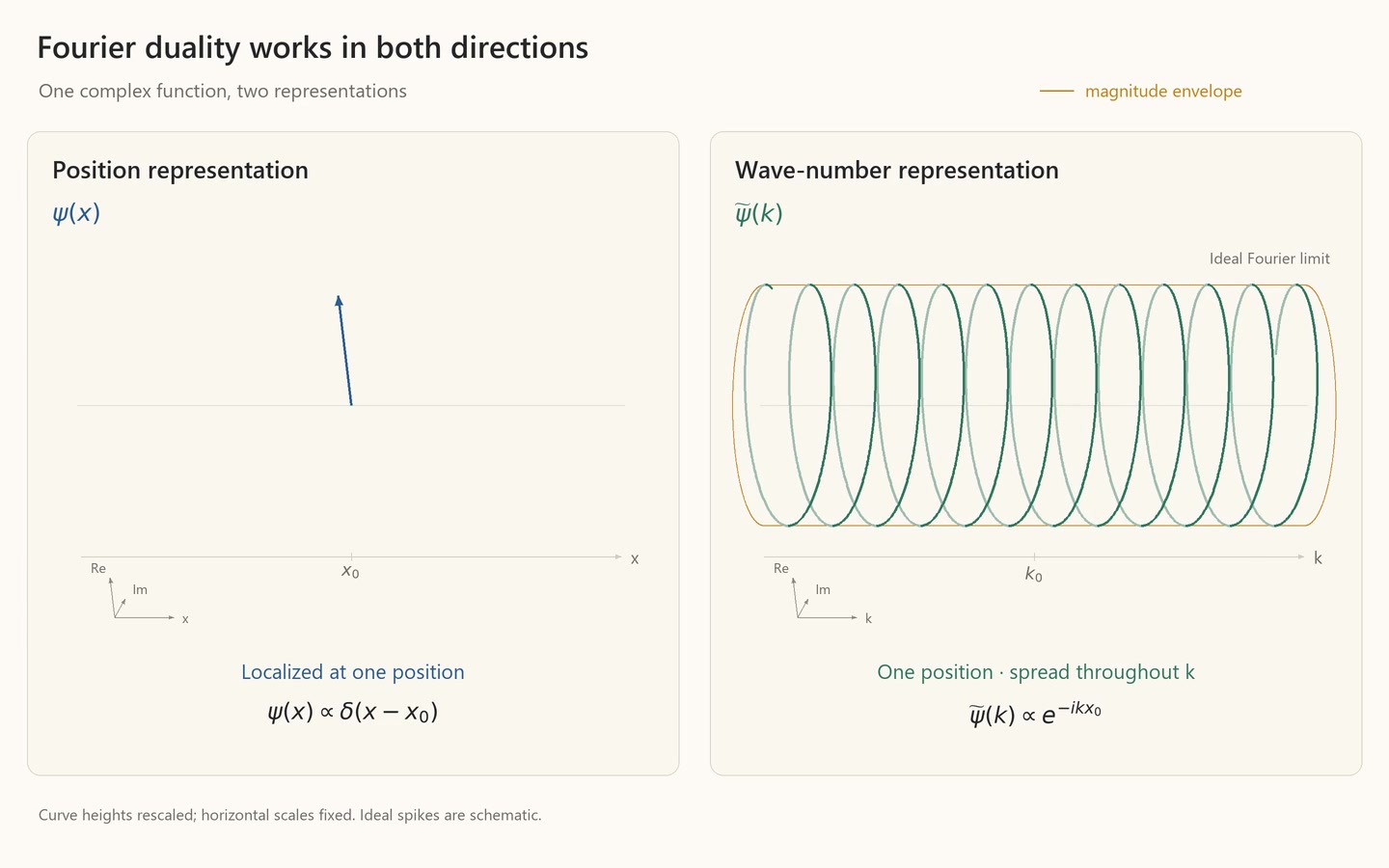
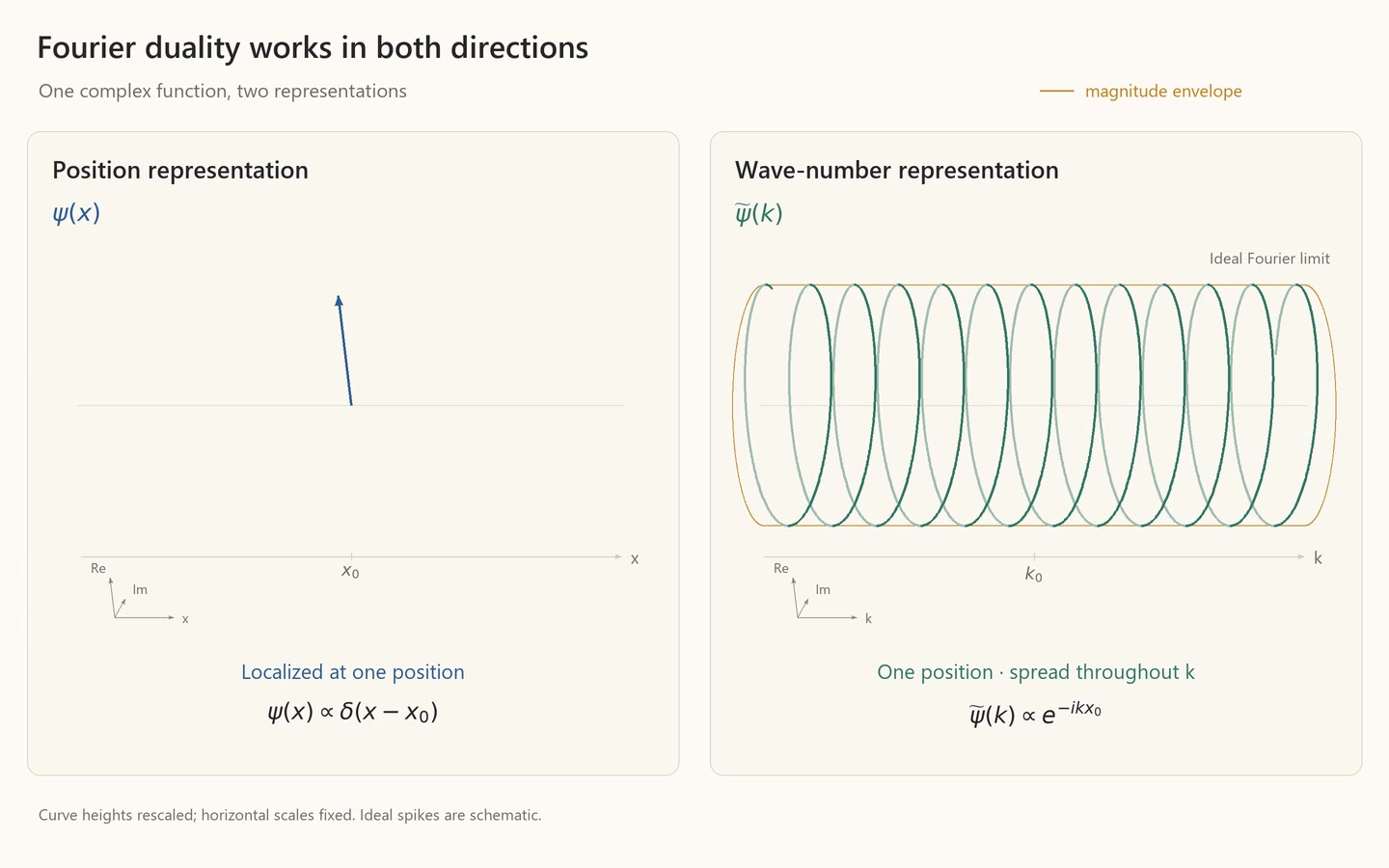
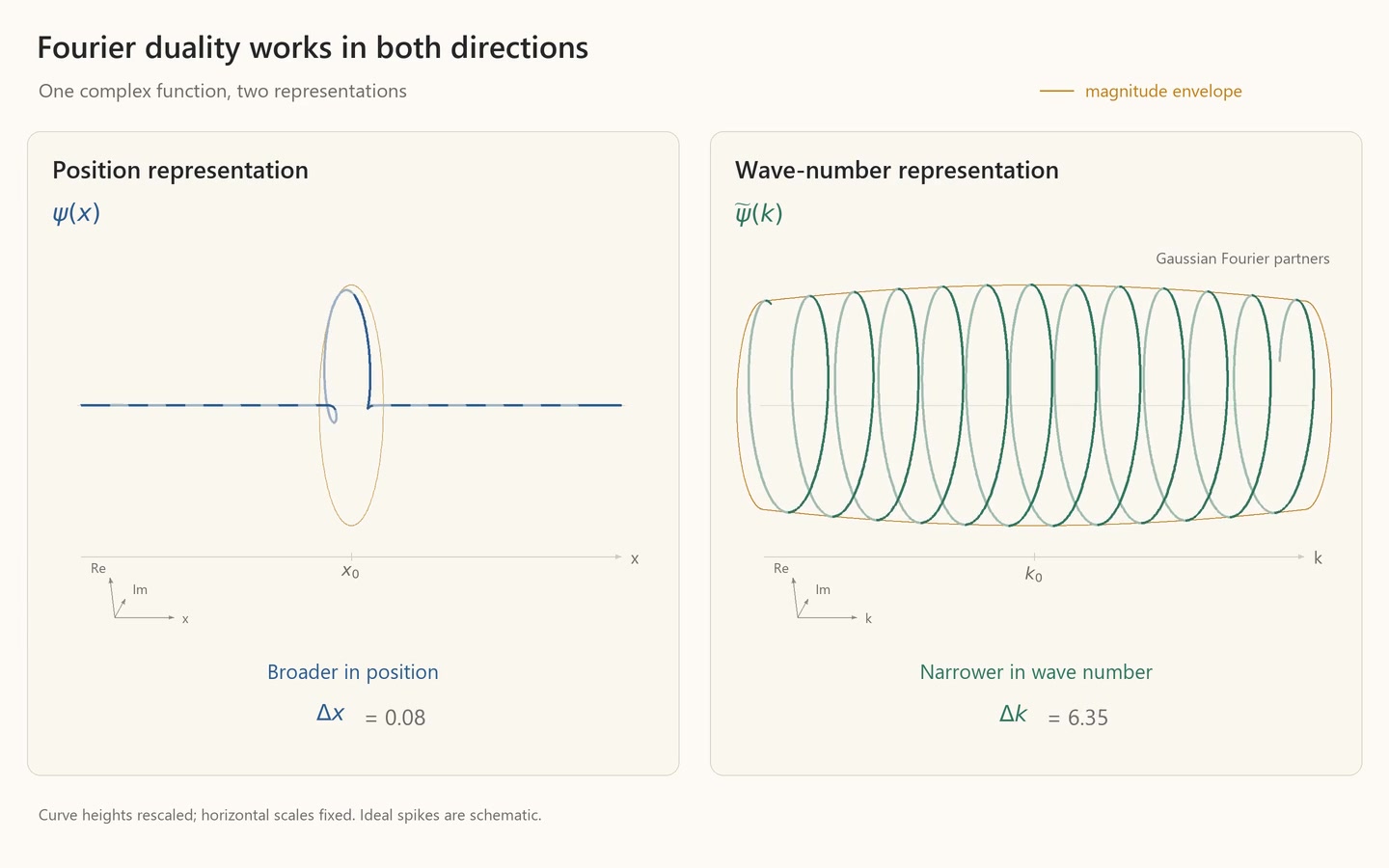
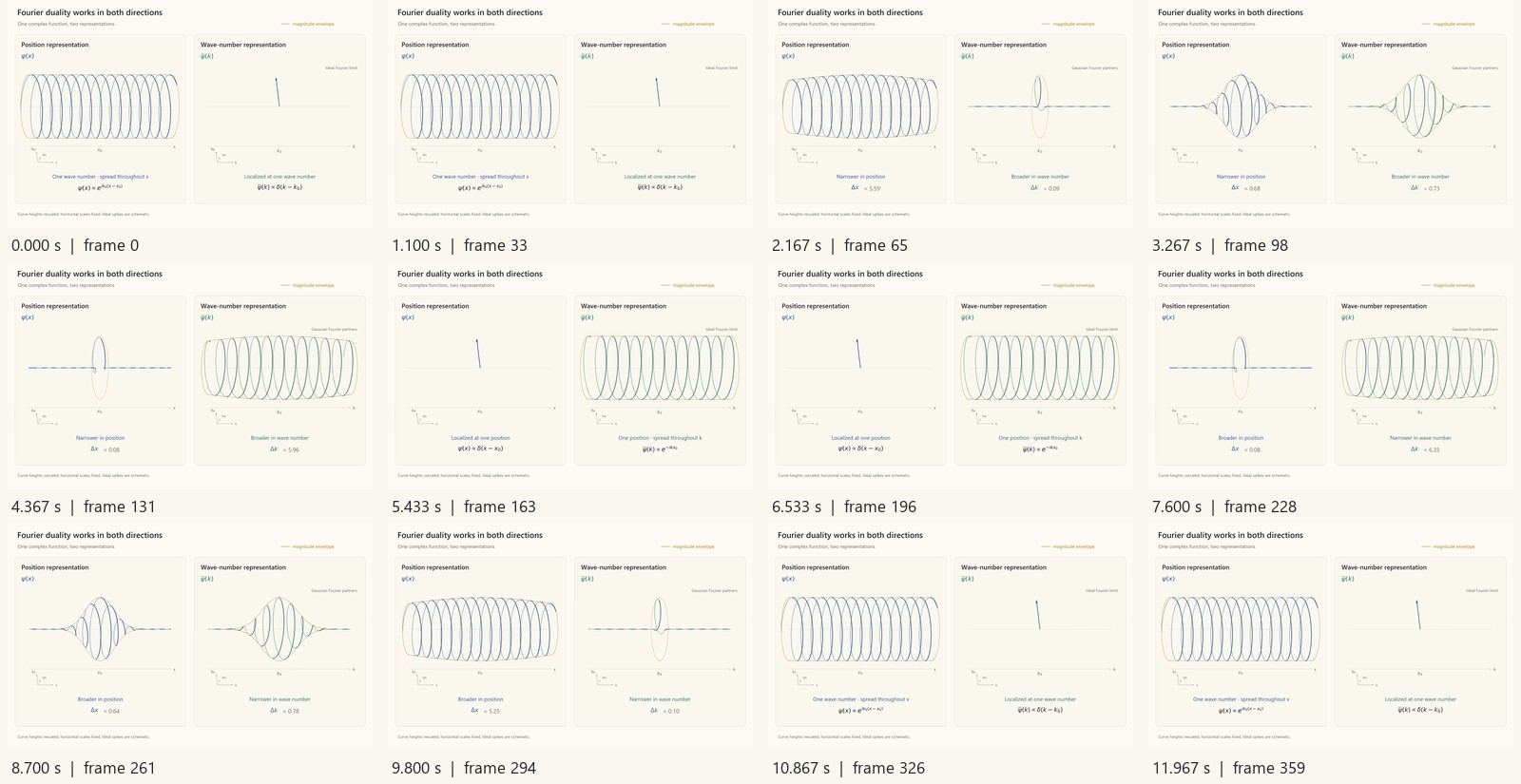
Trading off spread in position for spread in wave number
symmetry-xk-fourier-complex.mp4
These are sparse samples decoded from the current MP4, not newly rendered illustrations. They can support checks of the sampled states and labels, but cannot establish continuous motion, timing, transitions, or the absence of problems between samples. Use the full MP4 when judging those properties.
1440 × 900 · 30 fps · 12 s · 360 frames · 12 samples
MP4 SHA-256 3813ae79823f4c00f436d383dc644323c185560bfbb6e1625ce41f7bf17026fa
Frame manifest · Context markdown · Download complete review packet
Chapter context
Section: Position / Wave Number Uncertainty. Excerpts are verbatim; line numbers refer to the included chapter markdown.
Caption
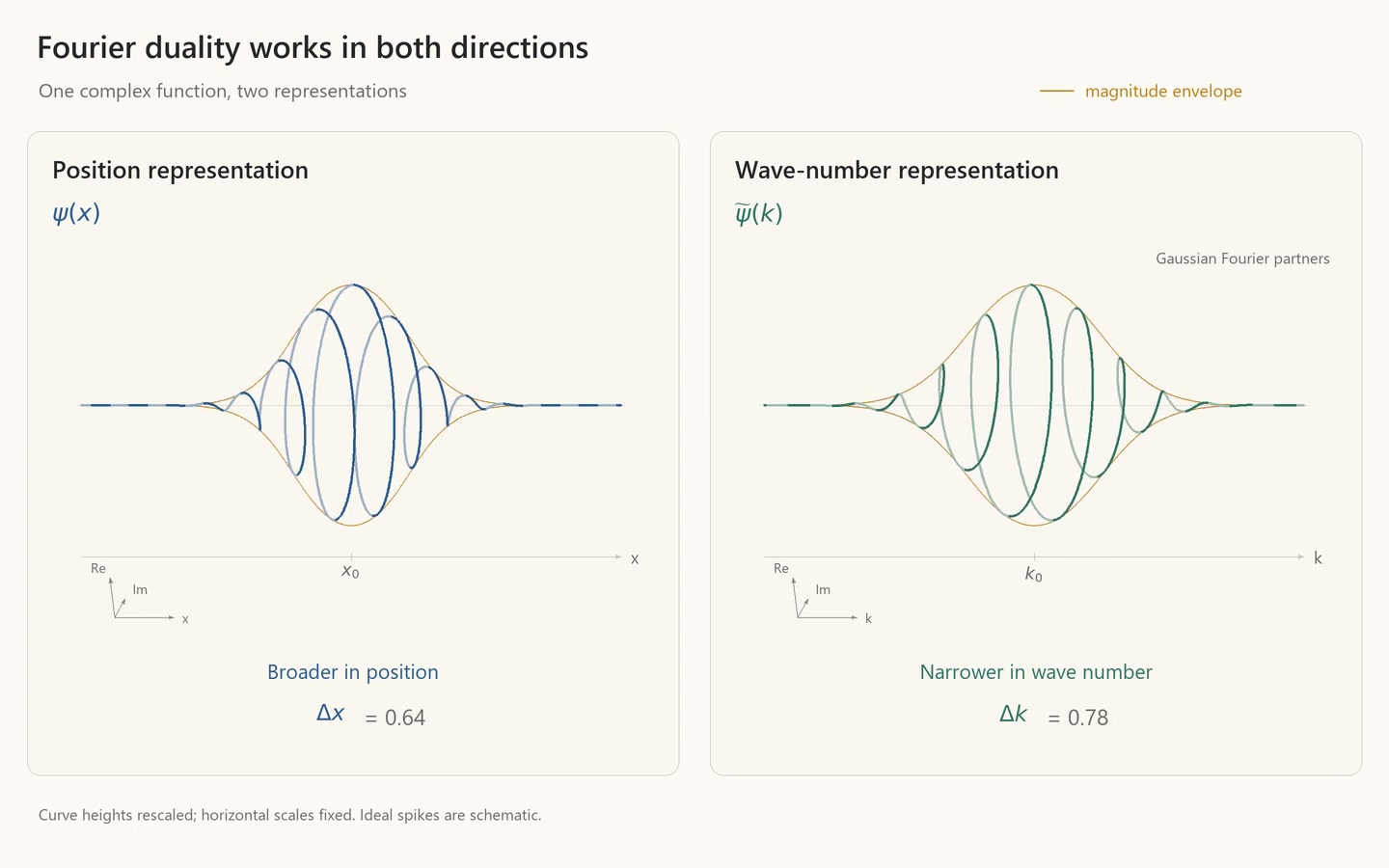
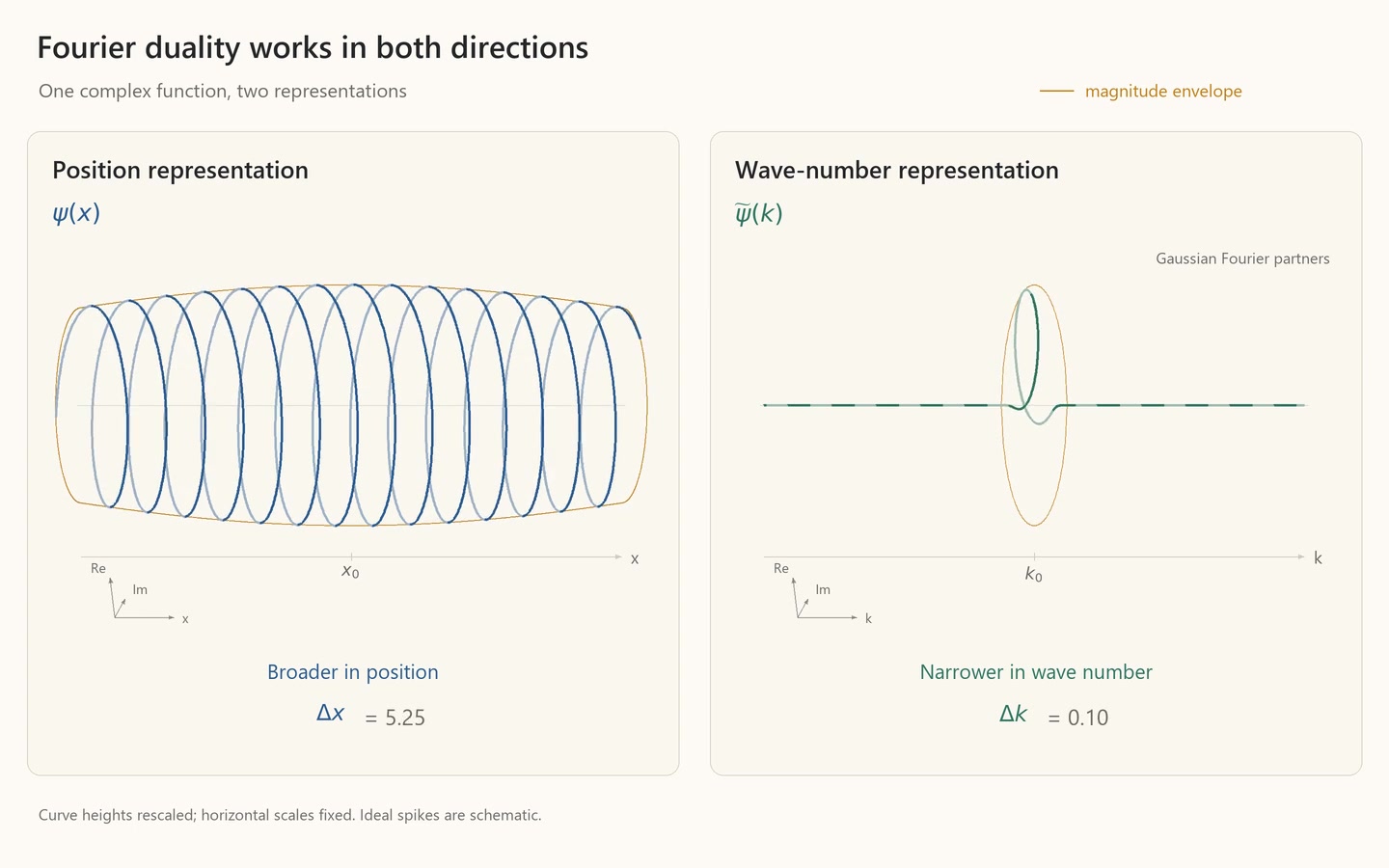
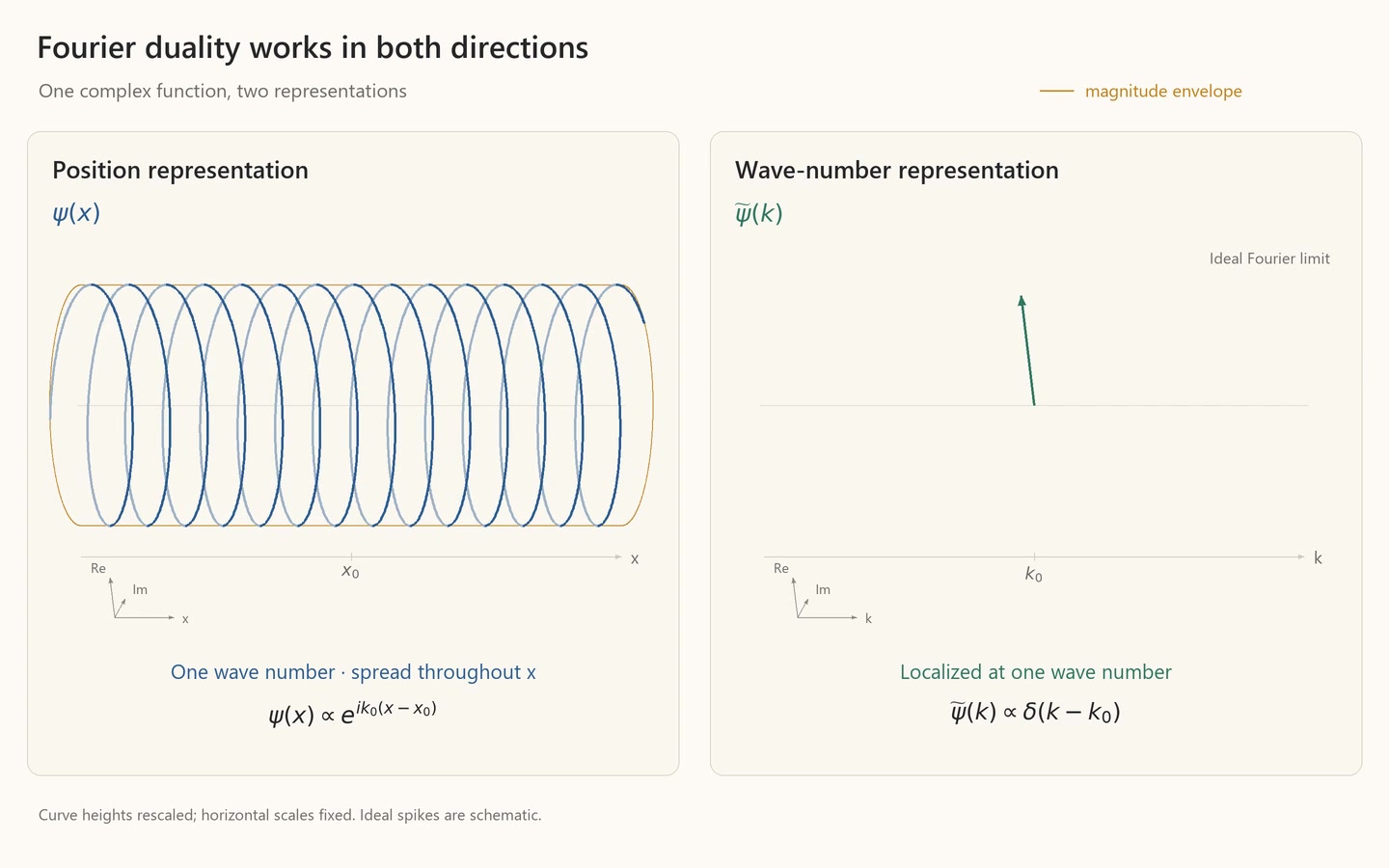
Trading off spread in position for spread in wave number
Image description
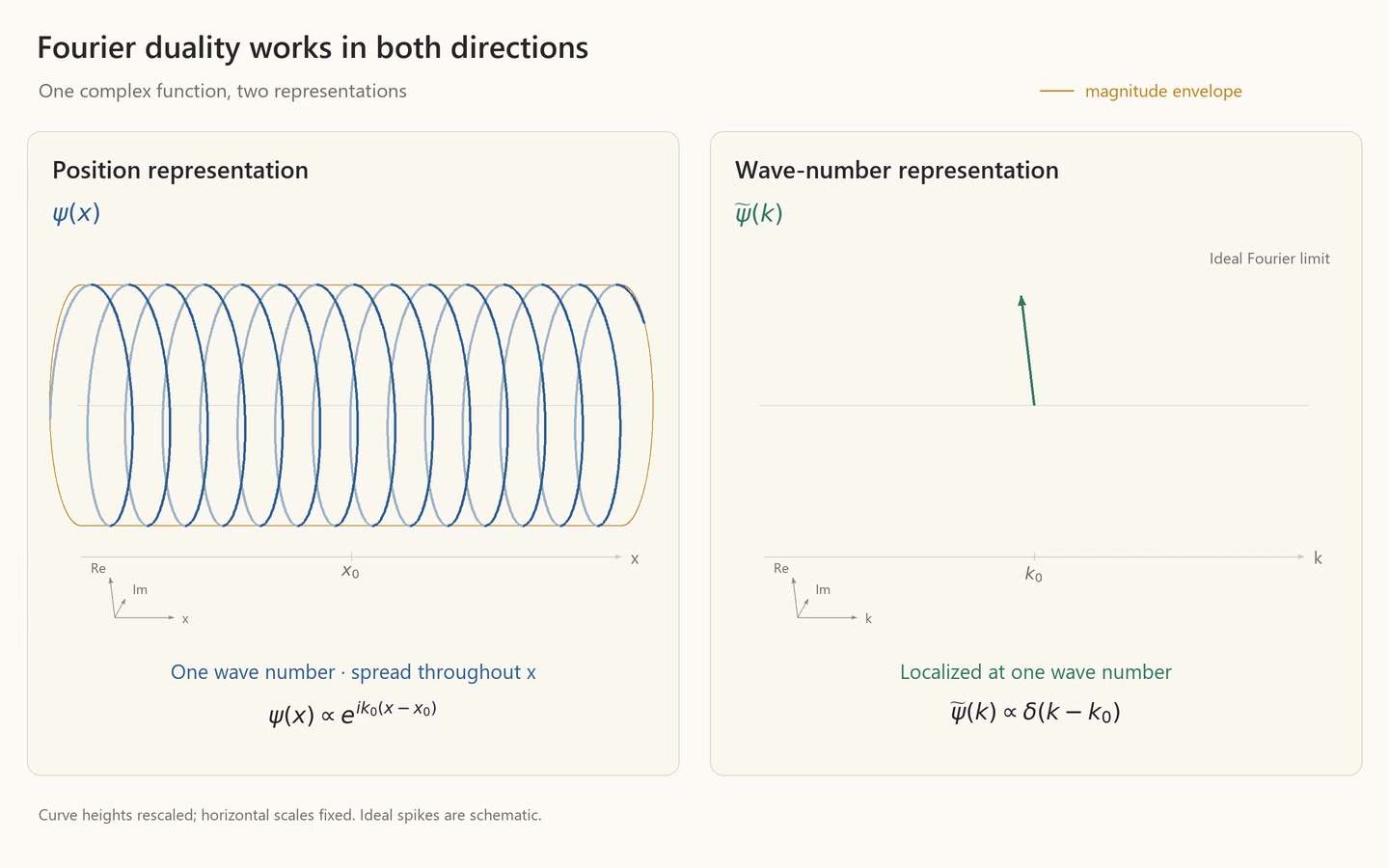
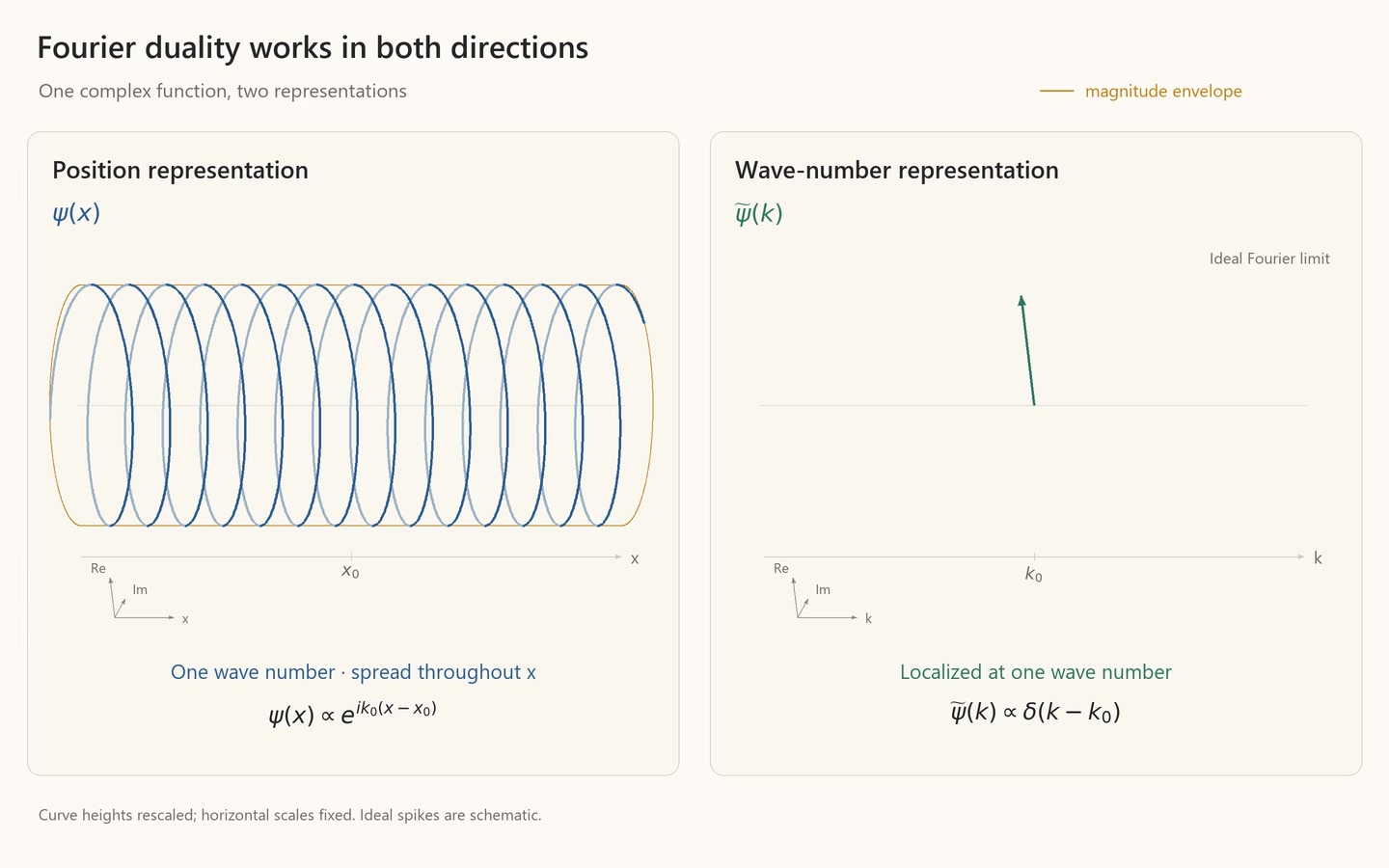
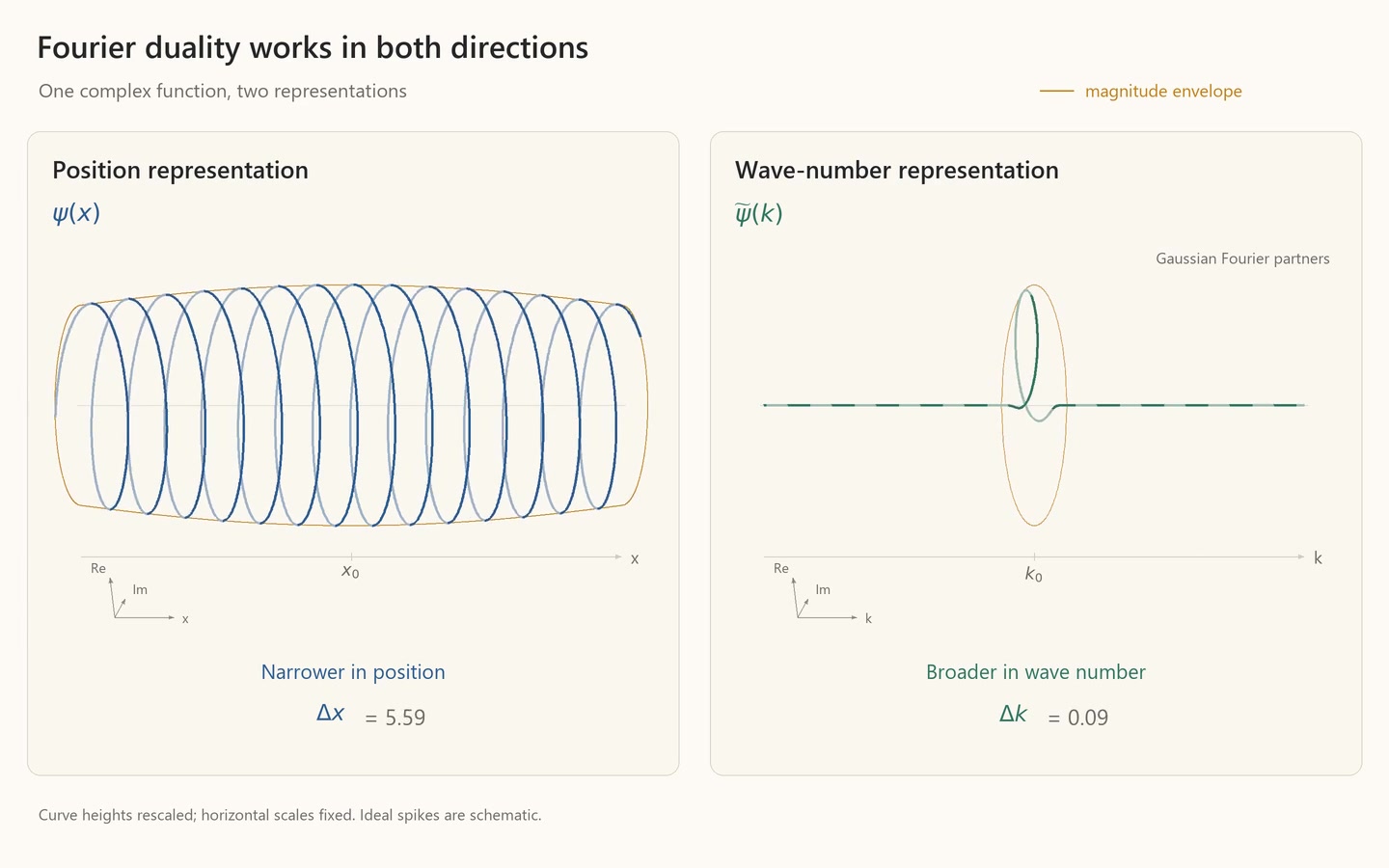
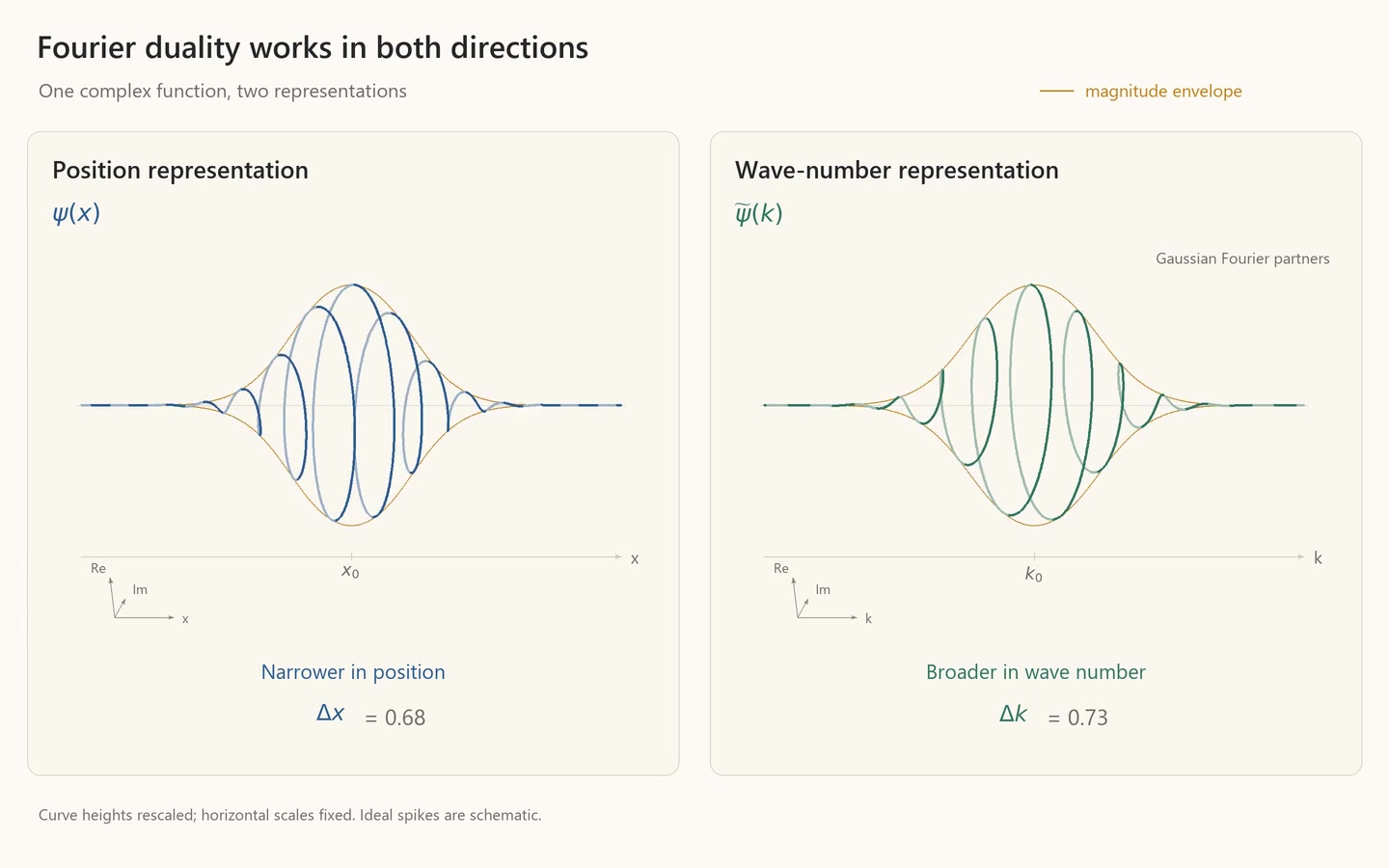
A complex wave function and its Fourier transform sweep between the localization extremes
Before the animation
Chapter lines 1025–1025
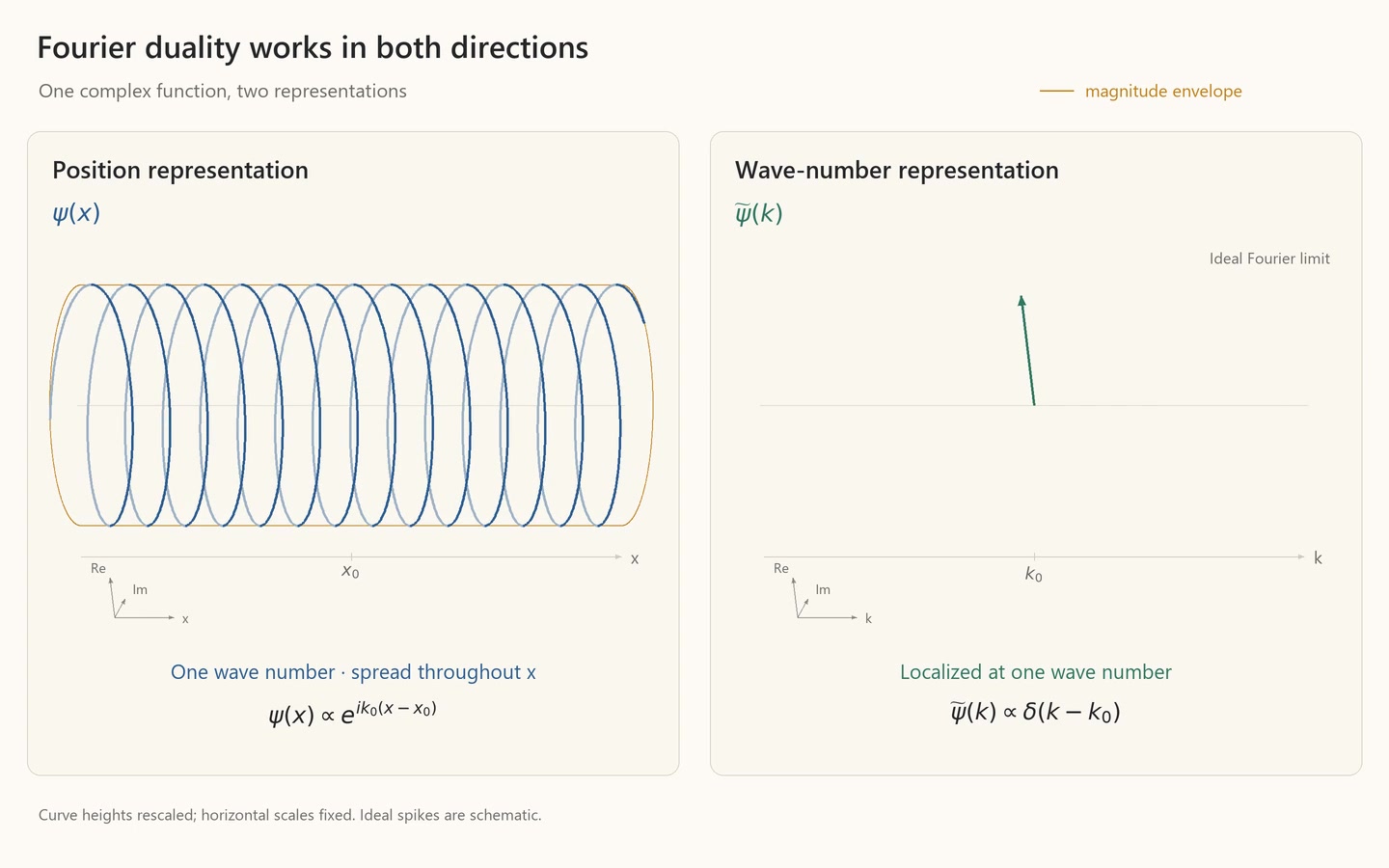
As we know, a single-mode wave function has a single wave number. But what position does it have? There is no way to answer this as the wave is uniform over all position space. The same statement holds in reverse. A wave packet ideally localized at one position is uniform over all $k$-space. Anywhere in between these extremes, as a wave packet is more localized in one space, it is more spread out in the dual space.
After the animation
Chapter lines 1033–1033
We can easily see this relationship drawn on paper, but we also hear it in music. The precise pitch of a tuning fork requires long sustain, while the percussive clap of a clave has no clear pitch. This tradeoff is the root of the Heisenberg uncertainty principle, or what is known in popular science as "quantum fuzziness."
Chapter lines 1035–1035
With this visual understanding of the tradeoff in the spread of the magnitude envelopes in $x$ and $k$ space, we can define the corresponding statistical standard deviation, or uncertainty, in position and wave number.
Generation source
Main script --render implements the complex Gaussian Fourier-pair sweep. The packet-phase module supplies shared drawing helpers and libraries; no earlier video is consumed. --check and --encoded-check write the companion validation.
Mapping evidence and limits
Exact NAME match. Matching validation records the full complex Fourier check and sigma_x sweep, 360 frames, 30 fps, 1440 x 900, 12 s; encoded-validation.json confirms these video dimensions and compares decoded samples with source frames.
Source SHA-256 values identify the exact downloadable bytes in this packet. The source mapping and recorded checks explain the likely generation pipeline; they do not prove that these exact source bytes produced the movie. A GitHub link pinned to a commit is provided only when the delivered source bytes exactly match that path at the build's Git HEAD.
- scripts/generate_symmetry_xk_fourier_complex.py · GitHub at 974f9de35254
SHA-256 bc828211e054f4da43a198d4ee8fa8fe93db2da0258786da8a9b2bb01b4015de - scripts/generate_symmetry_packet_phase_modes.py · GitHub at 974f9de35254
SHA-256 47fdf5353988db4807c5e9a21545b3f5dc44b097d7a5b077eec2889333f57edb
Existing generator checks (2 reports)
These are existing author-produced generator reports, copied without changes. Their checks were not rerun for this packet and are not independent certification. A report may describe an earlier generation run; inspect its contents before applying its claims to the current movie.
- symmetry-xk-fourier-complex-validation.json
SHA-256 4db68f1f87d59fd57b1412af48a31160dde56d62457b617df3cd80071b251aef - symmetry-xk-fourier-complex-encoded-validation.json
SHA-256 489d51531de2926d4c2511acc0c3247b6b7290537c74c5b9de2b001f7de93f69
Decoded contact sheet
Extraction method: Twelve evenly spaced decoded frame indices, including first and last. Native-resolution JPEGs from the encoded MP4; timestamps read from FFmpeg showinfo. No source rerendering. Frame indices are zero-based. Sparse samples do not establish continuous motion or capture every transition.. Frame indices are zero-based.
Full-size sampled frames