All animations · In the chapter · Open full MP4
Animation 16
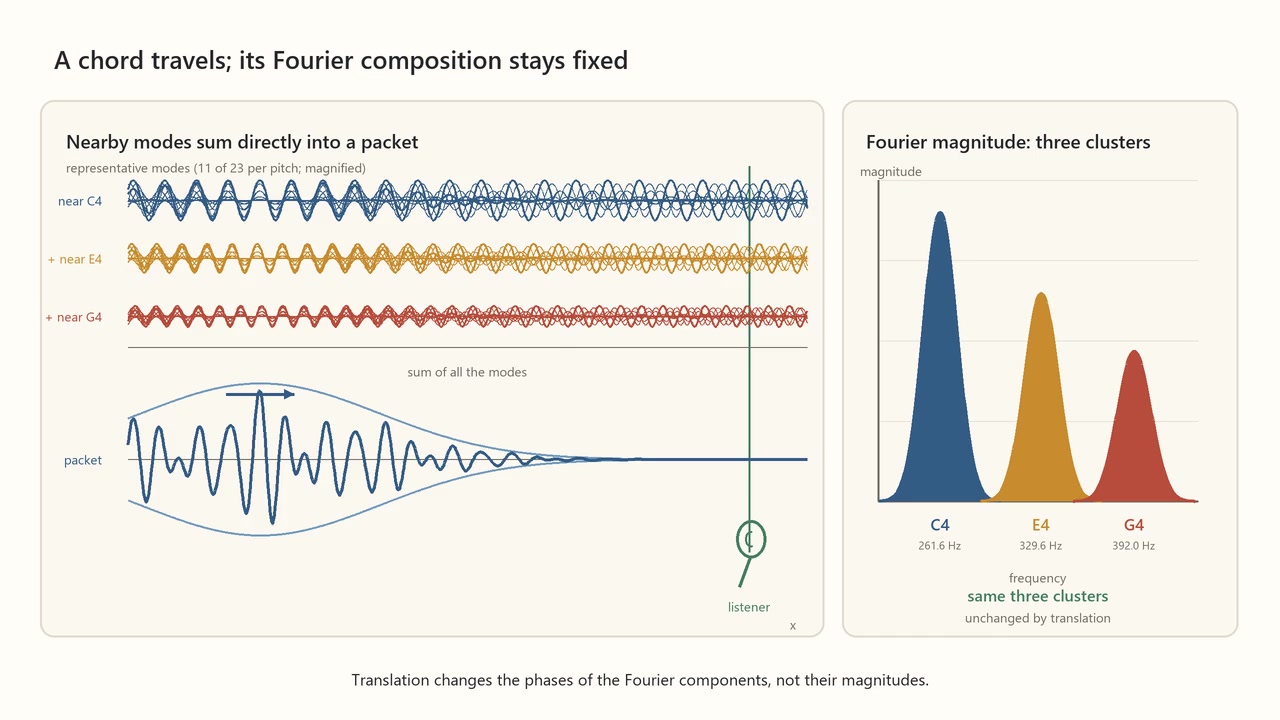
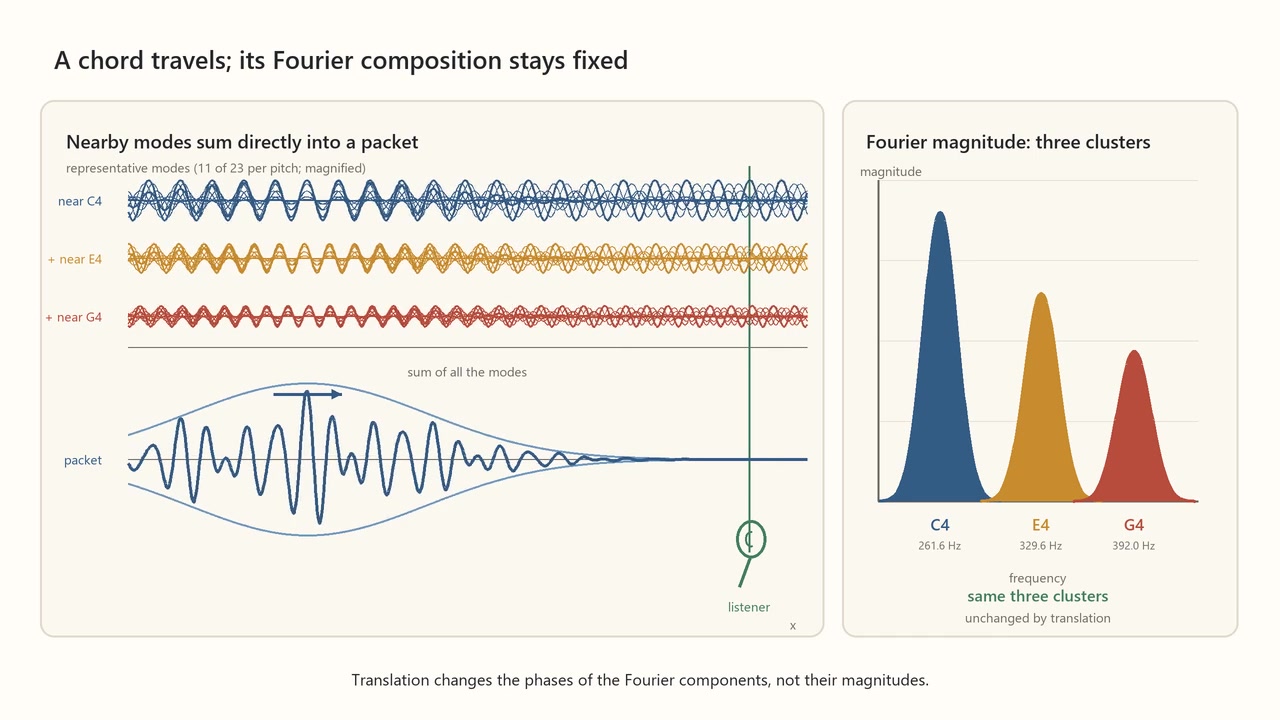
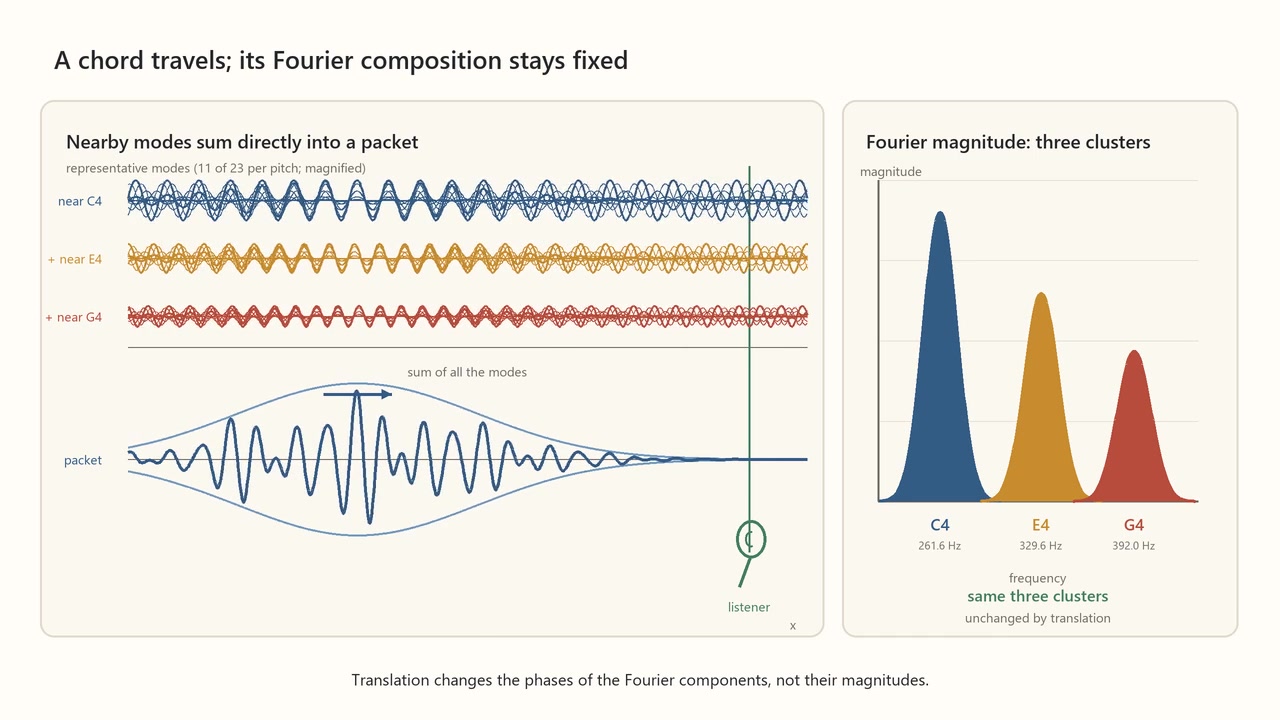
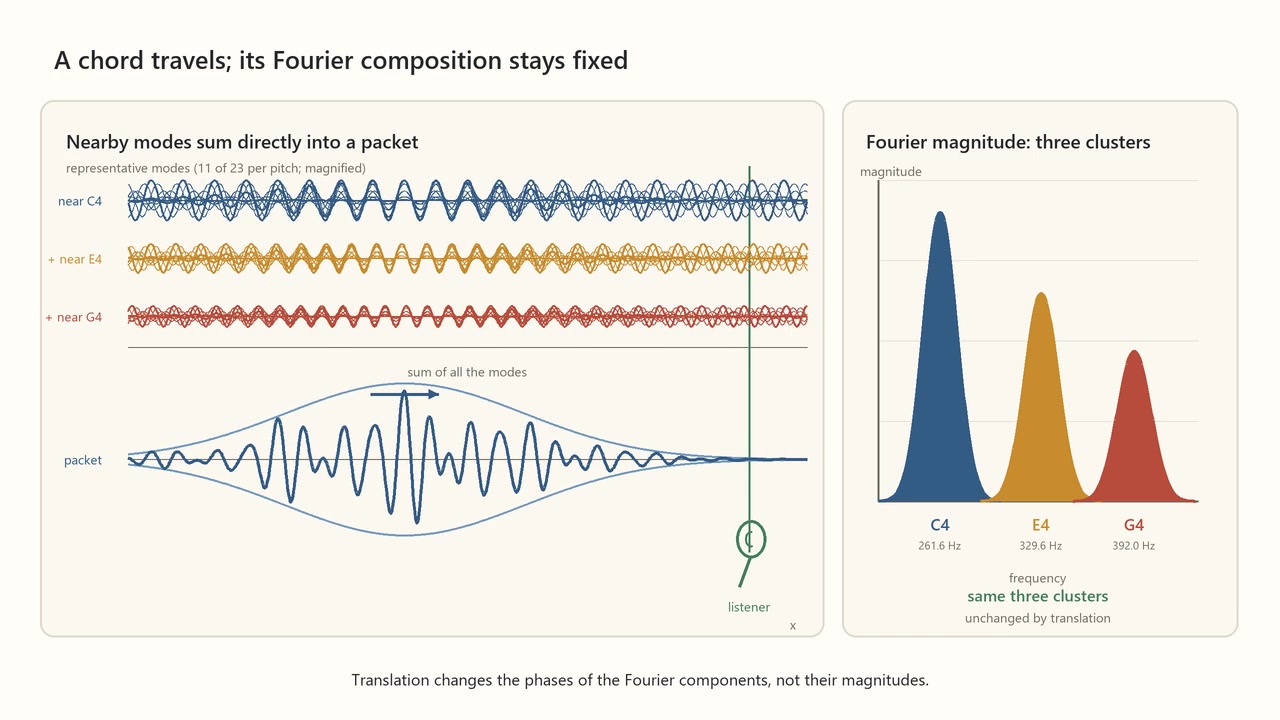
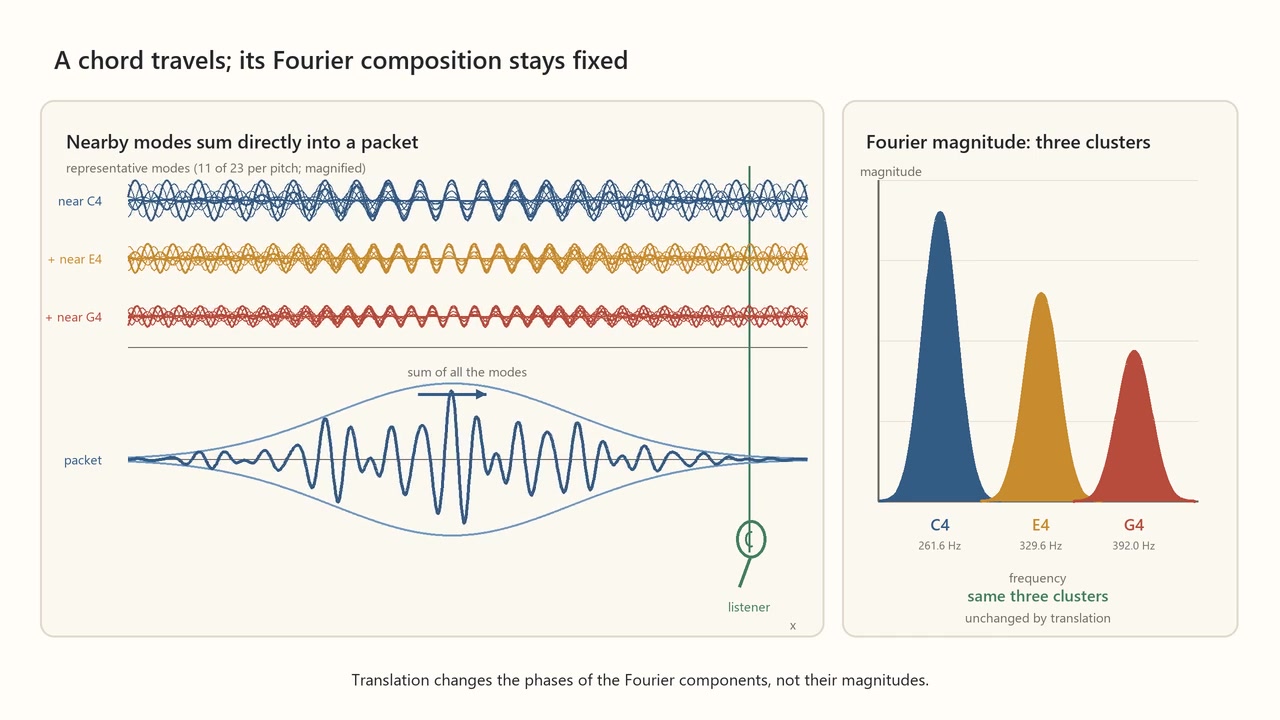
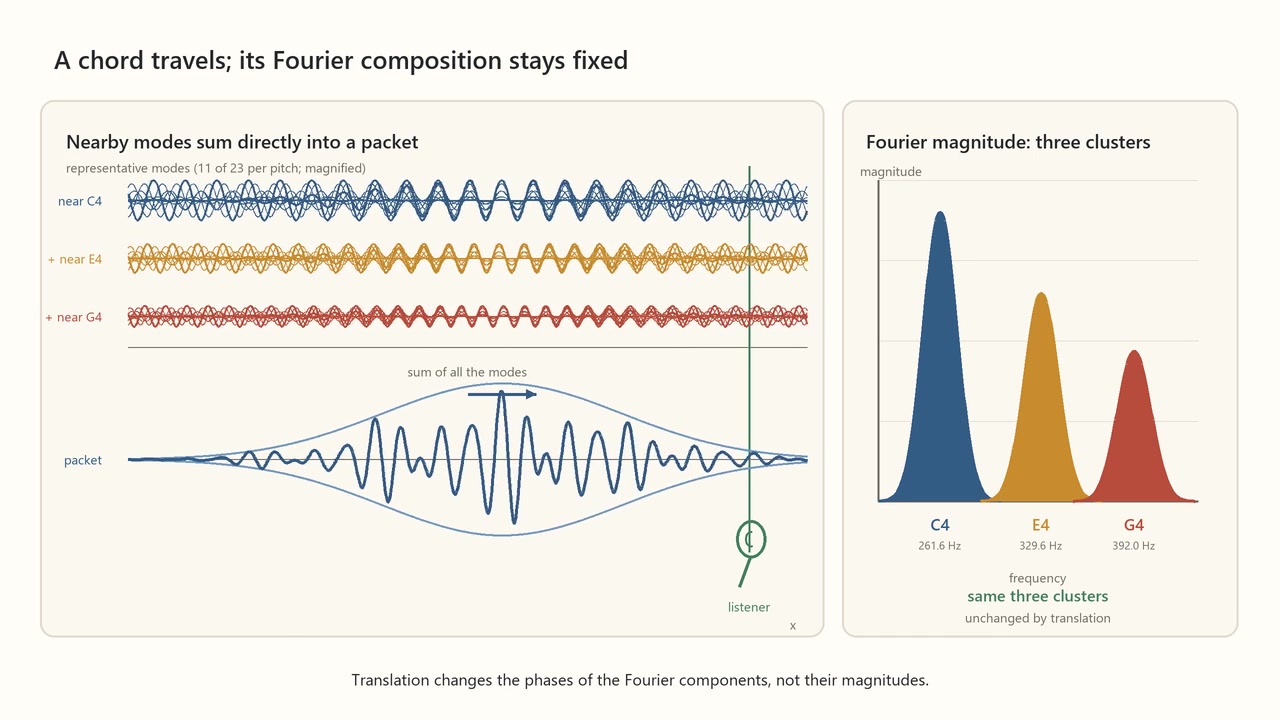
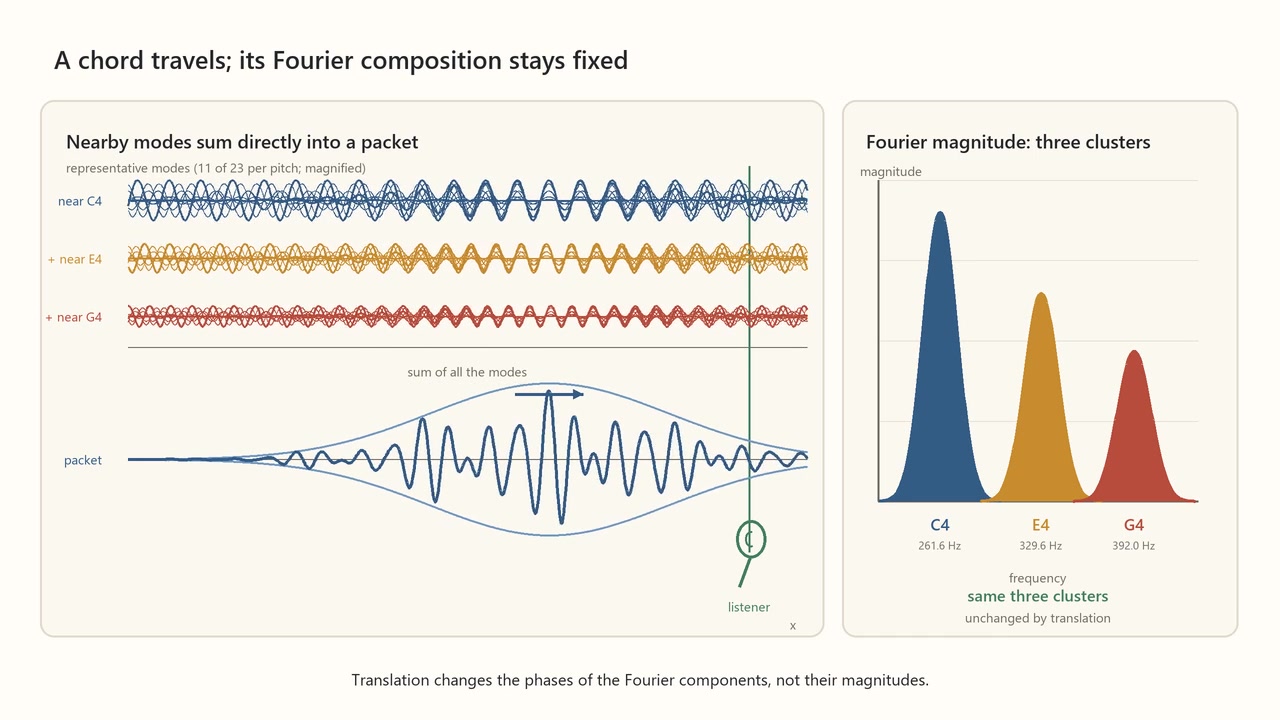
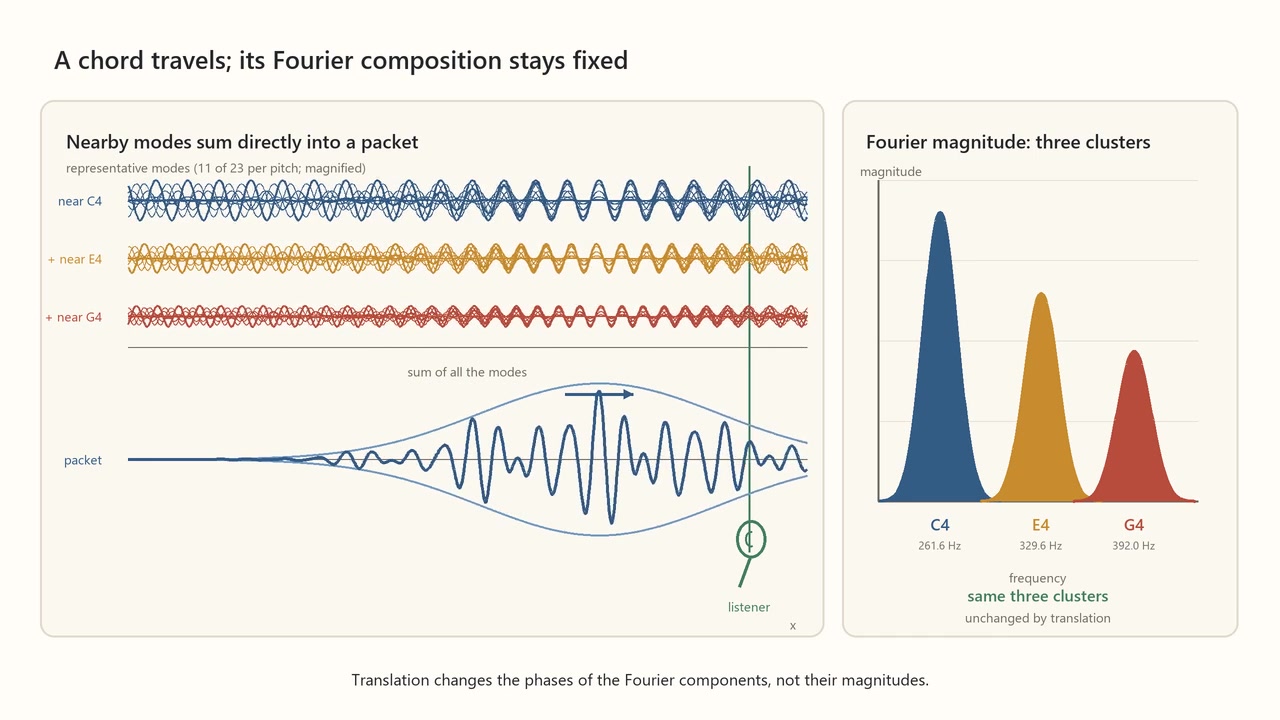
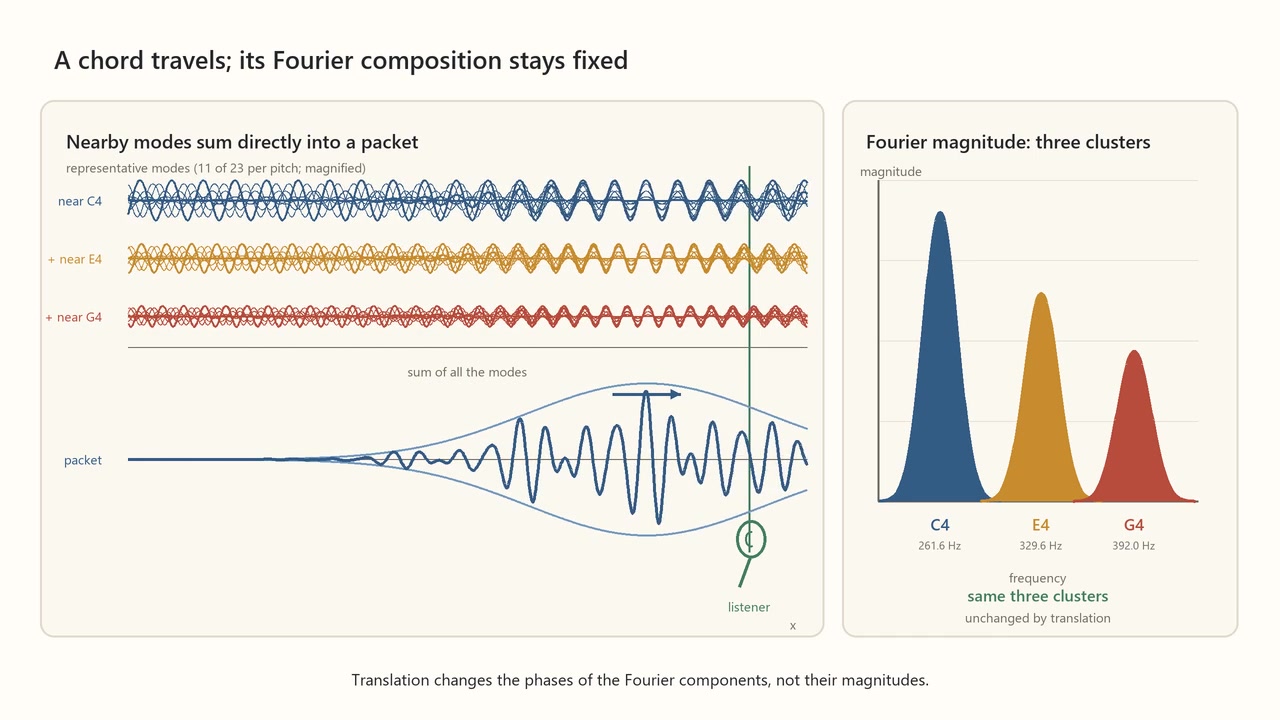
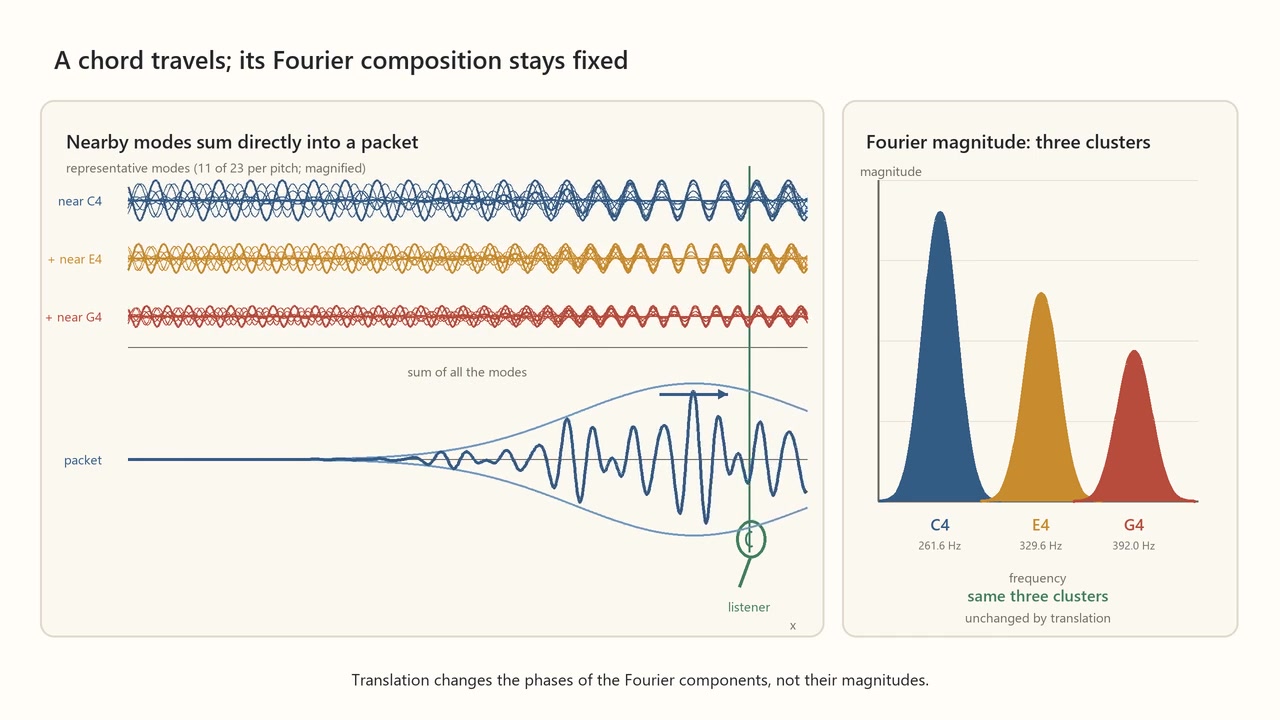
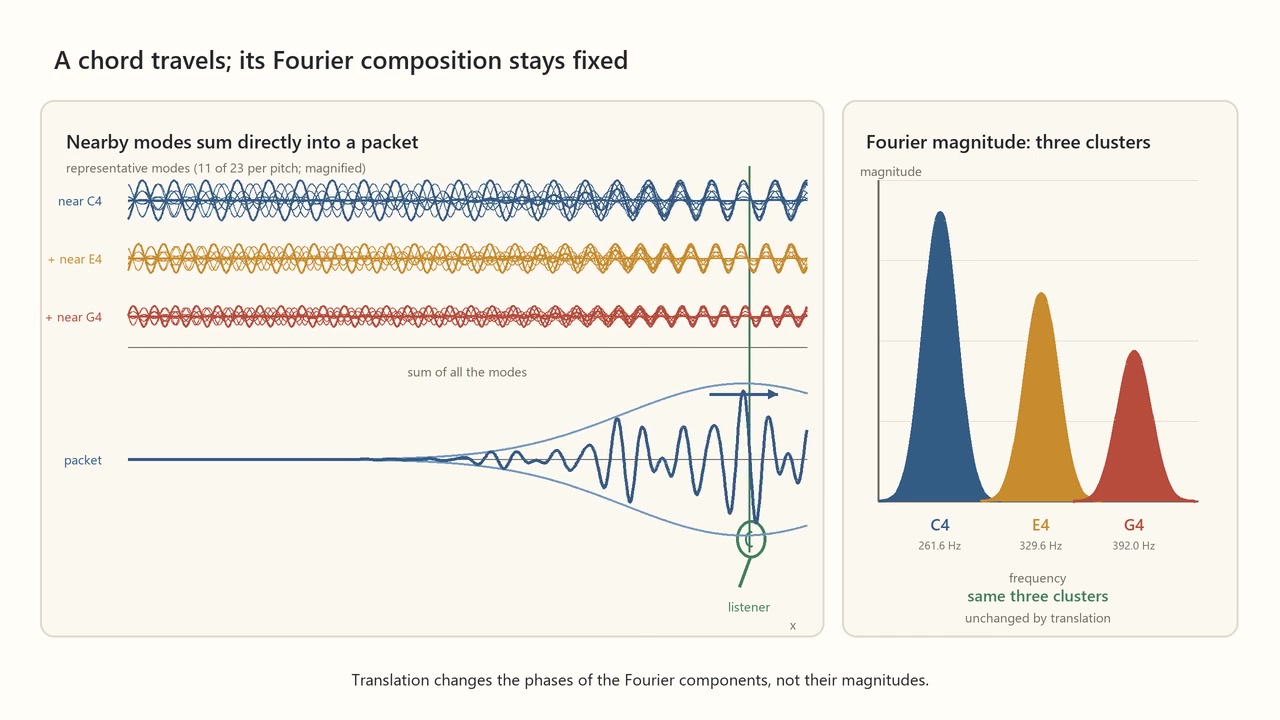
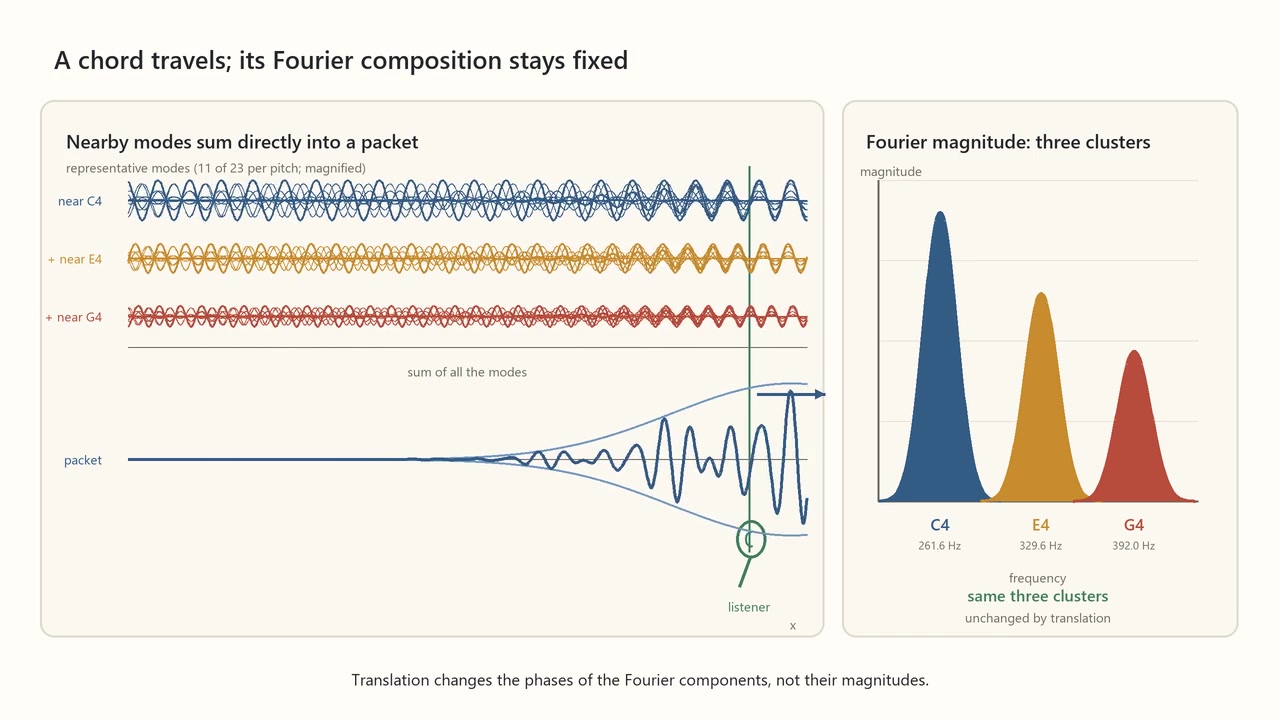
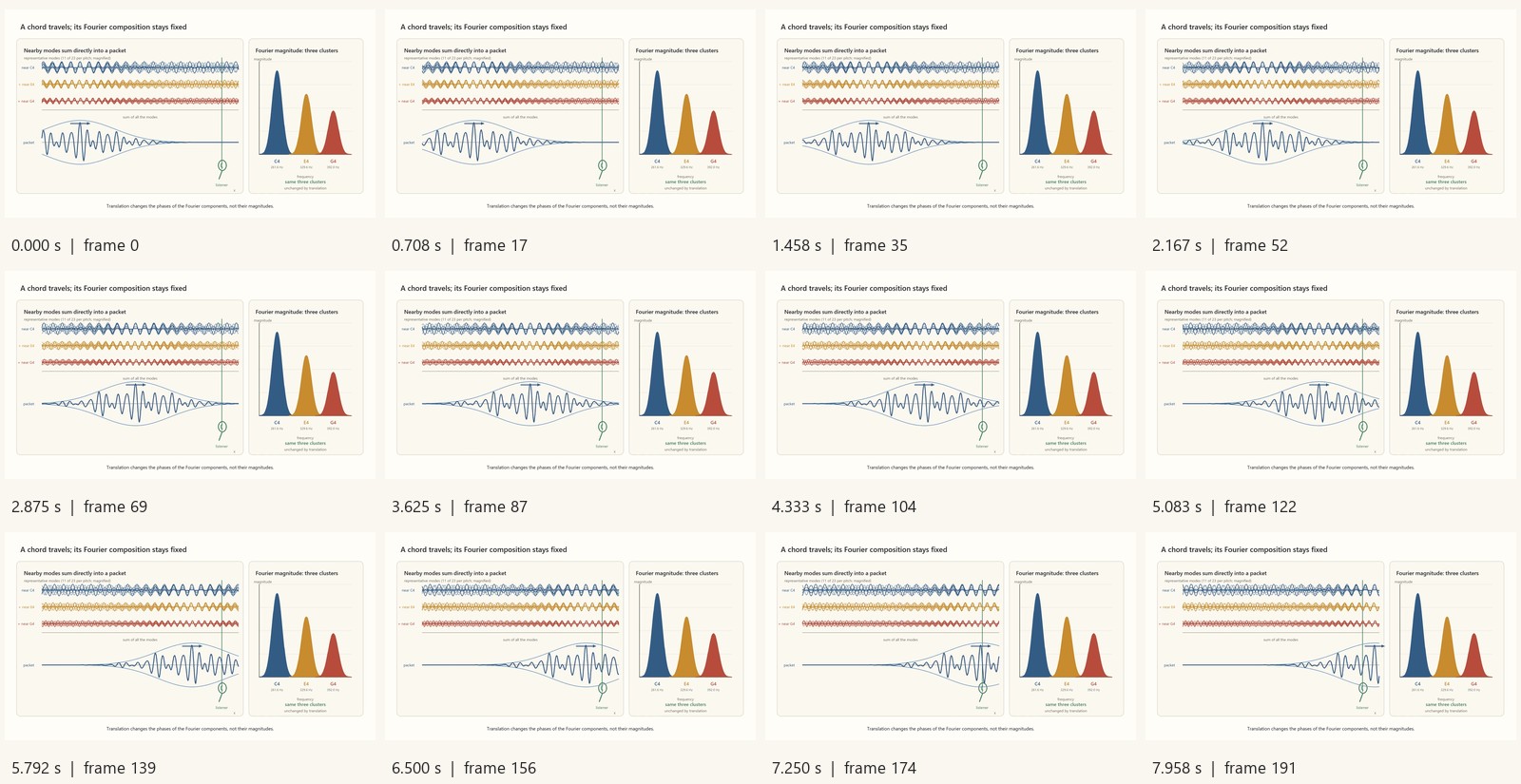
Three-tone chord packet and its Fourier decomposition
symmetry-fourier-three-tone-packet.mp4
These are sparse samples decoded from the current MP4, not newly rendered illustrations. They can support checks of the sampled states and labels, but cannot establish continuous motion, timing, transitions, or the absence of problems between samples. Use the full MP4 when judging those properties.
1280 × 720 · 24 fps · 8 s · 192 frames · 12 samples
MP4 SHA-256 09e84cada72761b75dfe9757ad61add85c19efcc3223b9be4f20c62a74c026de
Frame manifest · Context markdown · Download complete review packet
Chapter context
Section: The Fourier Structure of Waves. Excerpts are verbatim; line numbers refer to the included chapter markdown.
Caption
No separate caption in the chapter.
Image description
Three-tone chord packet and its Fourier decomposition
Before the animation
Chapter lines 800–800
If you strike a chord on a piano, some complicated function of time describes how the sound pressure reaches your ear. It starts soft, gets louder, softens again. It has discernible main tones, but also a clutter of overtones that comprise the timbre of the piano. While you hear a clear tonal structure, a plot of the sound pressure level over time reaching your ear would completely obscure that structure.
After the animation
Chapter lines 806–806
But we know something about this random-seeming function reaching your ear. We know it is comprised of mostly 3 pitches, and some overtones. If we plot the sound pressure level as a function of these pitches rather than as a function of time, the structure of our plot clearly reveals what we hear naturally with our ear. What we call a "pitch" is the frequency of a pure mode. The pattern of sound pressure over time is the sum, or "composition," of these modes. We can transform back and forth between the wave number and position representations. Typically we label the wave number representation with a tilde:
Chapter lines 808–810
Generation source
Run the main script without arguments. Its Fourier-chord renderer draws the three-tone packet frames with Pillow and encodes them with FFmpeg. It has no local Python imports or input movie.
Mapping evidence and limits
Despite the generator filename, render() explicitly sets the output stem to symmetry-fourier-three-tone-packet. Constants specify 1280 x 720, 24 fps, 192 frames. No matching validation JSON is present; attribution is by source/output name and pipeline, not a recorded movie hash.
Source SHA-256 values identify the exact downloadable bytes in this packet. The source mapping and recorded checks explain the likely generation pipeline; they do not prove that these exact source bytes produced the movie. A GitHub link pinned to a commit is provided only when the delivered source bytes exactly match that path at the build's Git HEAD.
- scripts/generate_symmetry_fourier_chord_packet_animation.py · GitHub at 974f9de35254
SHA-256 3b393e6935e8e605d02a727f38f1c9953f14ee7b0bcbe34ce85aac42086078b6
Decoded contact sheet
Extraction method: Twelve evenly spaced decoded frame indices, including first and last. Native-resolution JPEGs from the encoded MP4; timestamps read from FFmpeg showinfo. No source rerendering. Frame indices are zero-based. Sparse samples do not establish continuous motion or capture every transition.. Frame indices are zero-based.
Full-size sampled frames