All animations · In the chapter · Open full MP4
Animation 24
Two Path Interference
symmetry-double-slit-candidate-paths-shortwave-arcs.mp4
These are sparse samples decoded from the current MP4, not newly rendered illustrations. They can support checks of the sampled states and labels, but cannot establish continuous motion, timing, transitions, or the absence of problems between samples. Use the full MP4 when judging those properties.
1440 × 810 · 30 fps · 10 s · 300 frames · 12 samples
MP4 SHA-256 f567d8740a19e069ed3e38146db5b7a7672924649866e6bbde34c026bebdb688
Frame manifest · Context markdown · Download complete review packet
Chapter context
Section: Wave Propagation and Interference. Excerpts are verbatim; line numbers refer to the included chapter markdown.
Caption
Two Path Interference
Image description
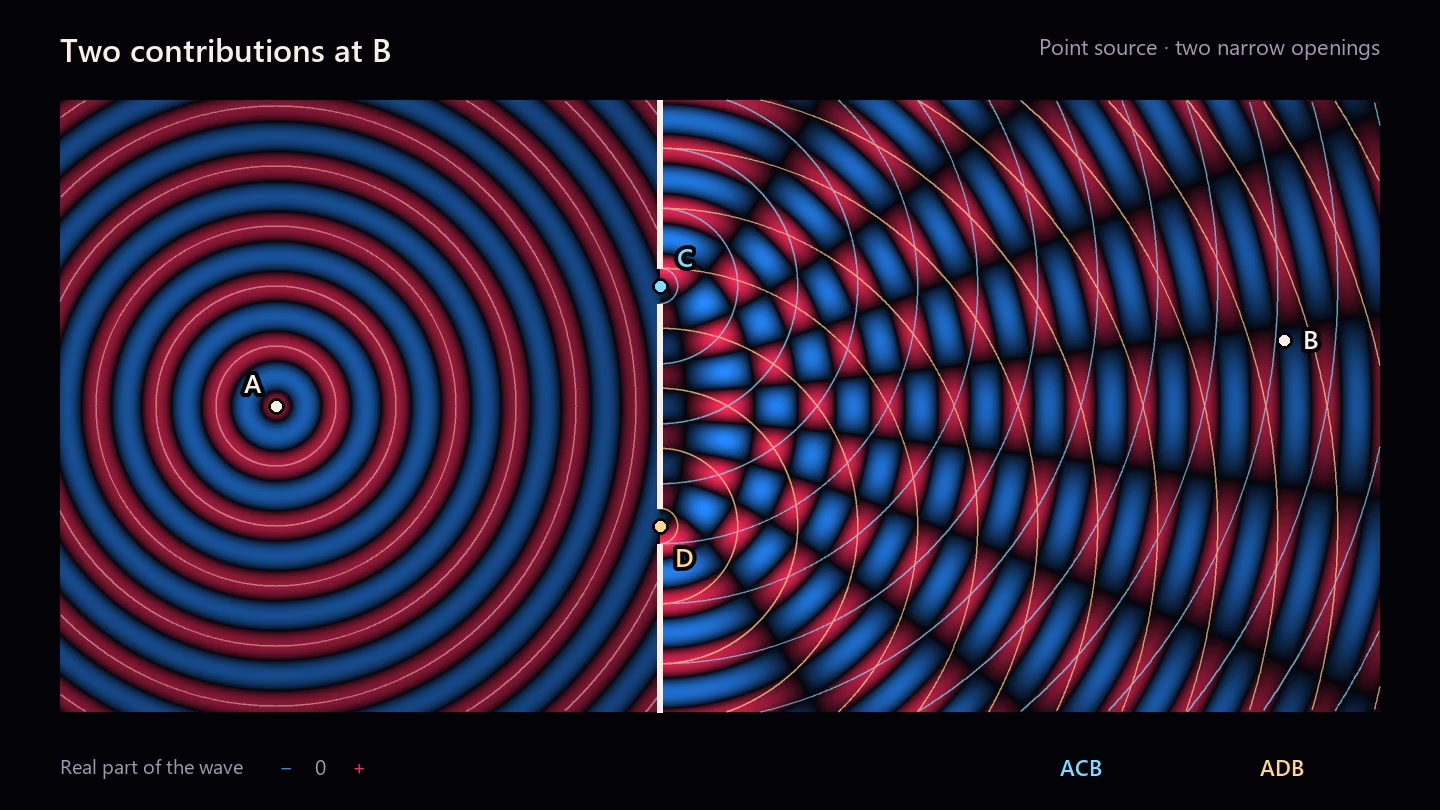
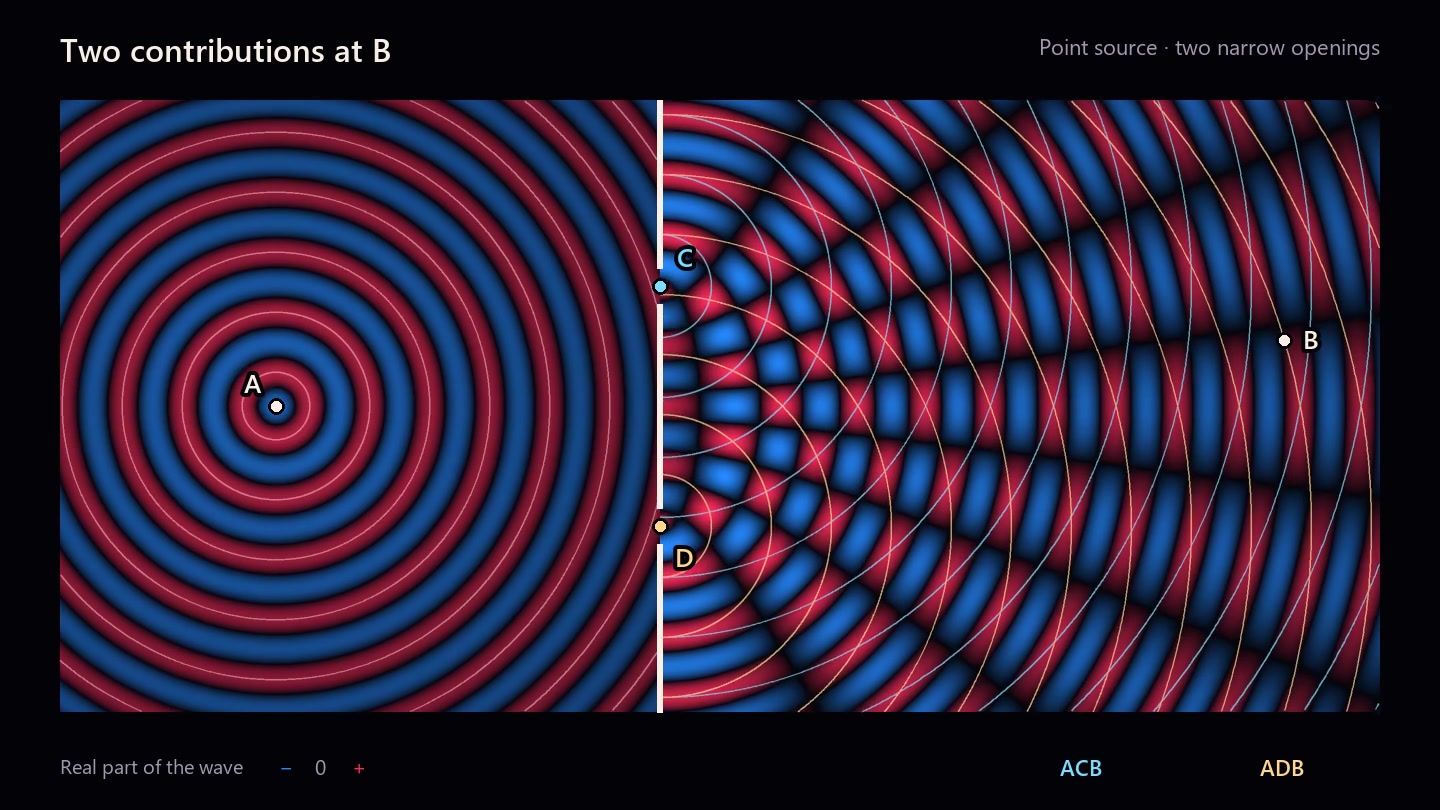
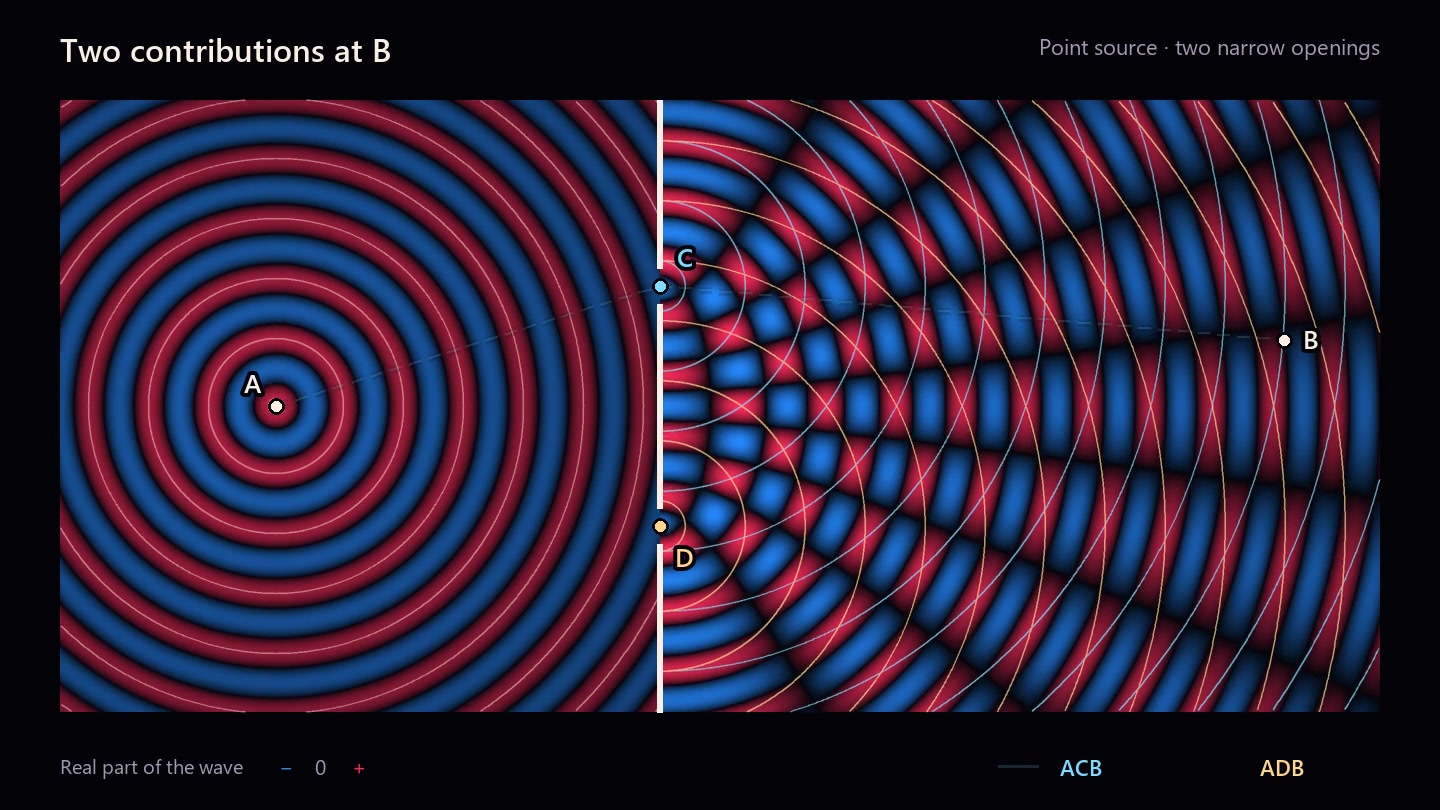
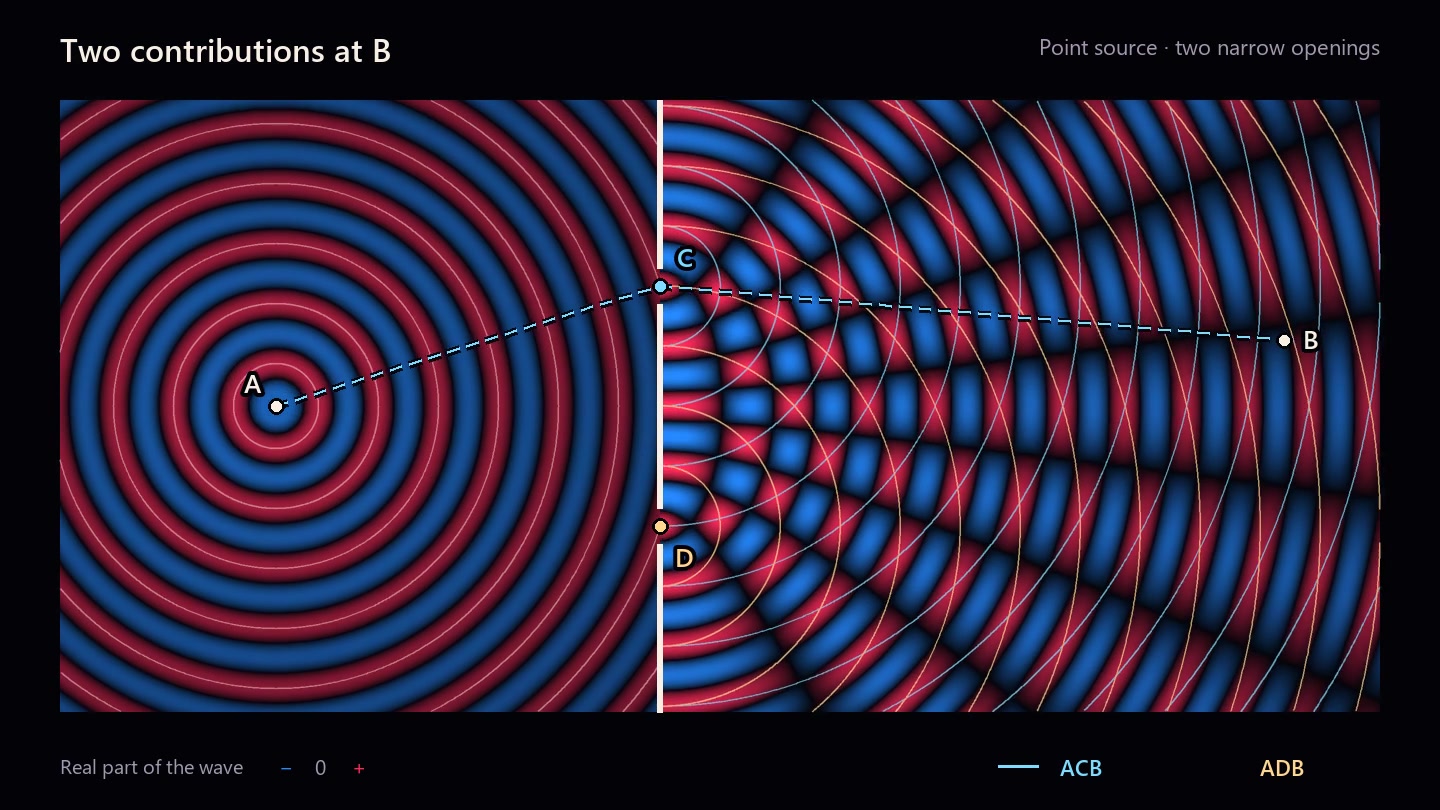
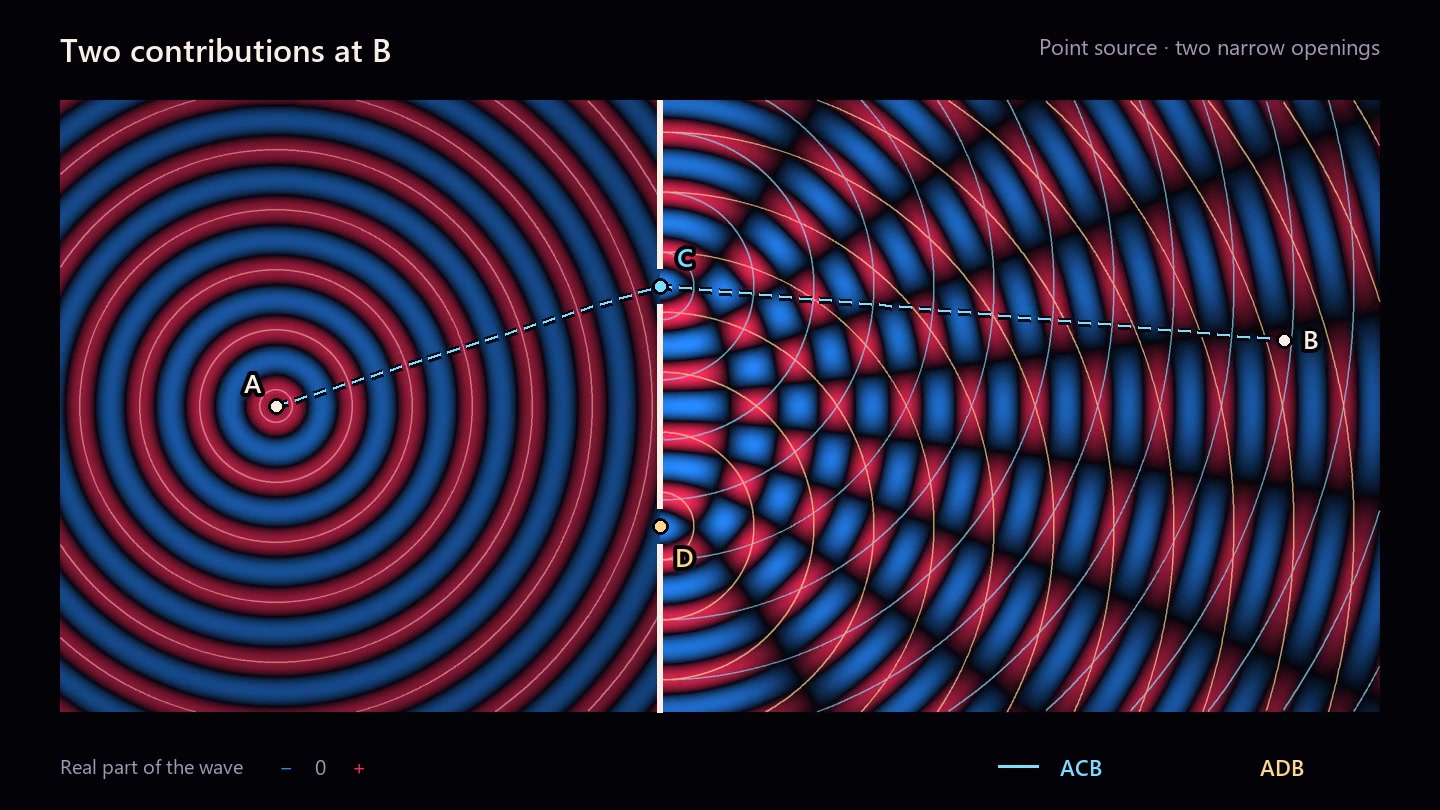
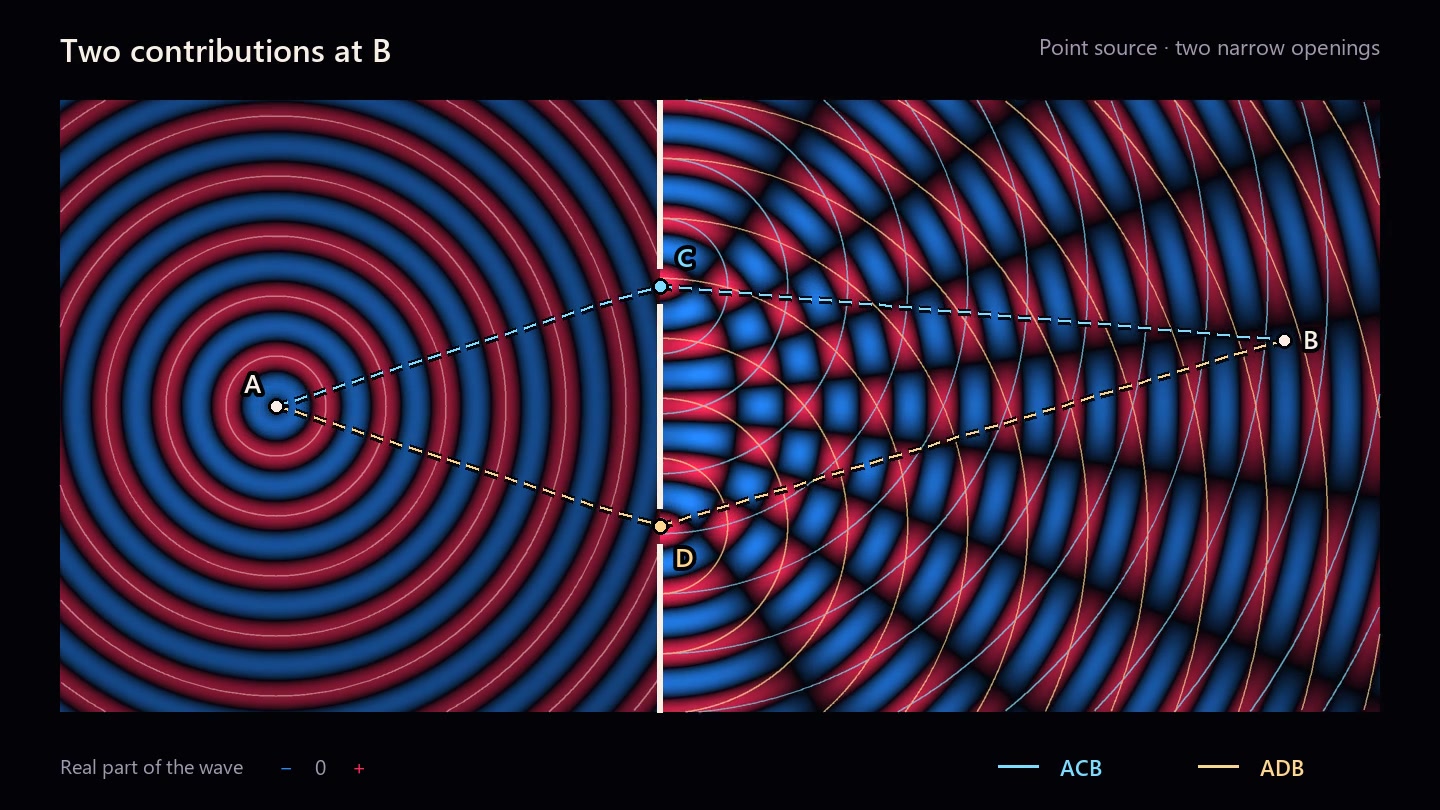
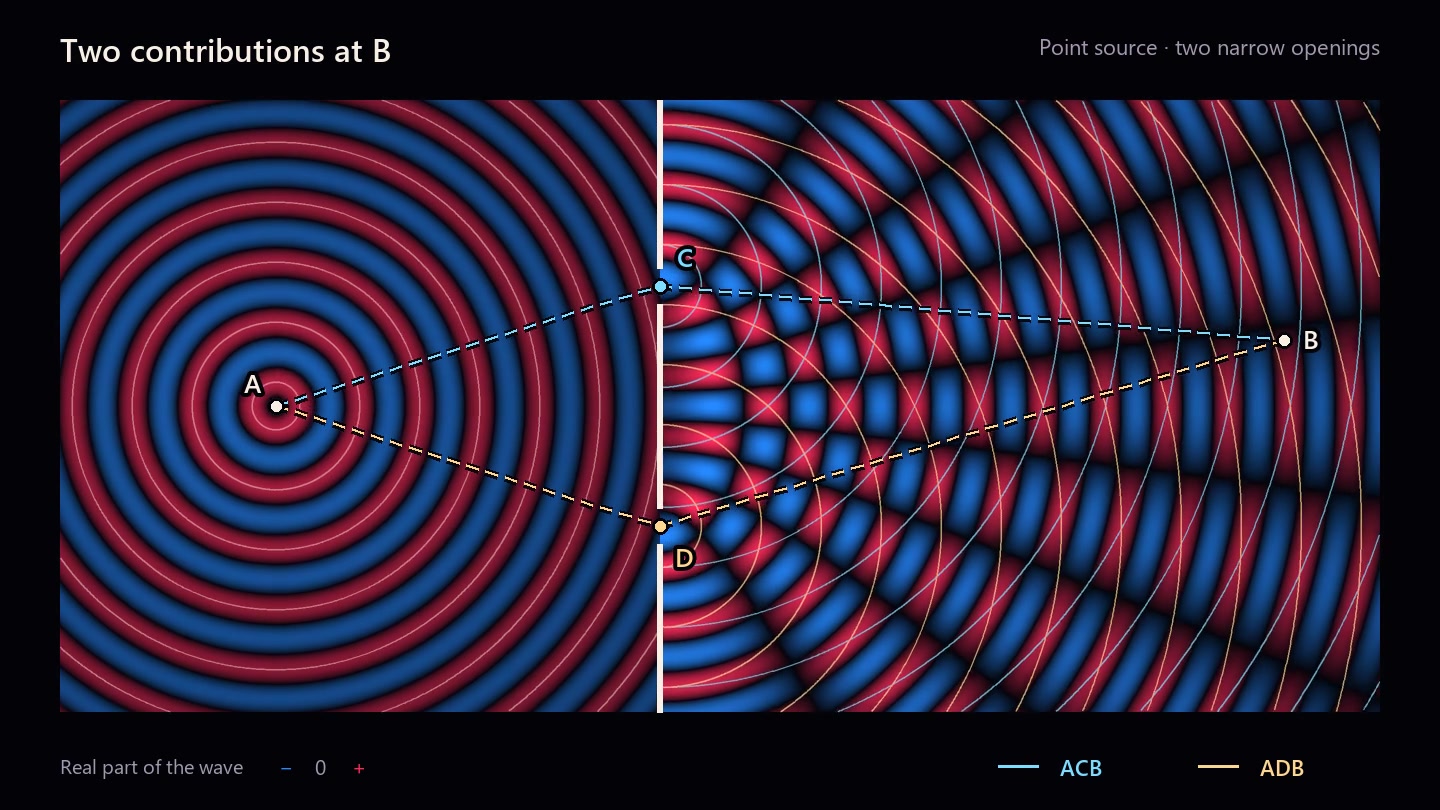
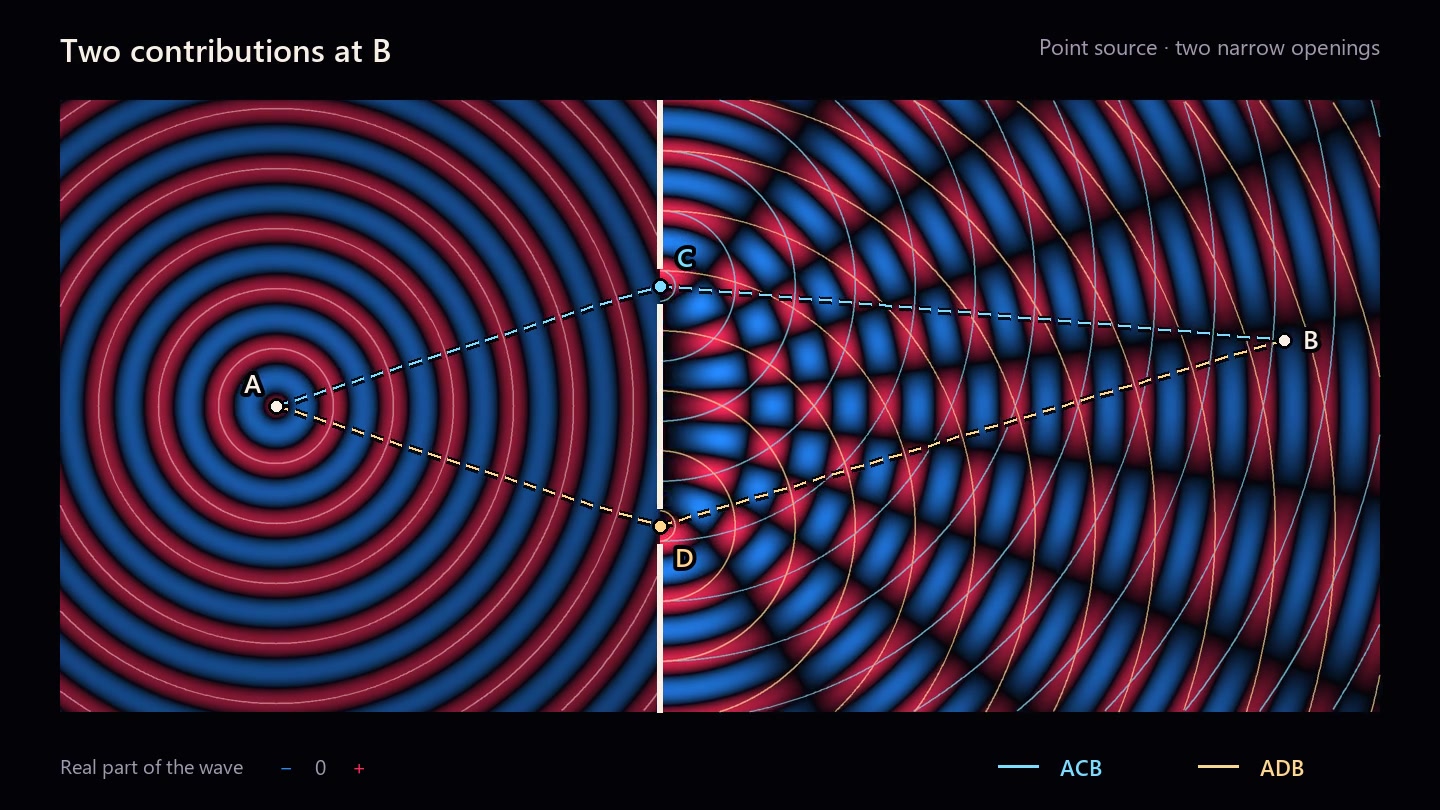
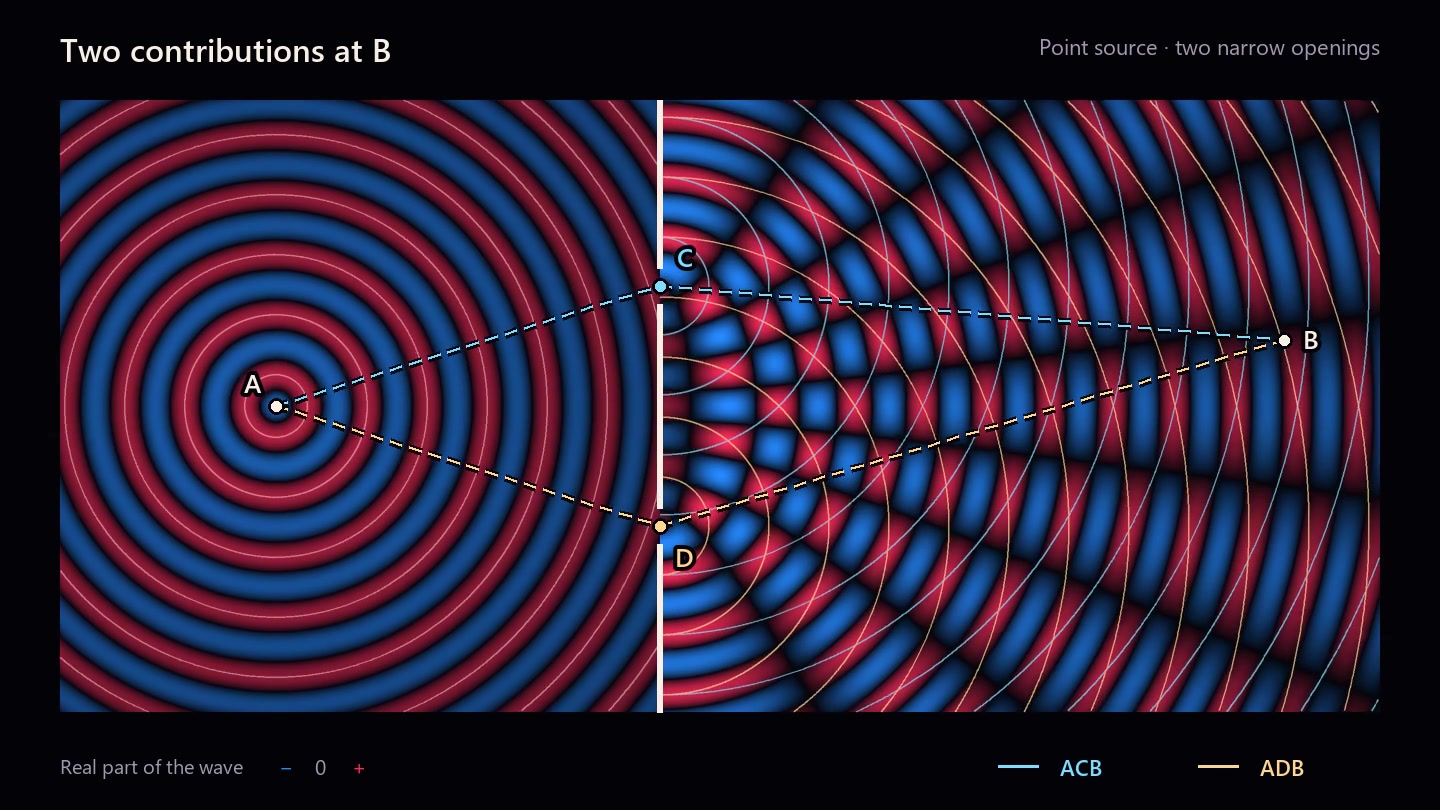
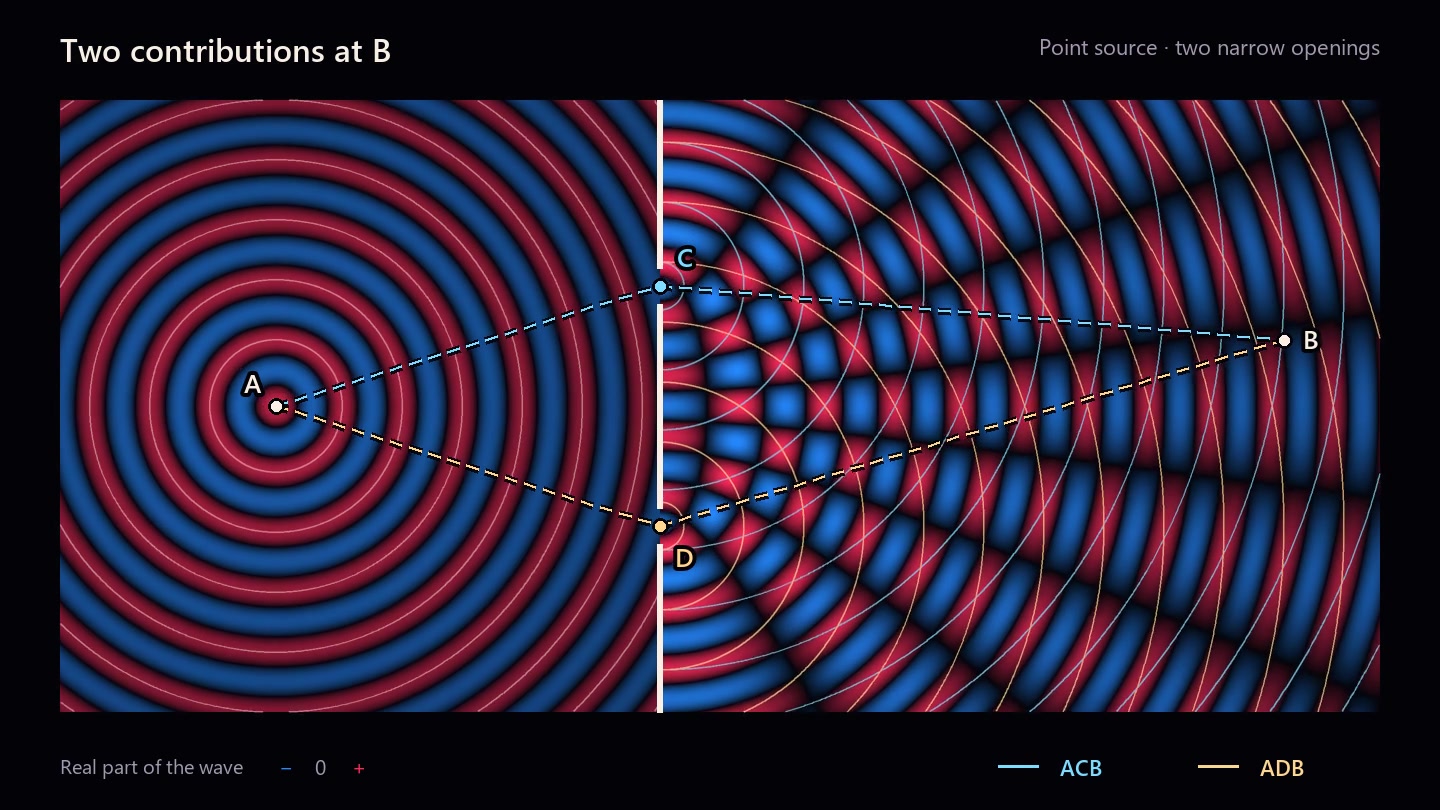
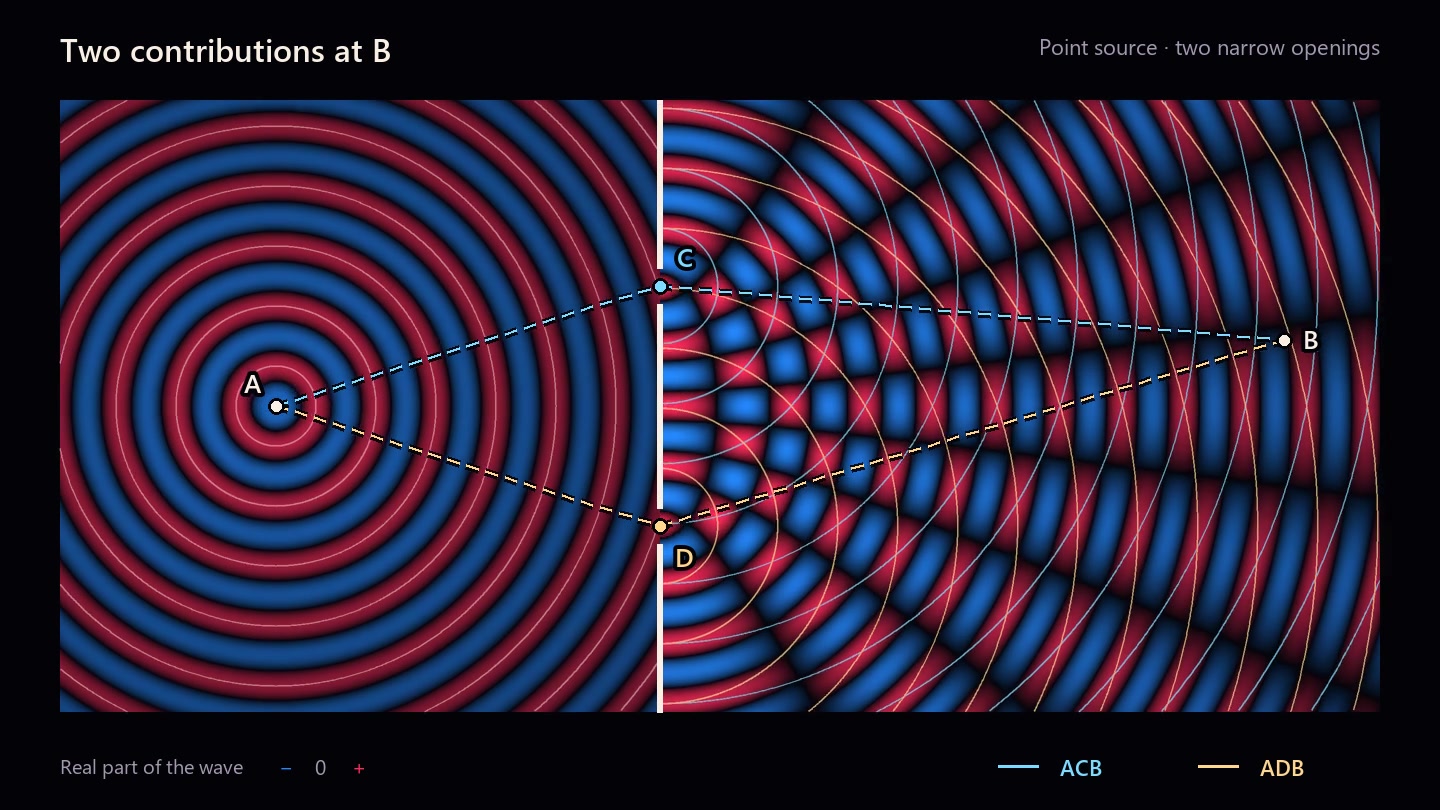
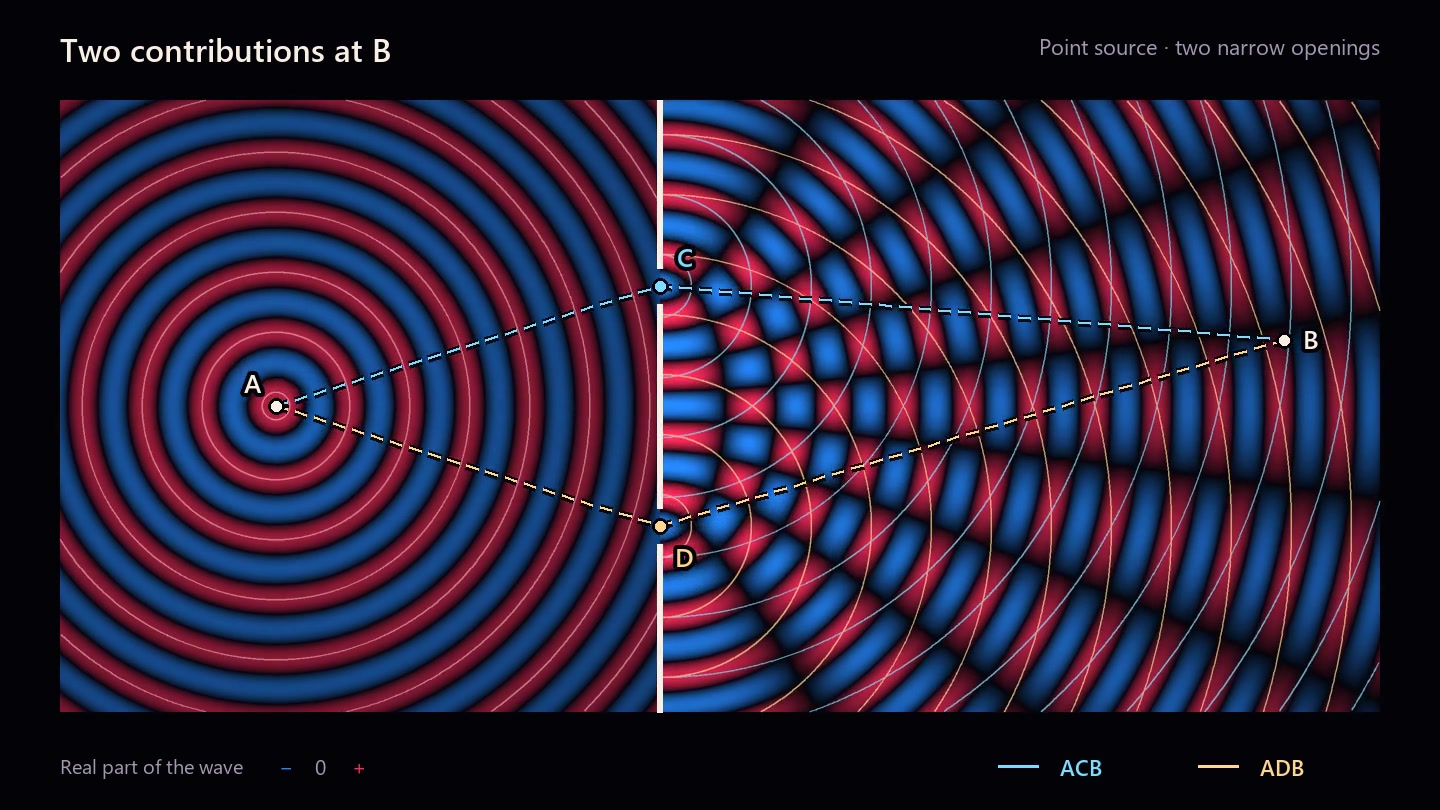
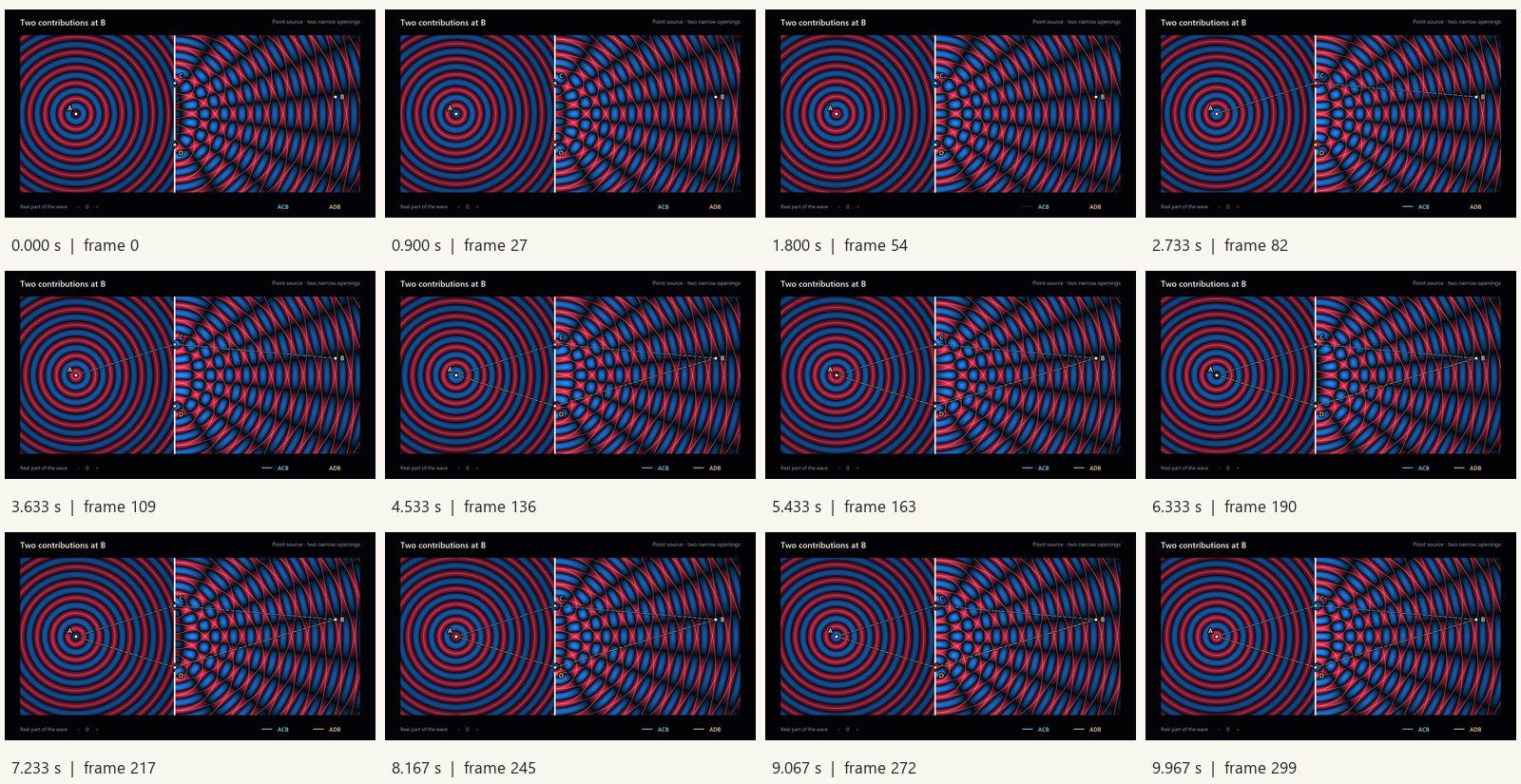
The two contributions $ACB$ and $ADB$ from a point source through two narrow openings
Before the animation
Chapter lines 1089–1089
Because time is special, $\omega$ is called (angular) frequency, not wave number, but from a mathematical perspective, it is just another wave number.
Chapter lines 1091–1091
Let us now ask the question: how do we find the amplitude at some point $B$ from some initial state of a wave? To do this, we can decompose the contributions into those from individual paths, starting with a very simple model. First, let's construct a point source of single-mode spherical waves emanating from $A$. Then let's add a barrier with two slits through which the wave can pass, $C$ and $D$. This setup allows us to calculate the amplitude at $B$ by combining only the amplitudes associated with the two paths $ACB$ and $ADB$.
After the animation
Chapter lines 1099–1099
First, let's figure out how any one straight segment of a plane wave contributes to the amplitude at its endpoint. From:
Chapter lines 1101–1103
Generation source
The vivid generator, whose NAME uses the shortwave-arcs stem, is the actual entrypoint (--render). It uses shared artwork from widening_apertures and renders the two-point-aperture phase illustration directly. --check and --encoded-check produce the companion reports.
Mapping evidence and limits
The vivid script explicitly sets NAME to symmetry-double-slit-candidate-paths-shortwave-arcs. Matching validation records wavelength 0.5 and the same A,C,D,B geometry as the script; matching encoded-validation.json records 300 frames, 30 fps, 1440 x 810, 10 s. notes/worked/double-slit-candidate-paths-vivid-animation.md identifies this output.
Source SHA-256 values identify the exact downloadable bytes in this packet. The source mapping and recorded checks explain the likely generation pipeline; they do not prove that these exact source bytes produced the movie. A GitHub link pinned to a commit is provided only when the delivered source bytes exactly match that path at the build's Git HEAD.
- scripts/generate_symmetry_double_slit_candidate_paths_vivid.py · GitHub at 974f9de35254
SHA-256 1d4eb3263ecd8d430541f6415d985f354769123b54fadc498a451598493f9aff - scripts/generate_symmetry_widening_apertures.py · GitHub at 974f9de35254
SHA-256 2850a5c705823e498af5ef6180f0639cde6955631a763bc735e3d8992bb35127
Existing generator checks (2 reports)
These are existing author-produced generator reports, copied without changes. Their checks were not rerun for this packet and are not independent certification. A report may describe an earlier generation run; inspect its contents before applying its claims to the current movie.
- symmetry-double-slit-candidate-paths-shortwave-arcs-validation.json
SHA-256 c107e456ee7ed53afd28475ef0d50f96d7198f9b11dfe1696ce211255f8fd31d - symmetry-double-slit-candidate-paths-shortwave-arcs-encoded-validation.json
SHA-256 0bca767337bc17d6da2d11c9fee2d8c5efee64cab1ab7aac100e250e8182c071
Decoded contact sheet
Extraction method: Twelve evenly spaced decoded frame indices, including first and last. Native-resolution JPEGs from the encoded MP4; timestamps read from FFmpeg showinfo. No source rerendering. Frame indices are zero-based. Sparse samples do not establish continuous motion or capture every transition.. Frame indices are zero-based.
Full-size sampled frames