All animations · In the chapter · Open full MP4
Animation 19
Visualizing Phase Change
symmetry-complex-phase-modes.mp4
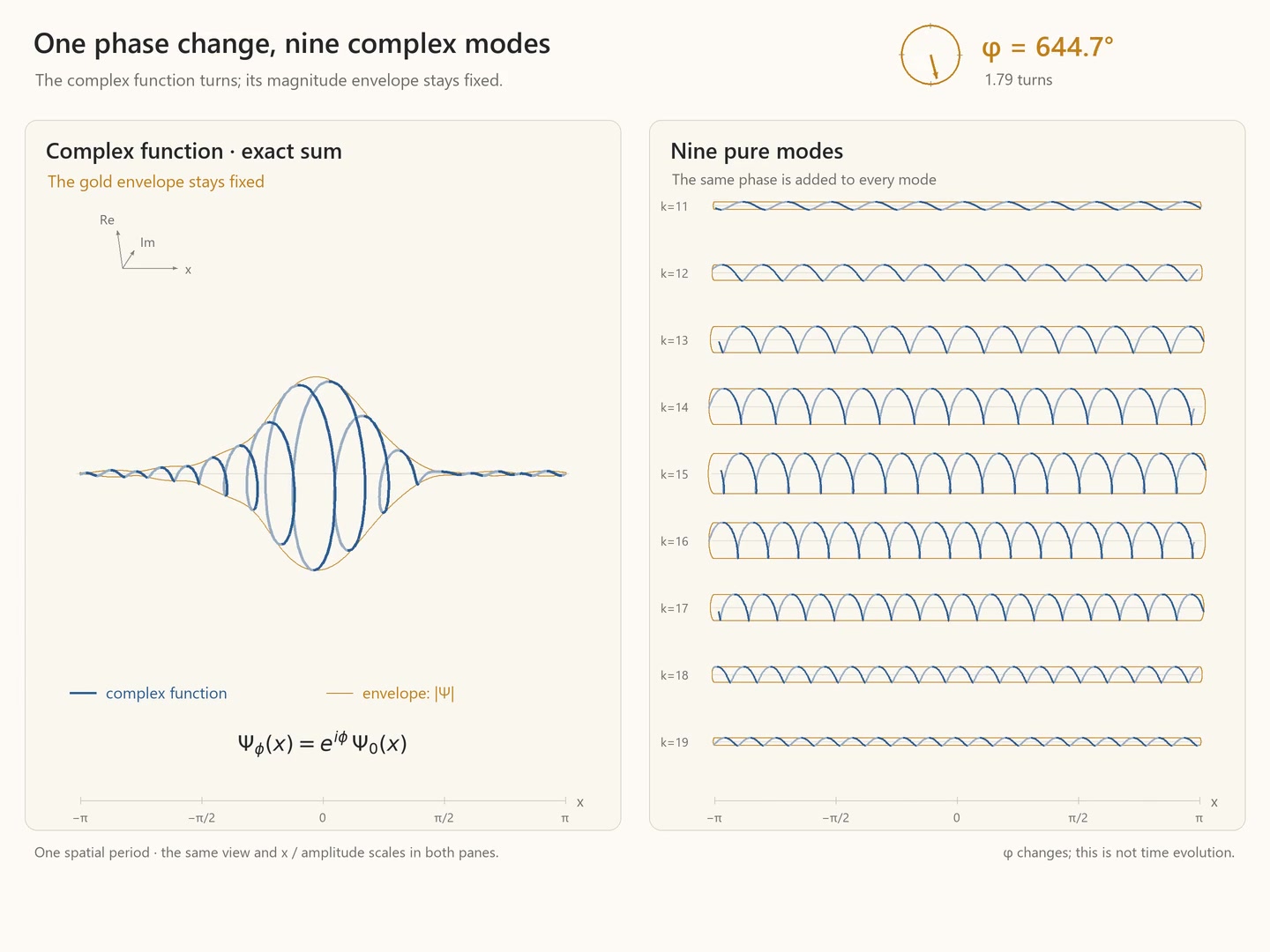
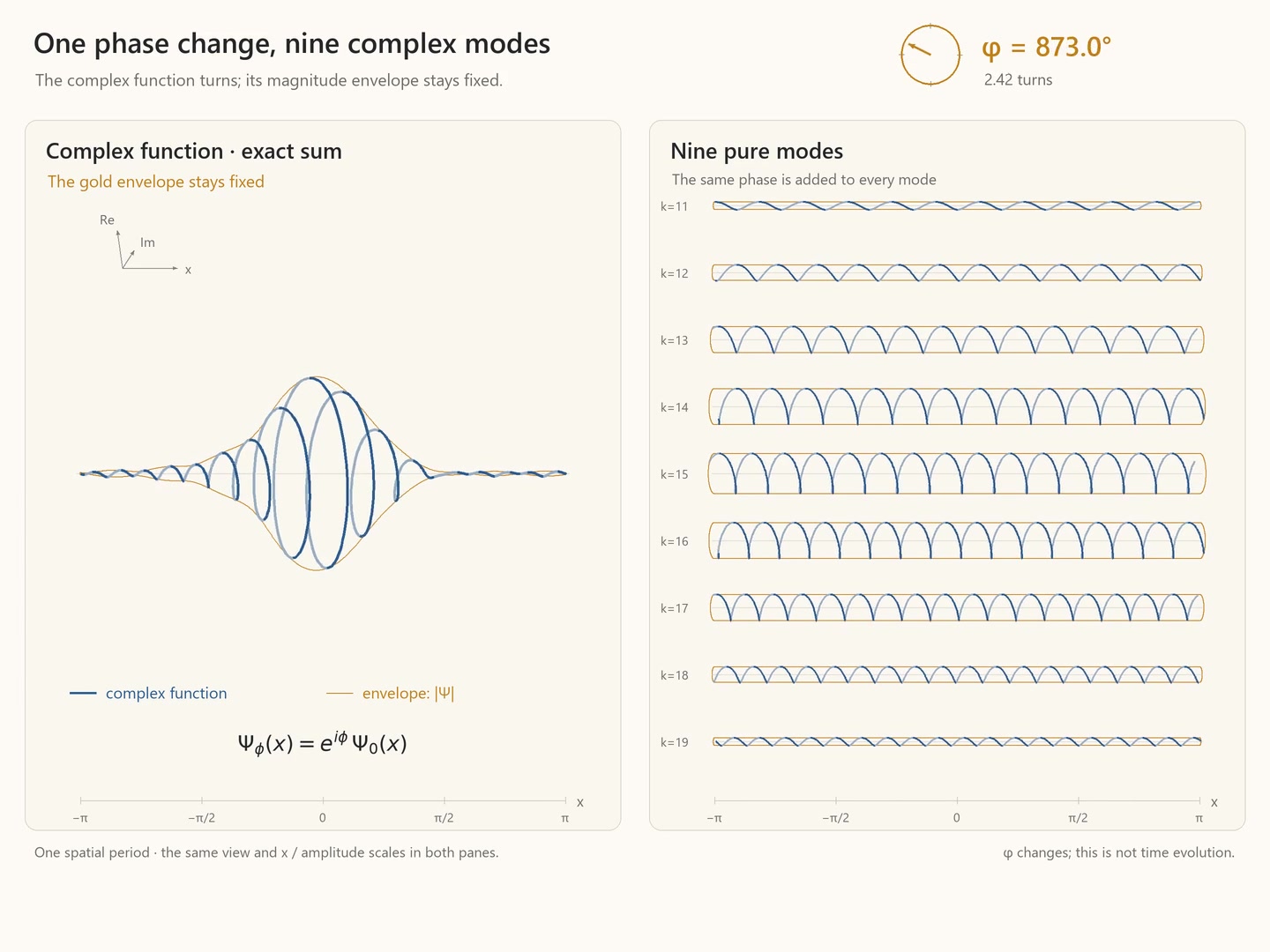
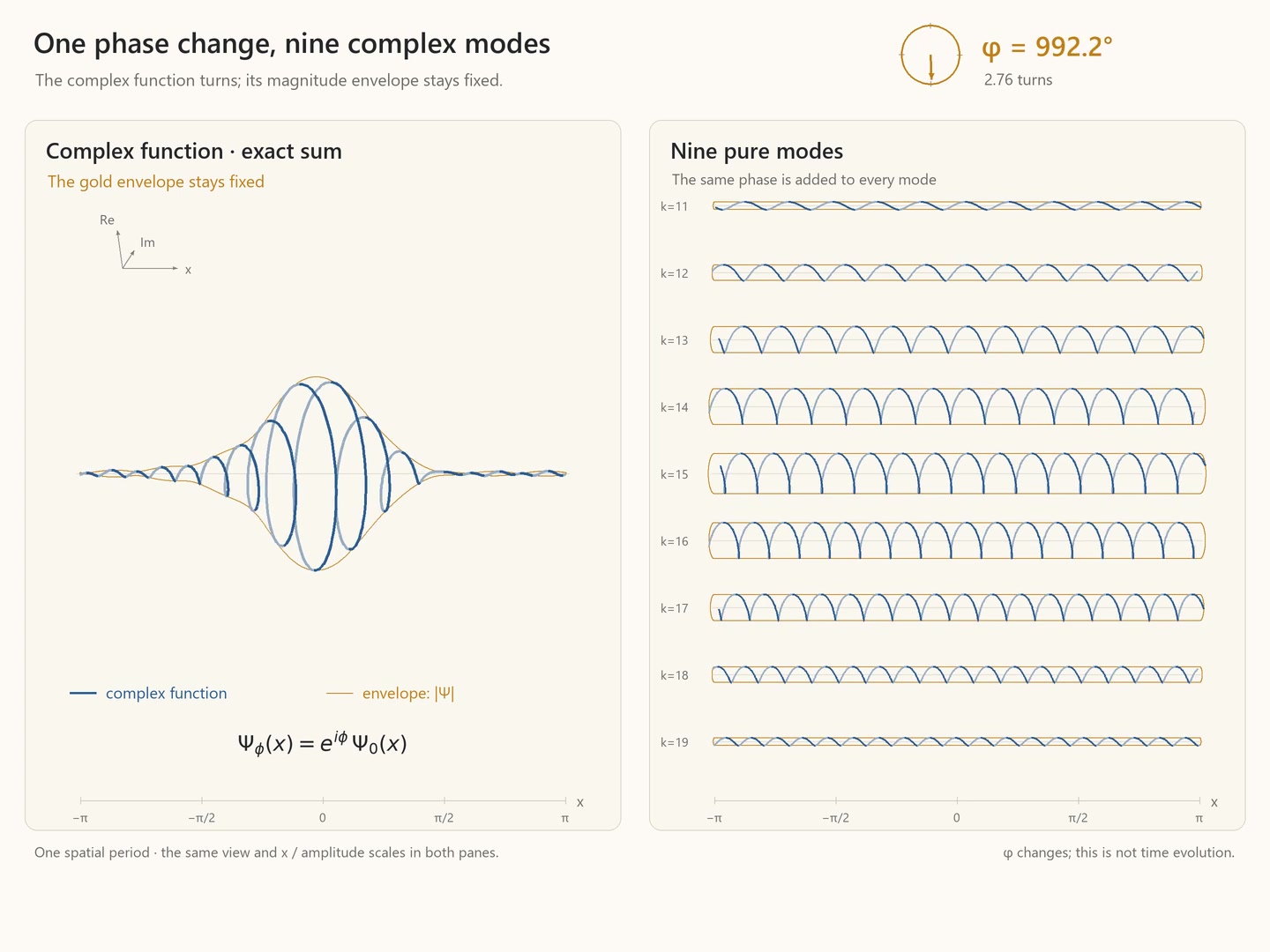
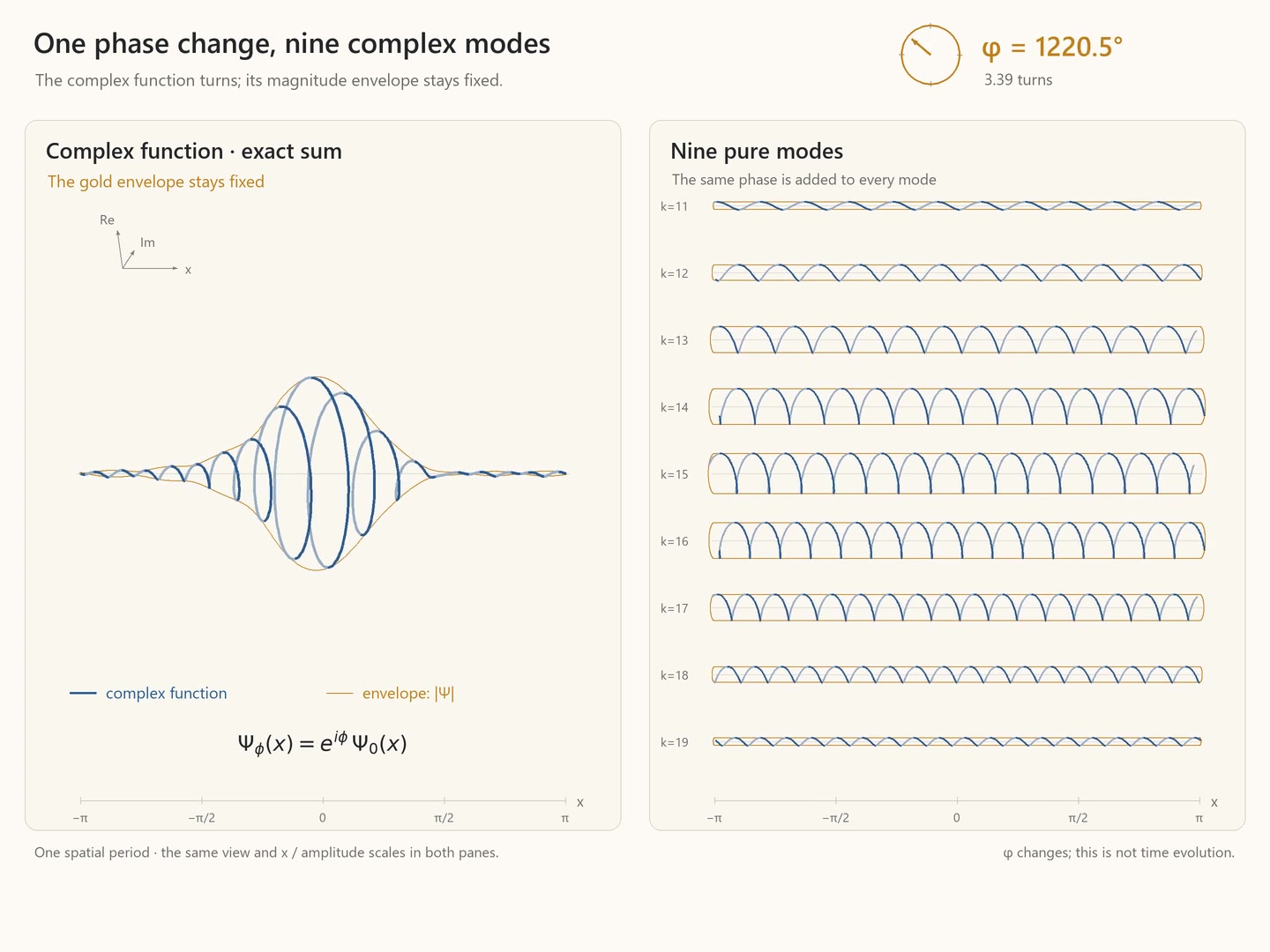
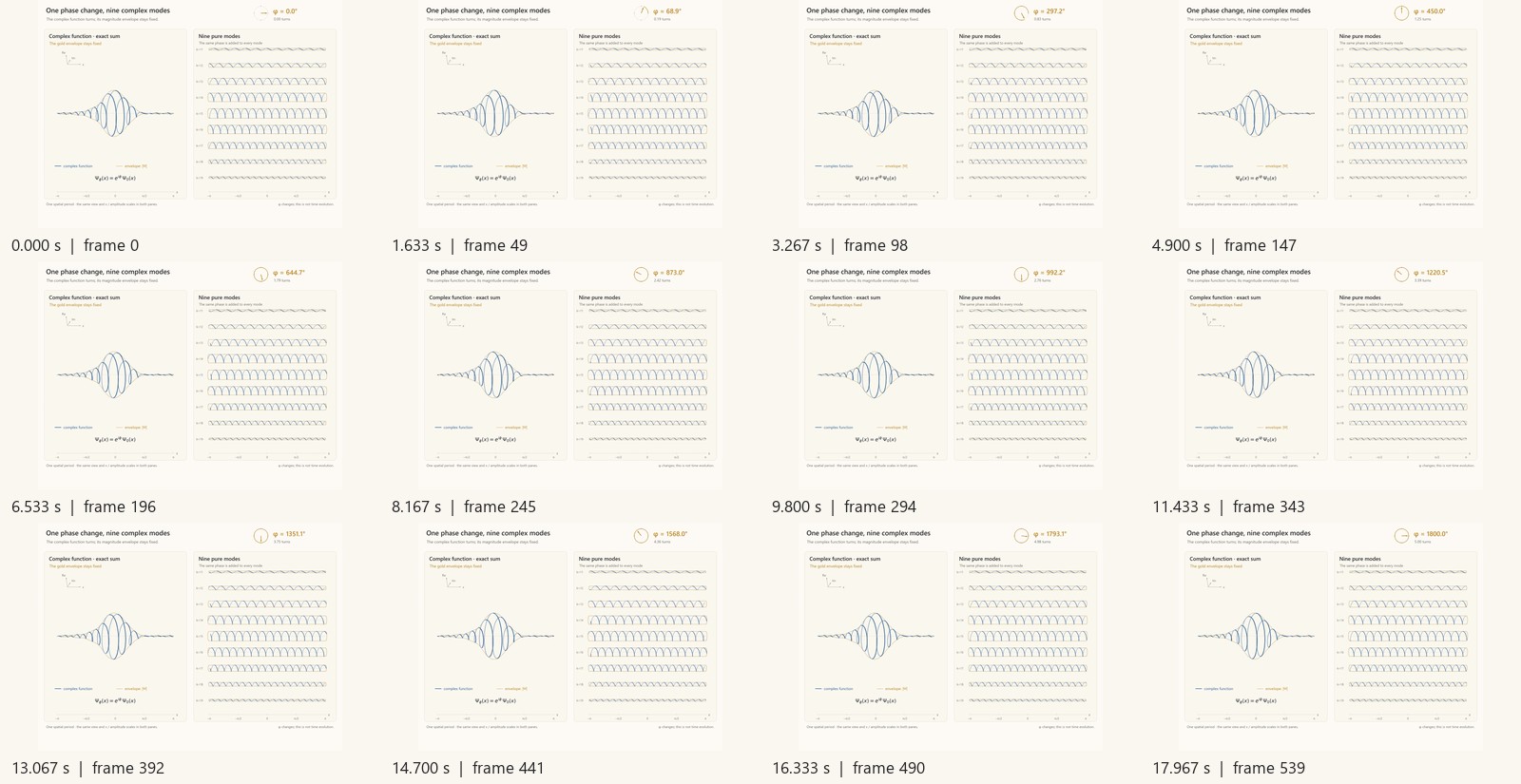
These are sparse samples decoded from the current MP4, not newly rendered illustrations. They can support checks of the sampled states and labels, but cannot establish continuous motion, timing, transitions, or the absence of problems between samples. Use the full MP4 when judging those properties.
1440 × 1080 · 30 fps · 18 s · 540 frames · 12 samples
MP4 SHA-256 157579b5ba38bda8a03bce2d88586dd45f37ffb060cf936cedb50e029738ca93
Frame manifest · Context markdown · Download complete review packet
Chapter context
Section: The Heisenberg Symmetry Group. Excerpts are verbatim; line numbers refer to the included chapter markdown.
Caption
Visualizing Phase Change
Image description
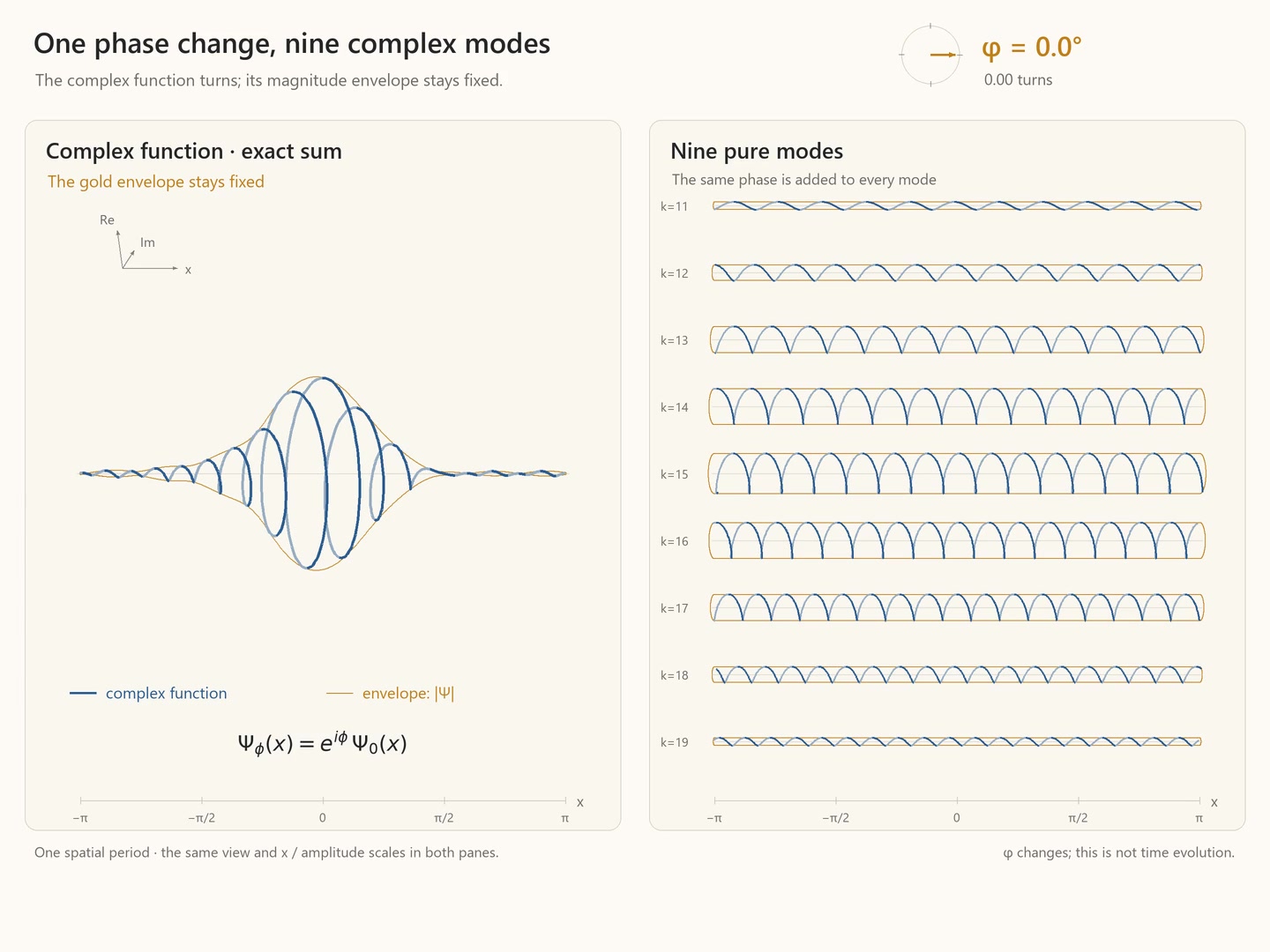
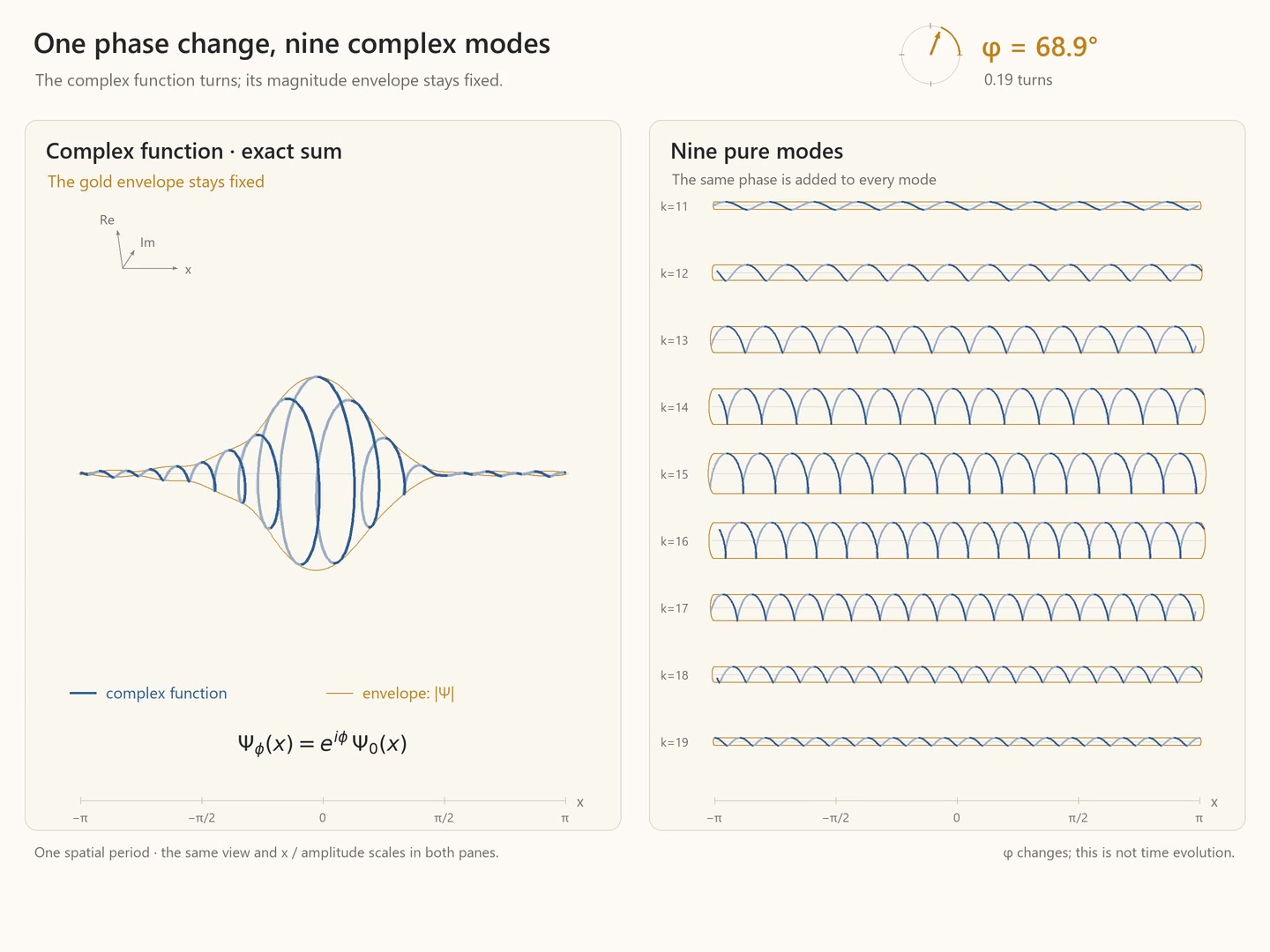
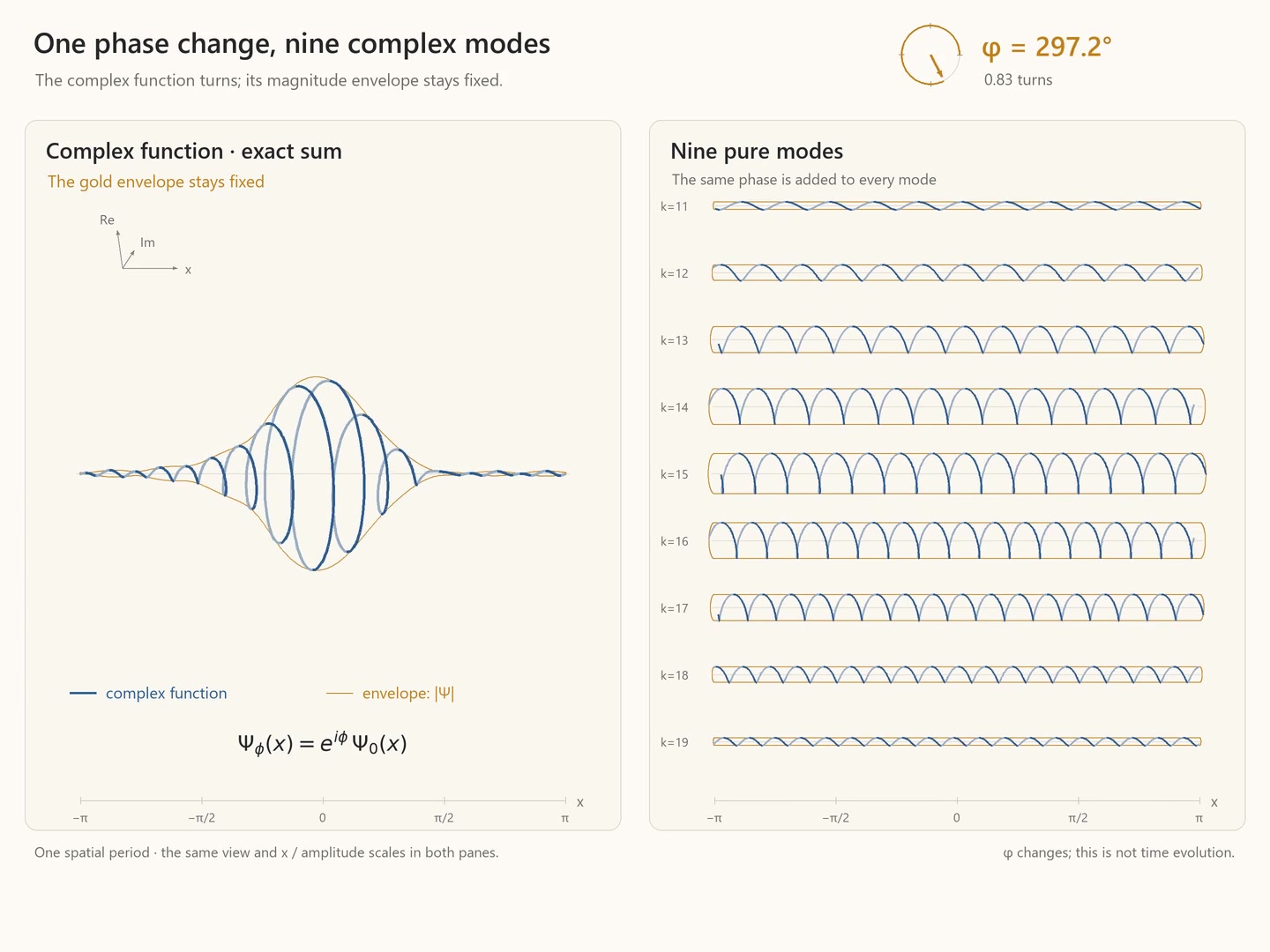
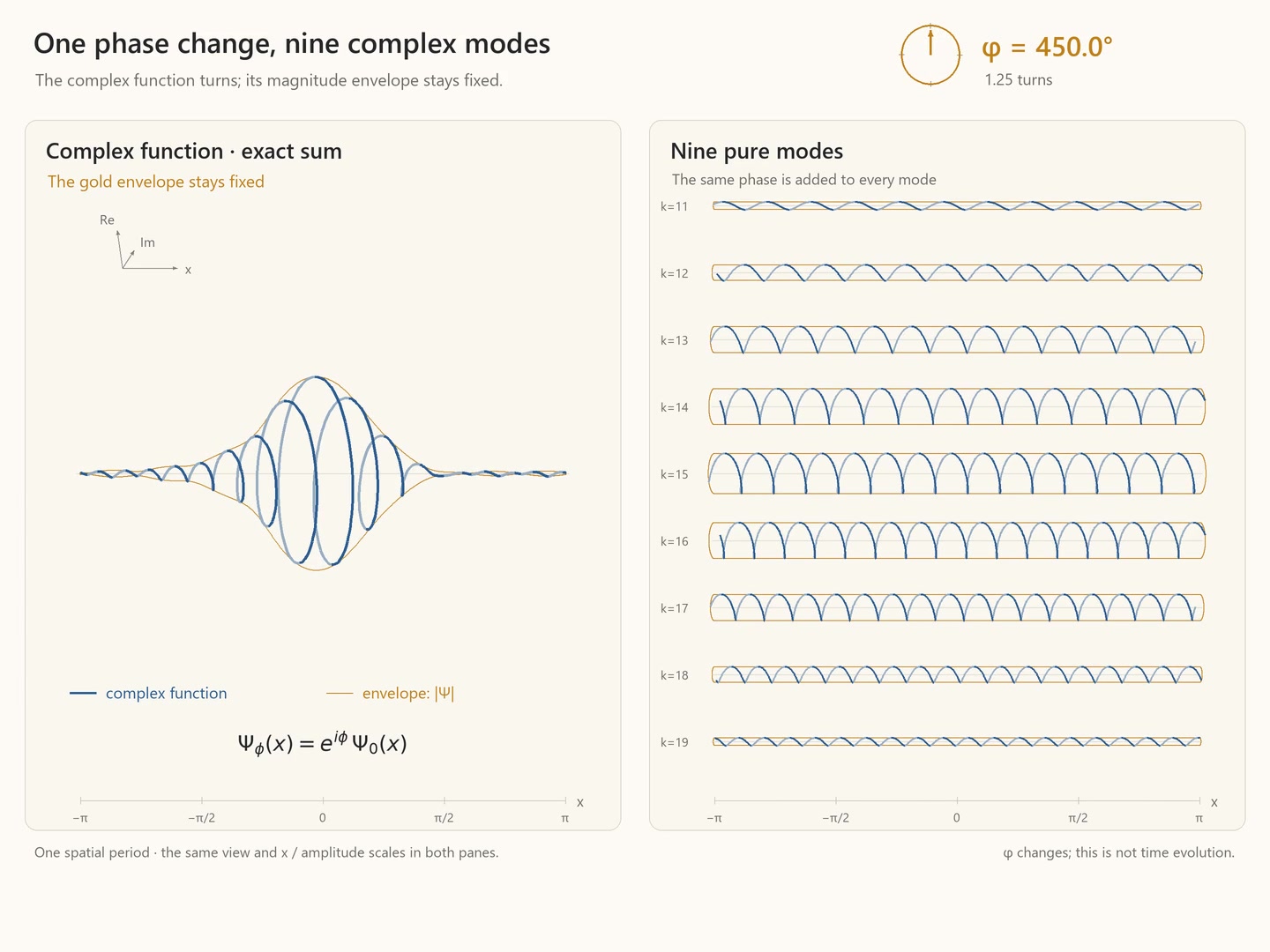
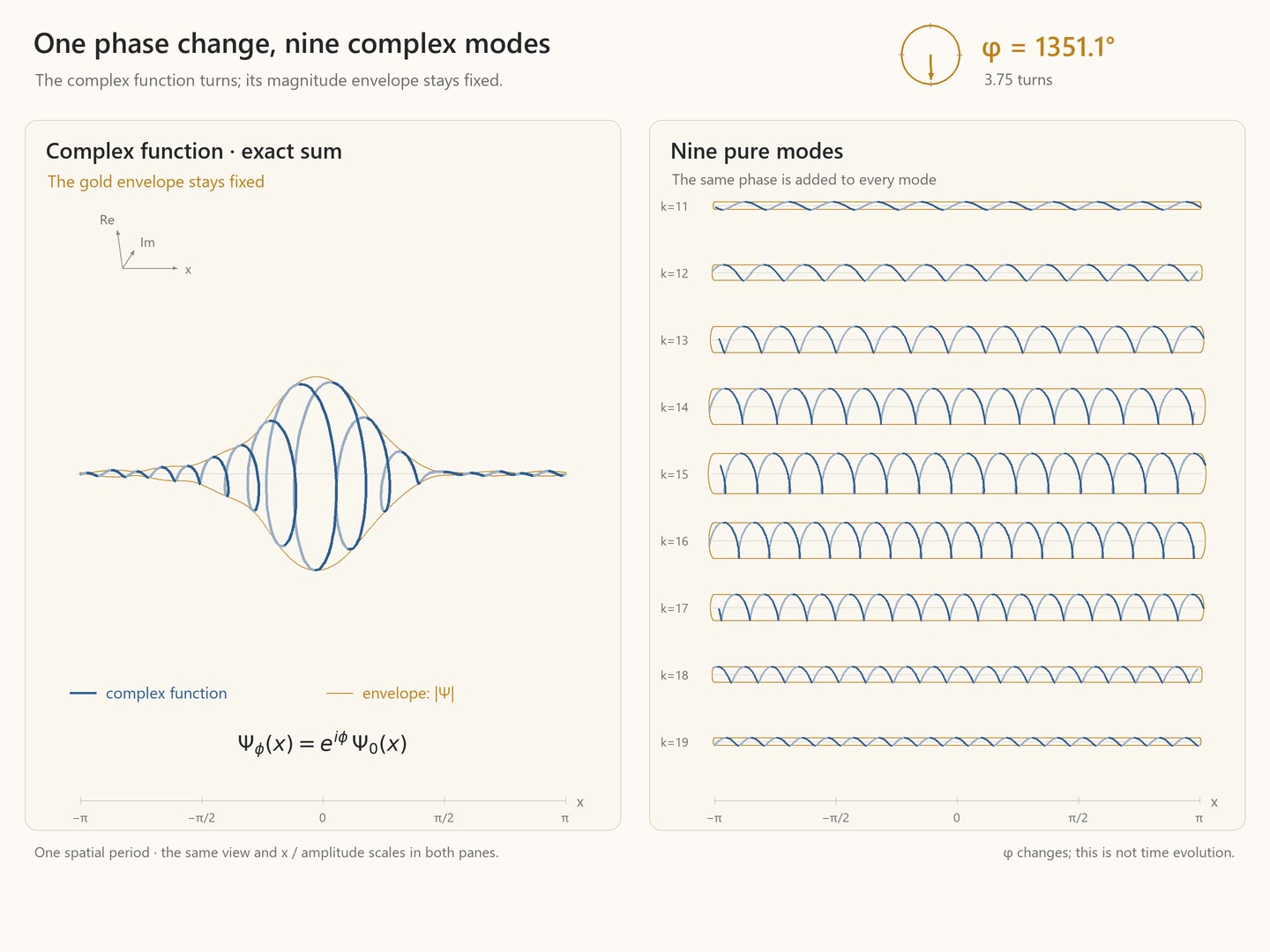
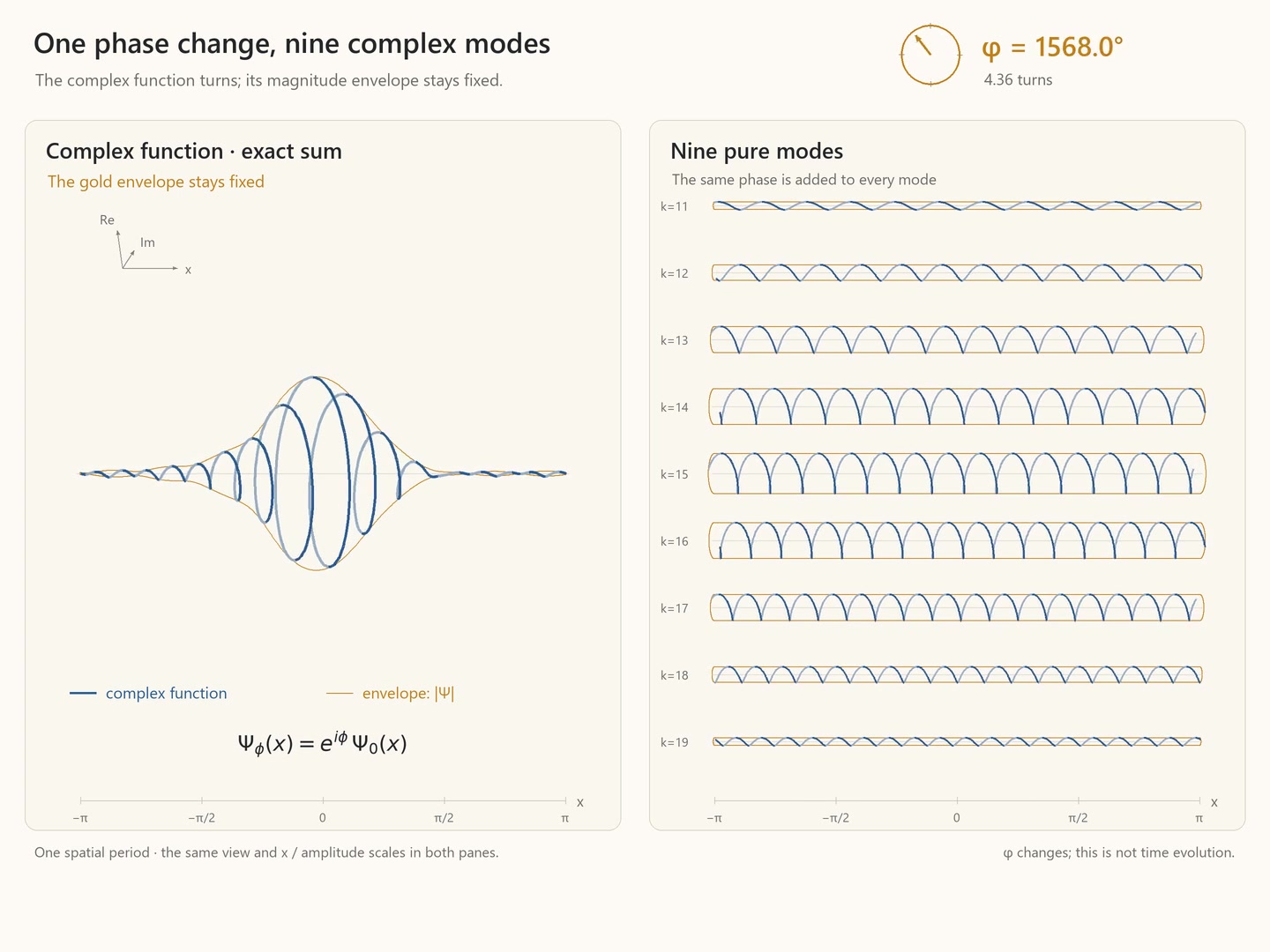
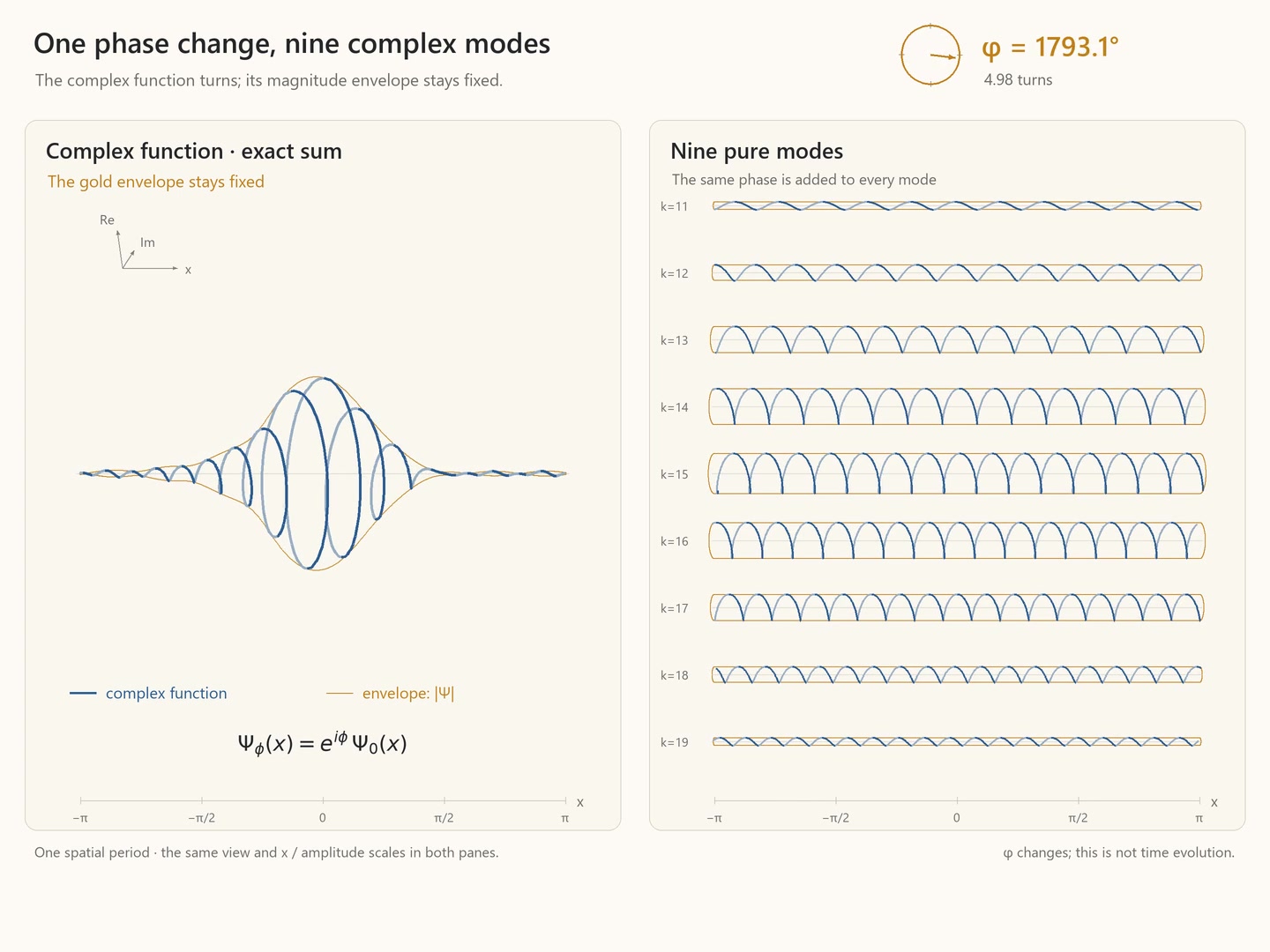
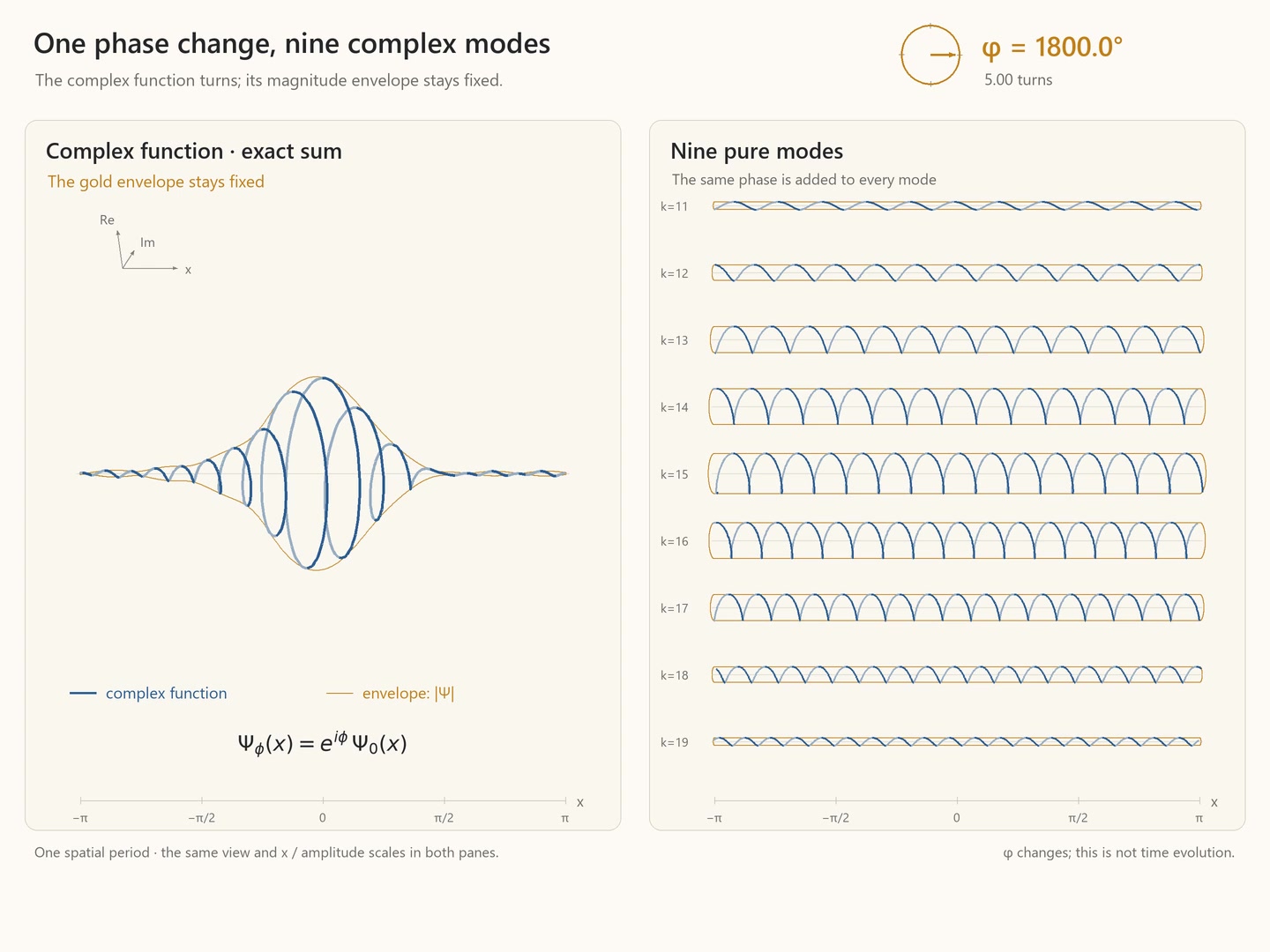
Nine complex modes and their exact sum rotate through five phase turns while their magnitude envelopes remain fixed
Before the animation
Chapter lines 891–891
In addition to position and wave number, waves have a third independent way of changing. A wave's phase, $\phi$, refers to where it is in its cyclic pattern. For example, a phase shift of $2\pi$, or one full "cycle," returns the wave to its exact initial state. We need to be a bit careful here. For a pure mode, shifting its position is indistinguishable from shifting its phase, somewhat in the way the turning of a barbershop sign appears as though its stripes are moving up and down. We might, then, be tempted to think there is no difference between position and phase shifts. But the single mode is an idealization. In the general case, in which the wave function is a packet composed of modes, position translation shifts the entire function. Phase translation shifts each mode by the same fraction of its cycle, changing the function while leaving its magnitude envelope unchanged.
After the animation
Chapter lines 899–899
We can also discover and define phase directly from our symmetry group's commutation relations, which gives us a useful algebraic packaging of the group structure. Let's ask the question:
Chapter lines 901–903
Generation source
Main script --render supplies the complex-mode frame renderer and uses drawing, numerical, and encoding helpers imported from generate_symmetry_packet_phase_modes. The imported script is a code dependency, not an input movie. --check and --encoded-check produce the companion checks.
Mapping evidence and limits
Exact NAME match. The matching validation JSON records nine wave numbers 11 through 19, five phase turns, 540 frames at 30 fps, 1440 x 1080, 18 s; encoded-validation.json confirms that frame count and compares decoded frames with this renderer.
Source SHA-256 values identify the exact downloadable bytes in this packet. The source mapping and recorded checks explain the likely generation pipeline; they do not prove that these exact source bytes produced the movie. A GitHub link pinned to a commit is provided only when the delivered source bytes exactly match that path at the build's Git HEAD.
- scripts/generate_symmetry_complex_phase_modes.py · GitHub at 974f9de35254
SHA-256 ca642fc9b34286da0cb58cfd6ea097abd347b9df6b00a7f58ca0f76ae311d39d - scripts/generate_symmetry_packet_phase_modes.py · GitHub at 974f9de35254
SHA-256 47fdf5353988db4807c5e9a21545b3f5dc44b097d7a5b077eec2889333f57edb
Existing generator checks (2 reports)
These are existing author-produced generator reports, copied without changes. Their checks were not rerun for this packet and are not independent certification. A report may describe an earlier generation run; inspect its contents before applying its claims to the current movie.
- symmetry-complex-phase-modes-validation.json
SHA-256 296253a9e08d9b2e9c68c58f928549bb81f4ca8e765607cae326f4e0914a0fd6 - symmetry-complex-phase-modes-encoded-validation.json
SHA-256 9bb4b715f3def3e25ea8e8e287a778d7e02fcba31fbfdac60eb7b84ce719683e
Decoded contact sheet
Extraction method: Twelve evenly spaced decoded frame indices, including first and last. Native-resolution JPEGs from the encoded MP4; timestamps read from FFmpeg showinfo. No source rerendering. Frame indices are zero-based. Sparse samples do not establish continuous motion or capture every transition.. Frame indices are zero-based.
Full-size sampled frames