All animations · In the chapter · Open full MP4
Animation 30
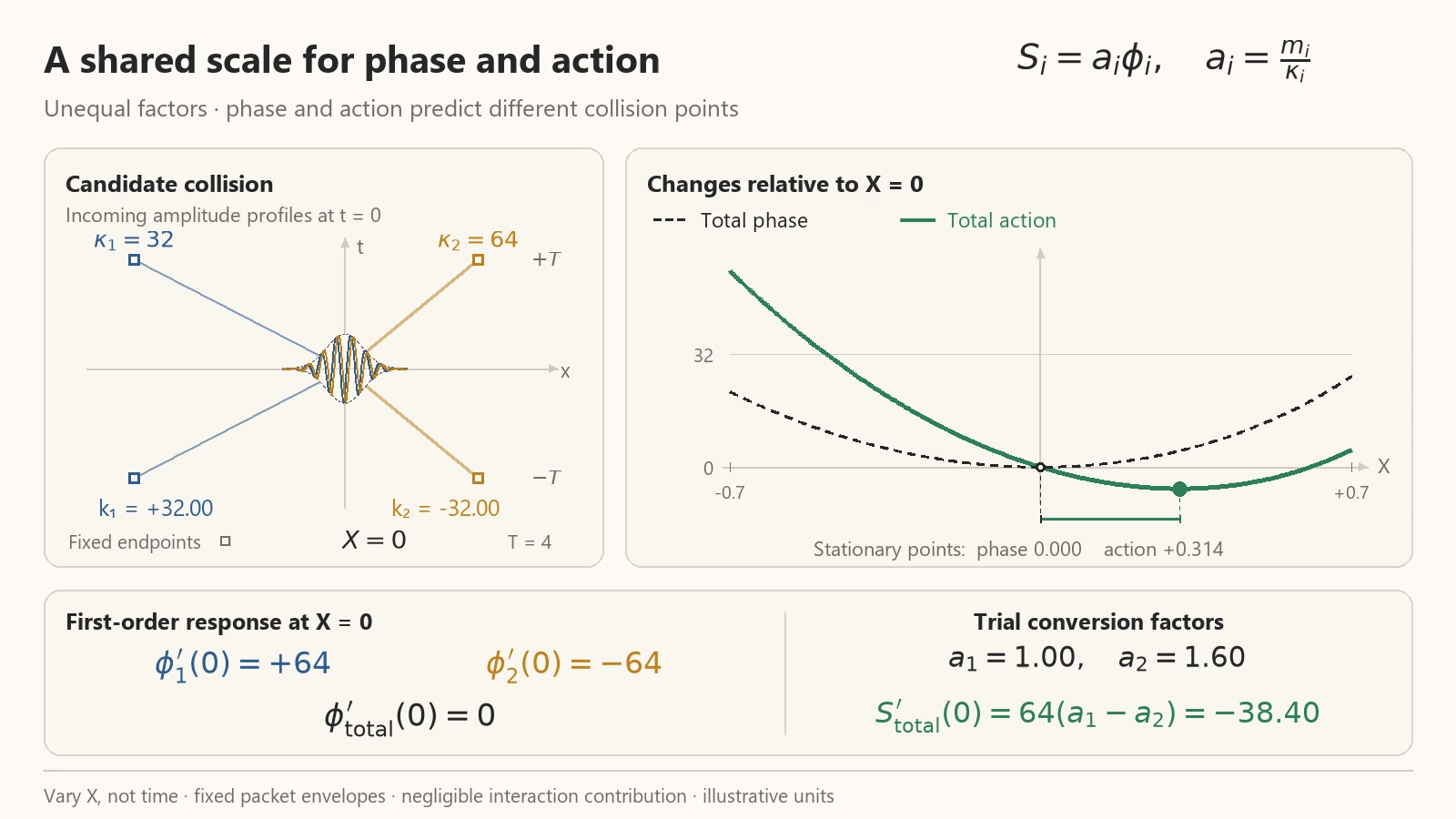
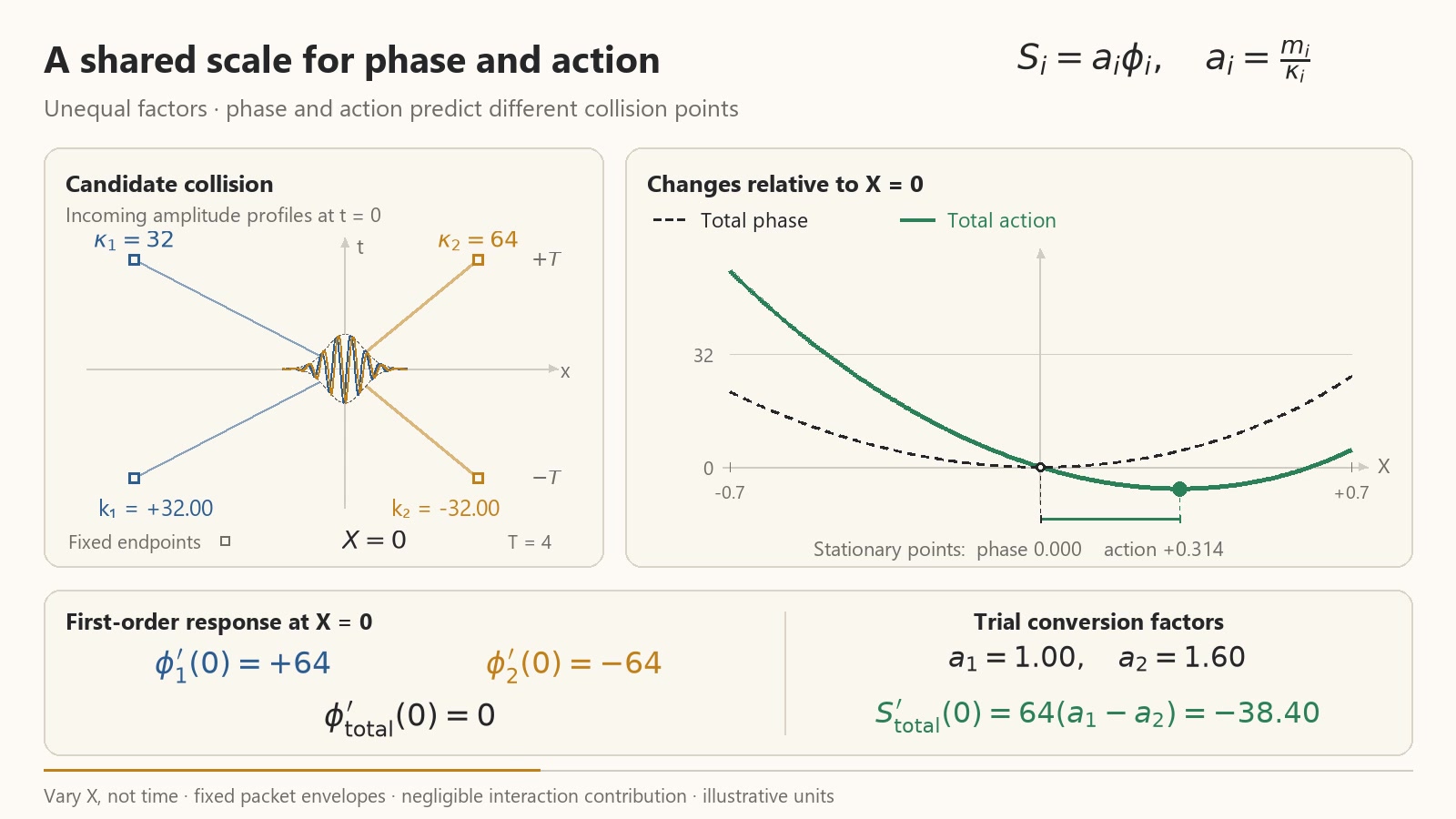
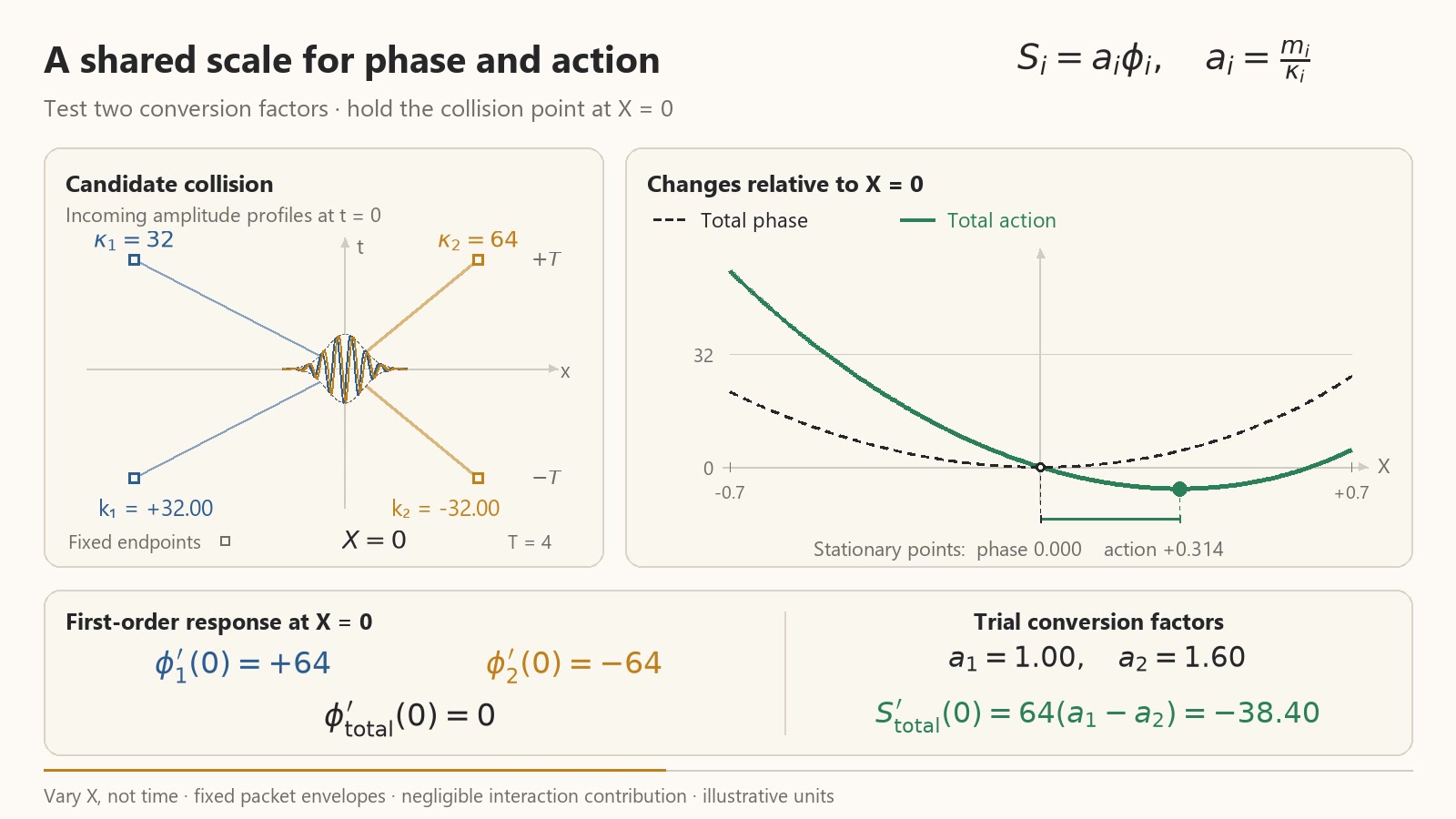
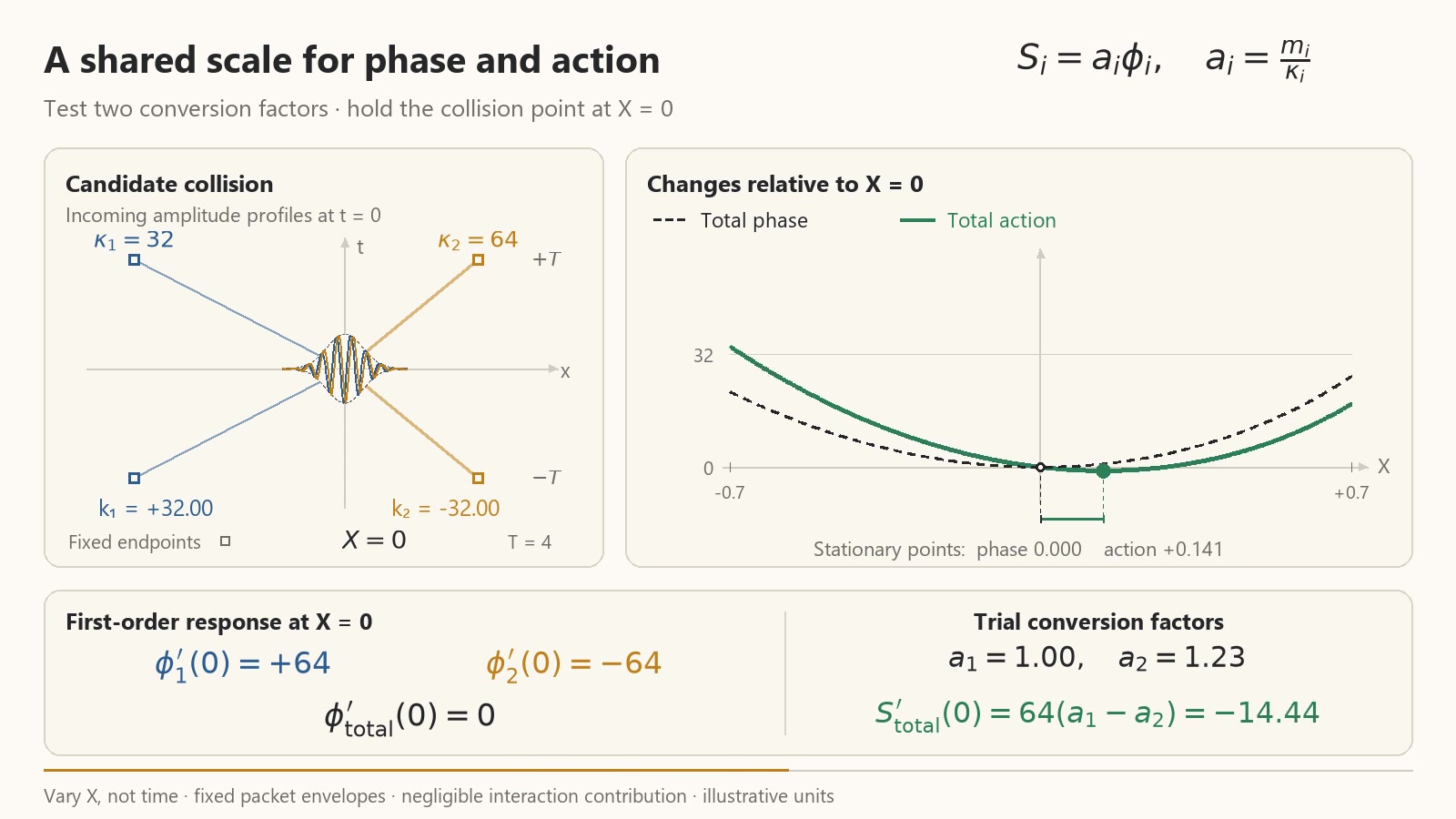
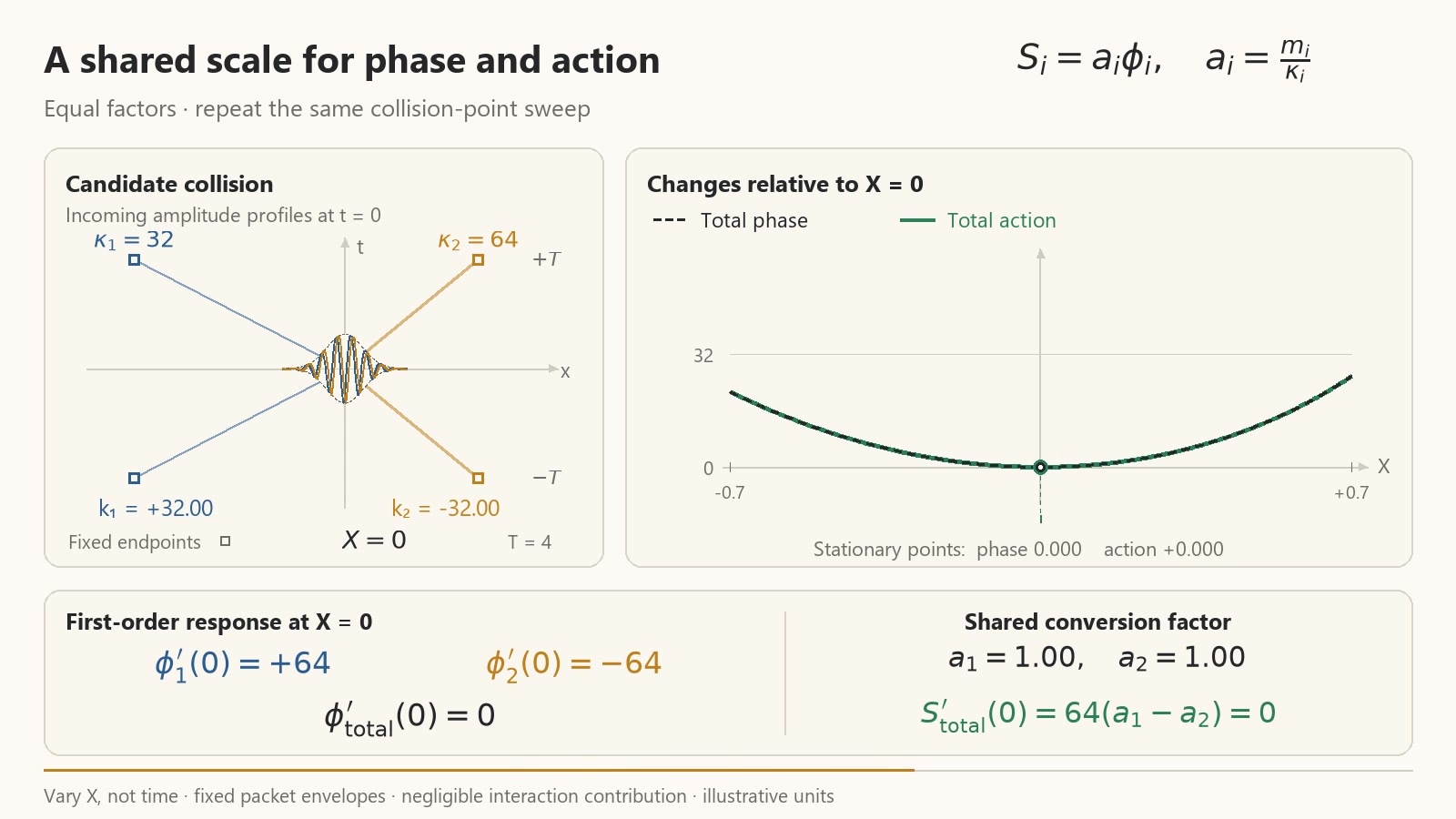
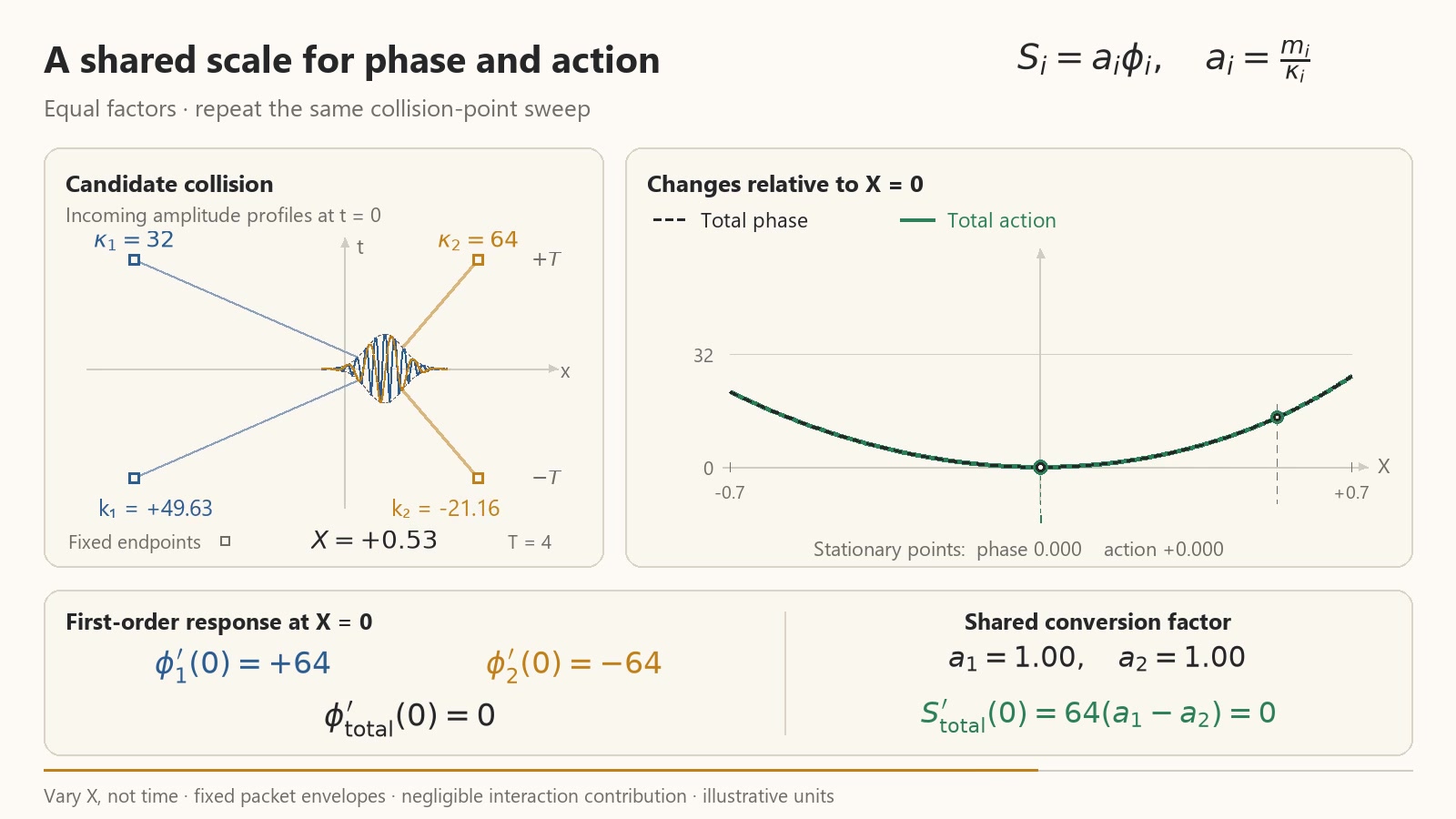
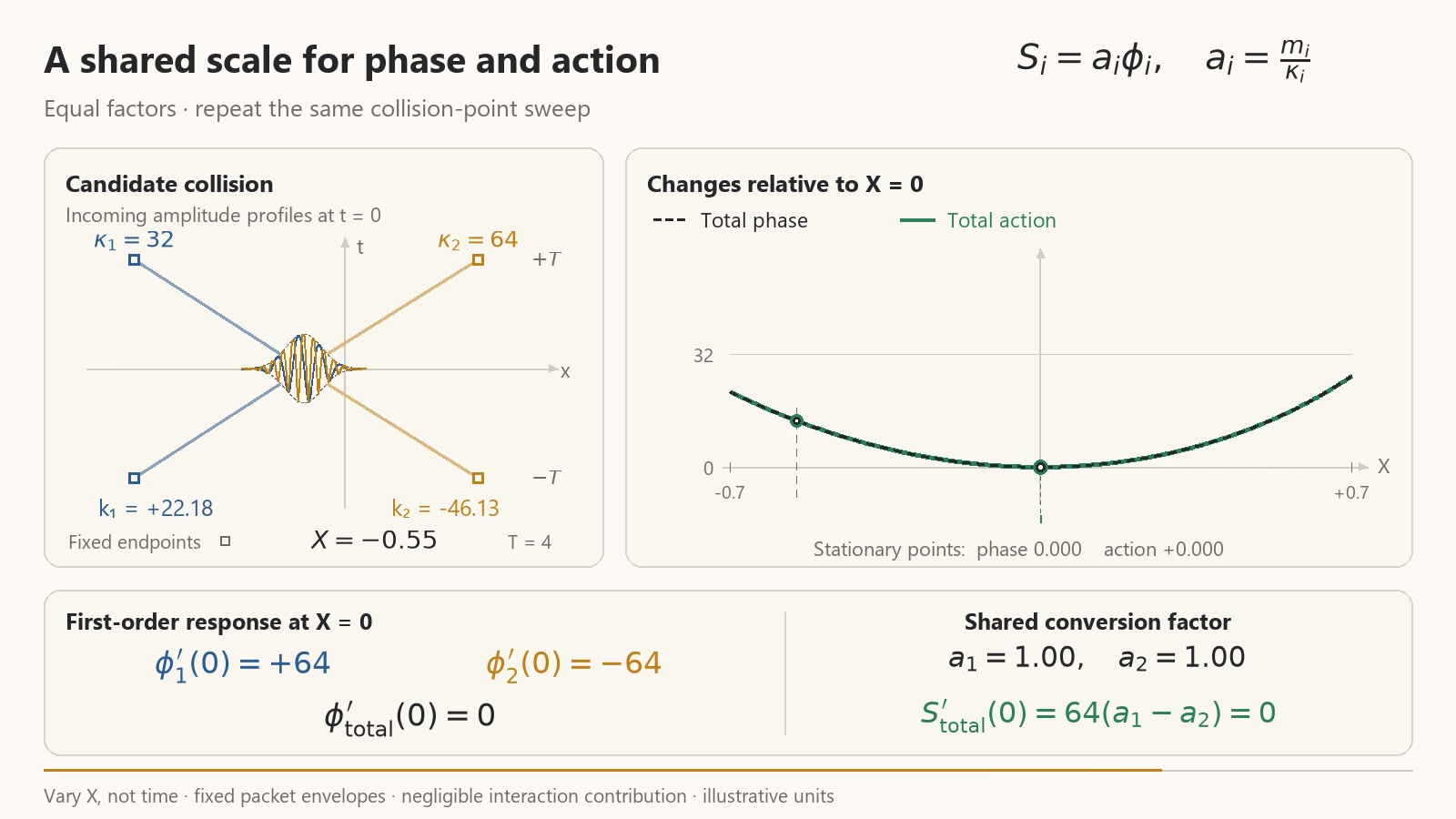
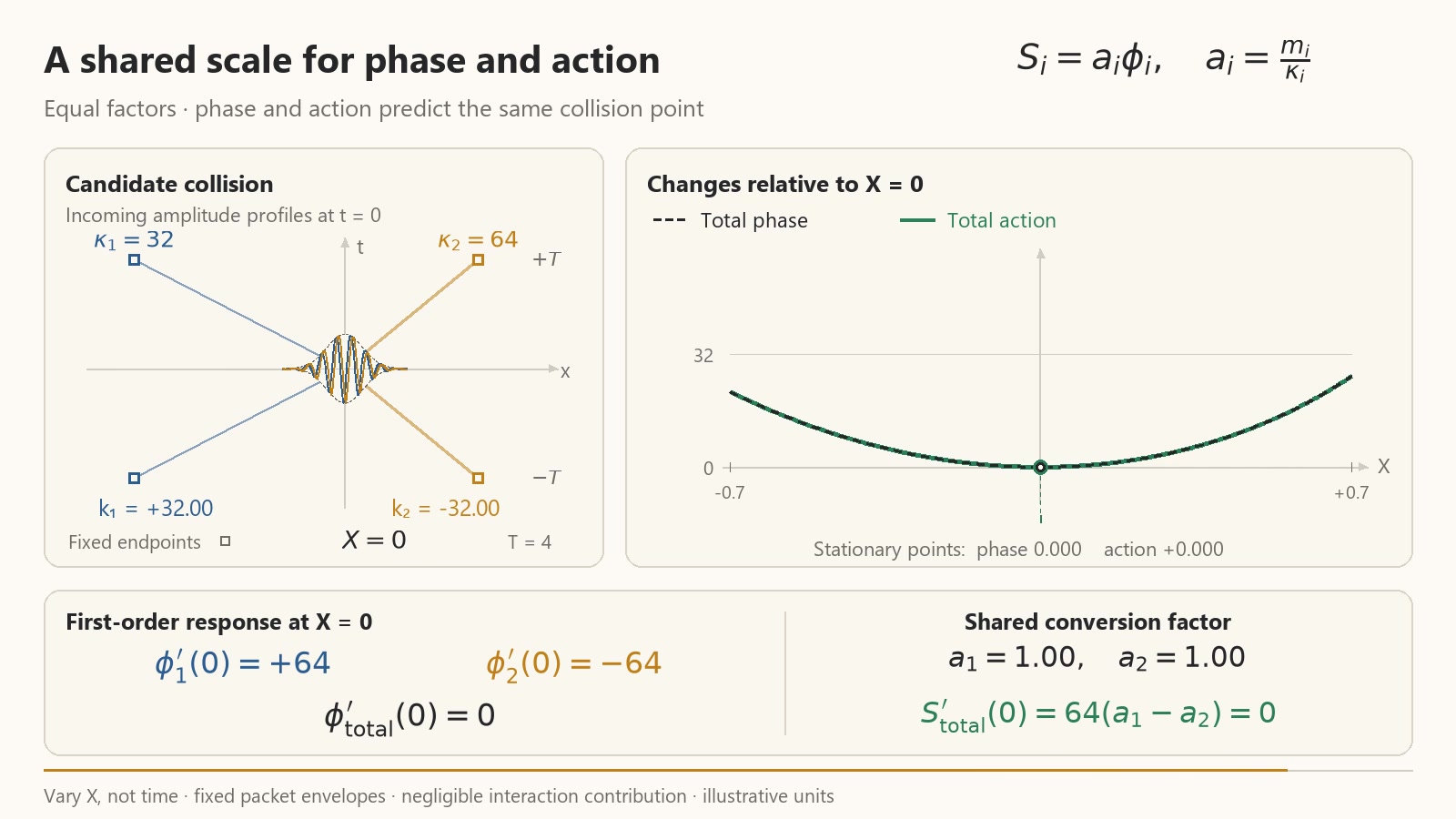
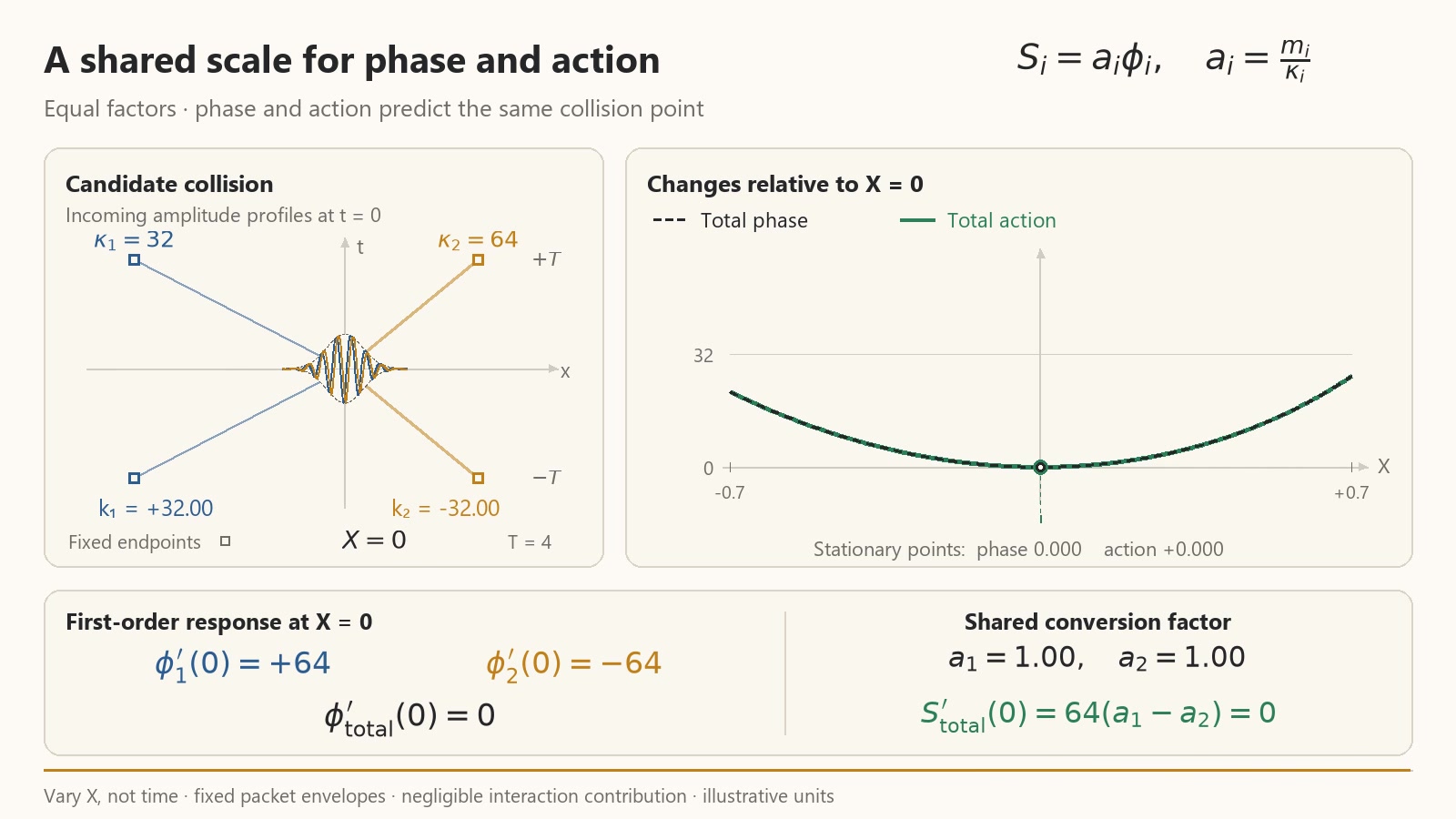
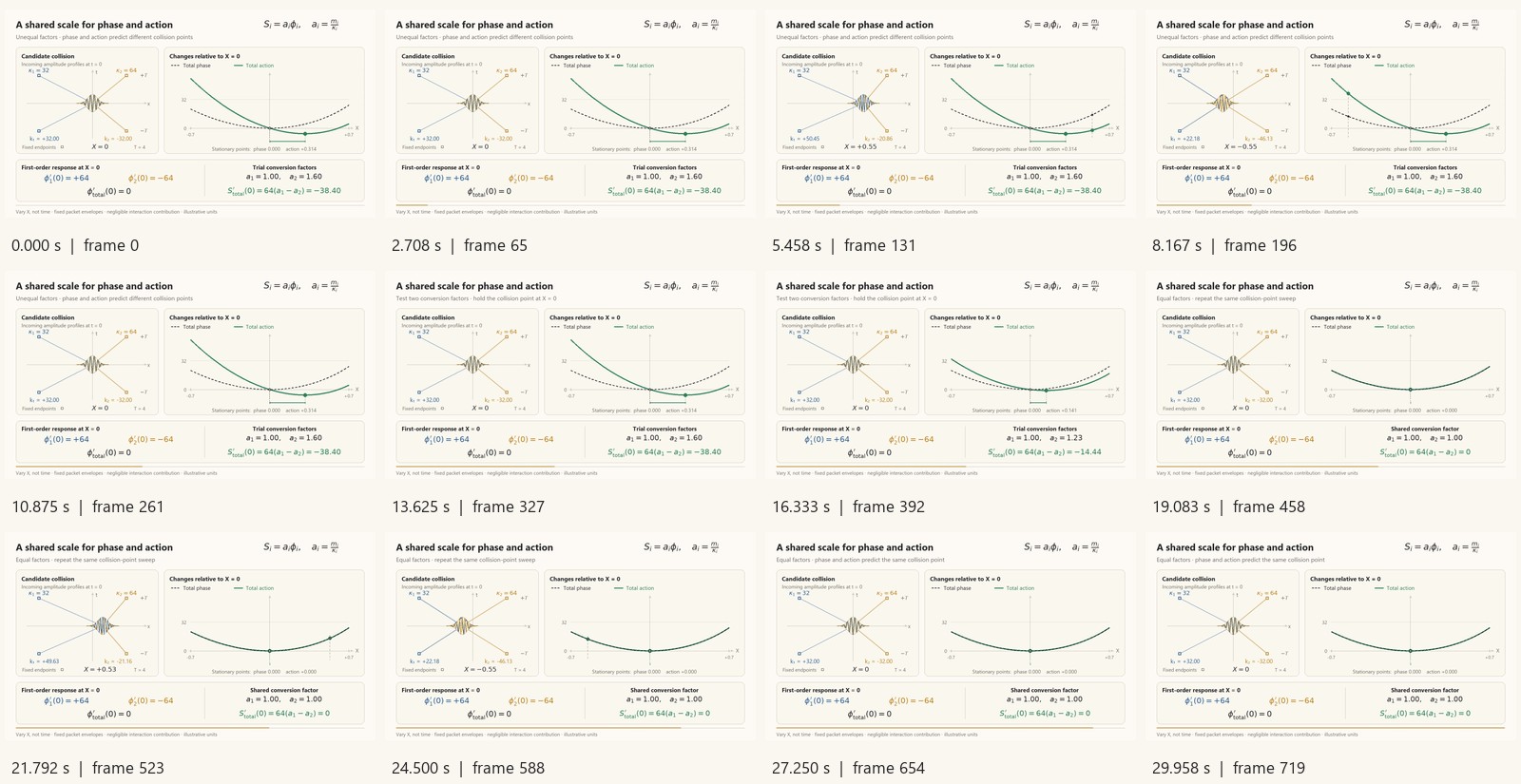
A shared conversion factor makes phase and action select the same collision
symmetry-collision-shared-scale.mp4
These are sparse samples decoded from the current MP4, not newly rendered illustrations. They can support checks of the sampled states and labels, but cannot establish continuous motion, timing, transitions, or the absence of problems between samples. Use the full MP4 when judging those properties.
1600 × 900 · 24 fps · 30 s · 720 frames · 12 samples
MP4 SHA-256 643b2fb49af55e498bcfecd3f8d610c91b4697d58a2683bf0de2579752b3f55a
Frame manifest · Context markdown · Download complete review packet
Chapter context
Section: From Wave Mechanics to Quantum Mechanics. Excerpts are verbatim; line numbers refer to the included chapter markdown.
Caption
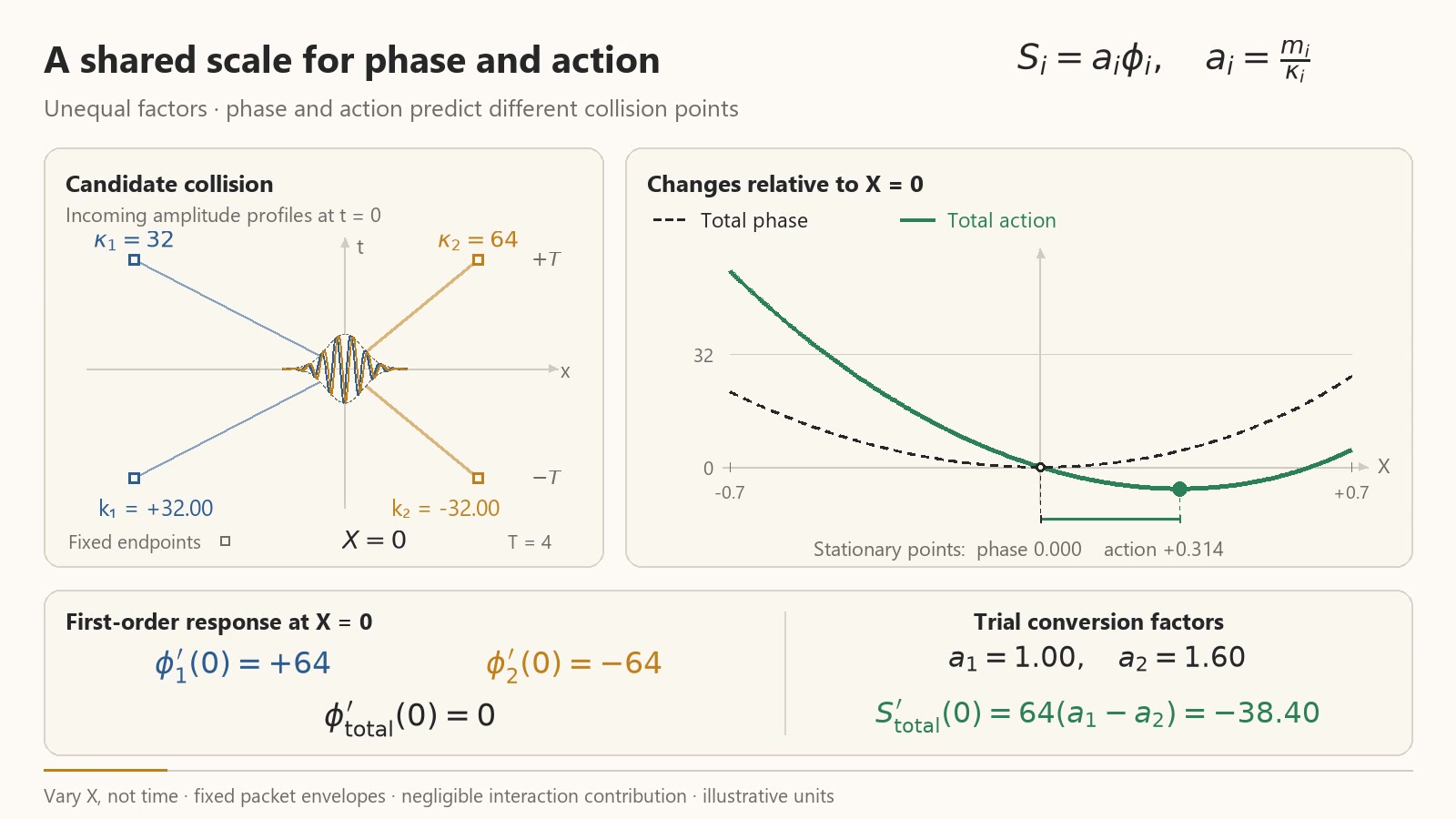
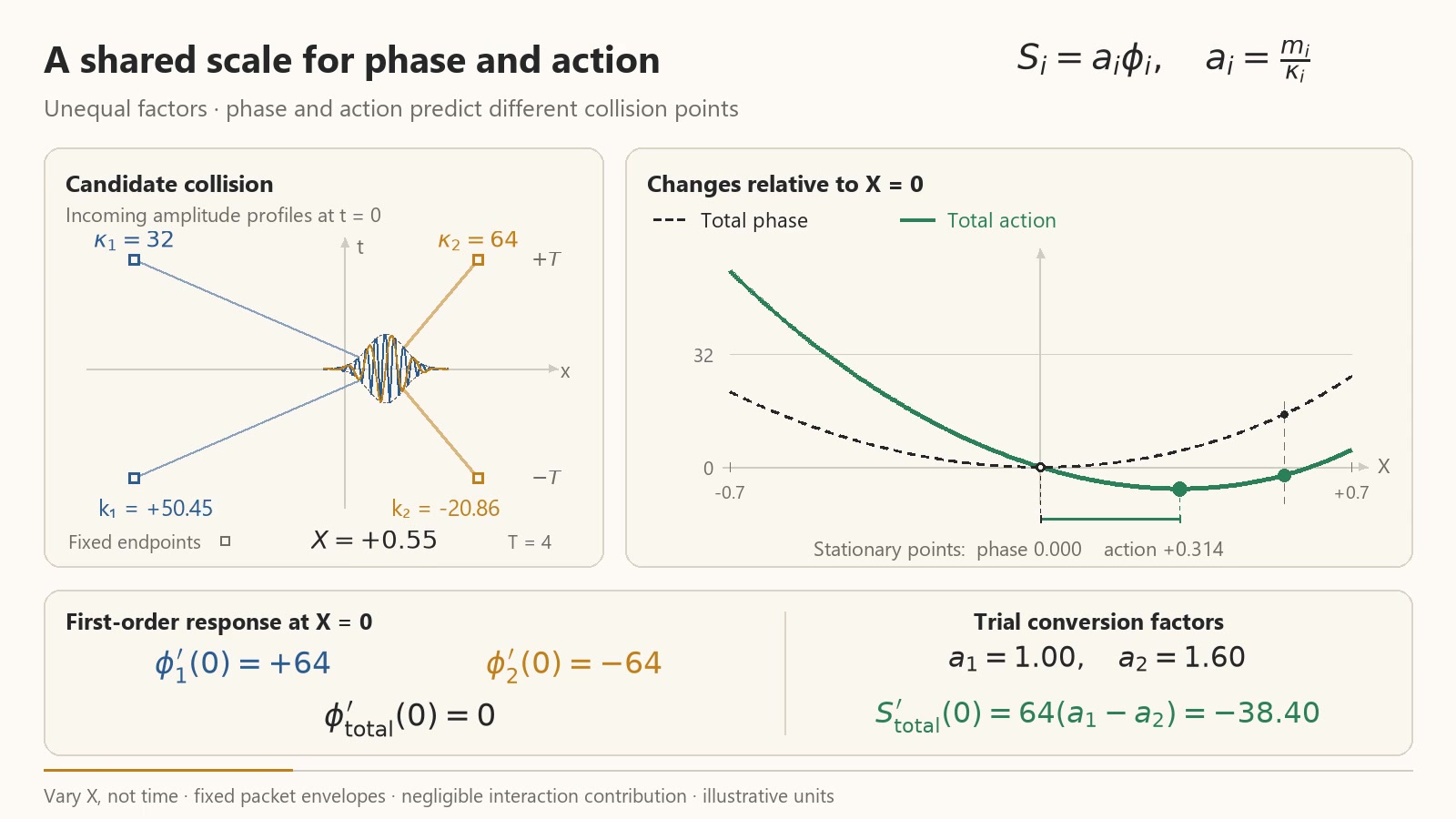
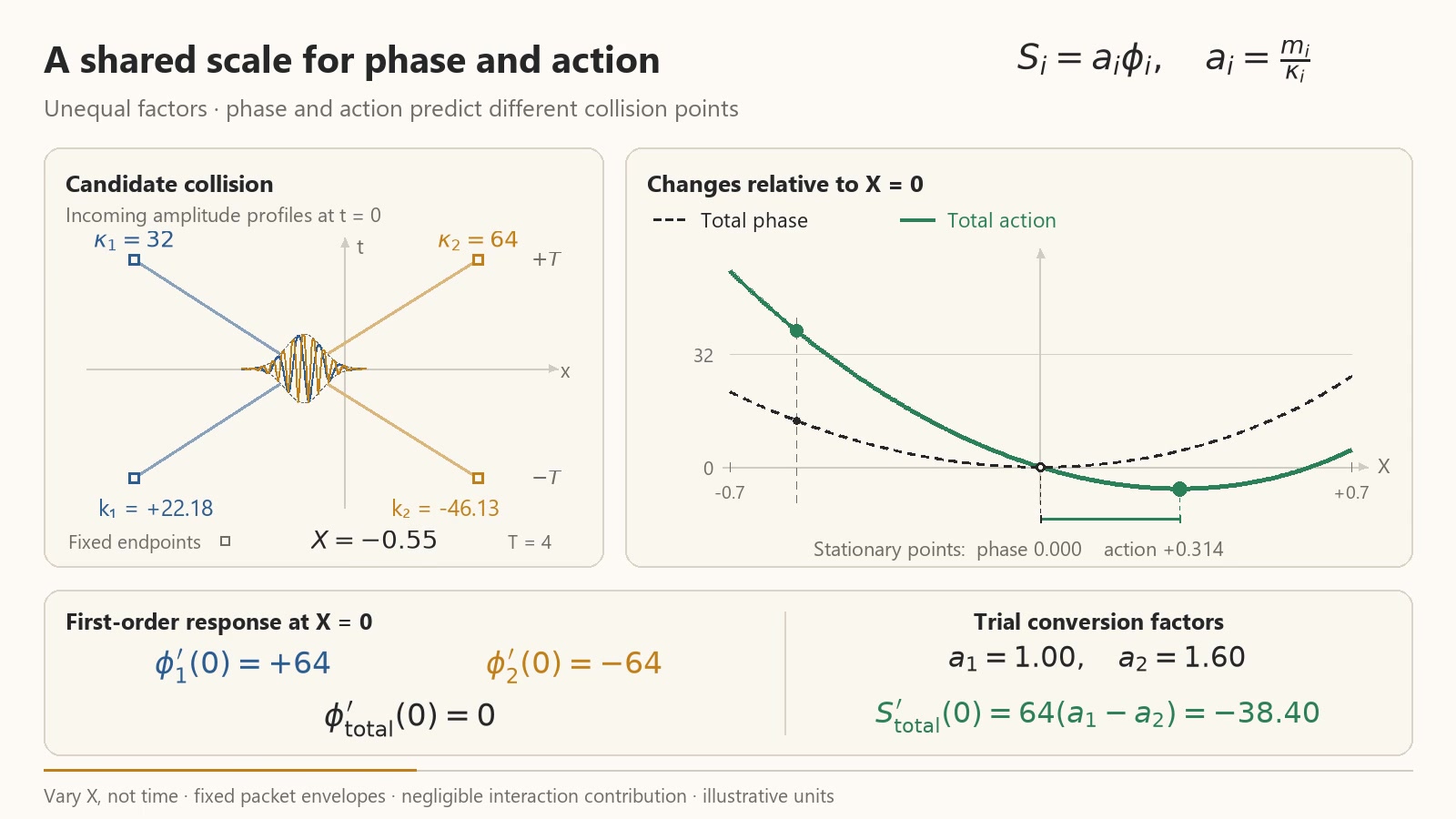
A shared conversion factor makes phase and action select the same collision
Image description
Varying a candidate collision point leaves phase and action stationary at different points for unequal conversion factors, and at the same point for a shared factor
Before the animation
Chapter lines 1276–1281
Chapter lines 1283–1283
If the collision changes a particle’s speed or direction, we can shift the candidate collision point so that its phase changes to first order. Choose such a shift, so $\epsilon\ne0$. For the action to be stationary at the same point, $a_1=a_2$. The shared conversion factor is $\hbar$.
After the animation
Chapter lines 1291–1291
We can measure its numerical value in the lab by comparing mass, as measured through collisions, to wavelength, as measured through interference. We then find:
Chapter lines 1293–1295
Generation source
Main script --render first writes review stills and numerical validation, then directly encodes the shared-scale collision illustration and appends decoded-video metadata to its validation report. It has no local Python imports or input movie.
Mapping evidence and limits
The script's STEM and output match the linked movie. Matching validation JSON records 1600 x 900, 24 fps, 720 frames, 30 s, and confirms those values in its encoded_video block. It contains no movie hash, so this is source/output-name attribution rather than a hash-attested build.
Source SHA-256 values identify the exact downloadable bytes in this packet. The source mapping and recorded checks explain the likely generation pipeline; they do not prove that these exact source bytes produced the movie. A GitHub link pinned to a commit is provided only when the delivered source bytes exactly match that path at the build's Git HEAD.
- scripts/generate_symmetry_collision_shared_scale.py · GitHub at 974f9de35254
SHA-256 2baf2763d05bfd3654c9bb9202dc7a0454f3ca6d4fe965079a87c42c06918868
Existing generator checks (1 reports)
These are existing author-produced generator reports, copied without changes. Their checks were not rerun for this packet and are not independent certification. A report may describe an earlier generation run; inspect its contents before applying its claims to the current movie.
- symmetry-collision-shared-scale-validation.json
SHA-256 45a7200089400e0d39c1743ecc3c88c74479f8aa59baa5586263ddf6830e855f
Decoded contact sheet
Extraction method: Twelve evenly spaced decoded frame indices, including first and last. Native-resolution JPEGs from the encoded MP4; timestamps read from FFmpeg showinfo. No source rerendering. Frame indices are zero-based. Sparse samples do not establish continuous motion or capture every transition.. Frame indices are zero-based.
Full-size sampled frames