All animations · In the chapter · Open full MP4
Animation 29
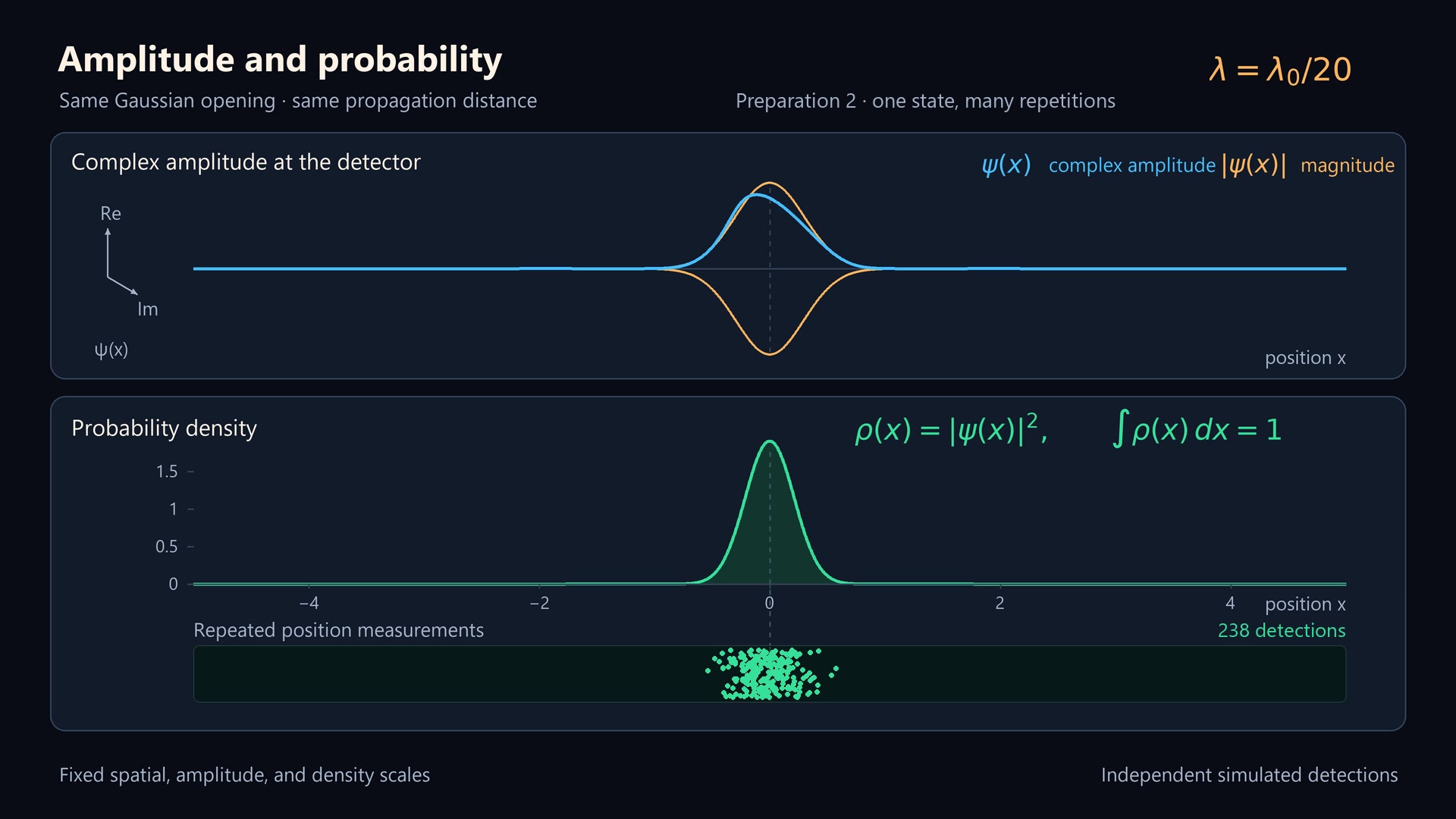
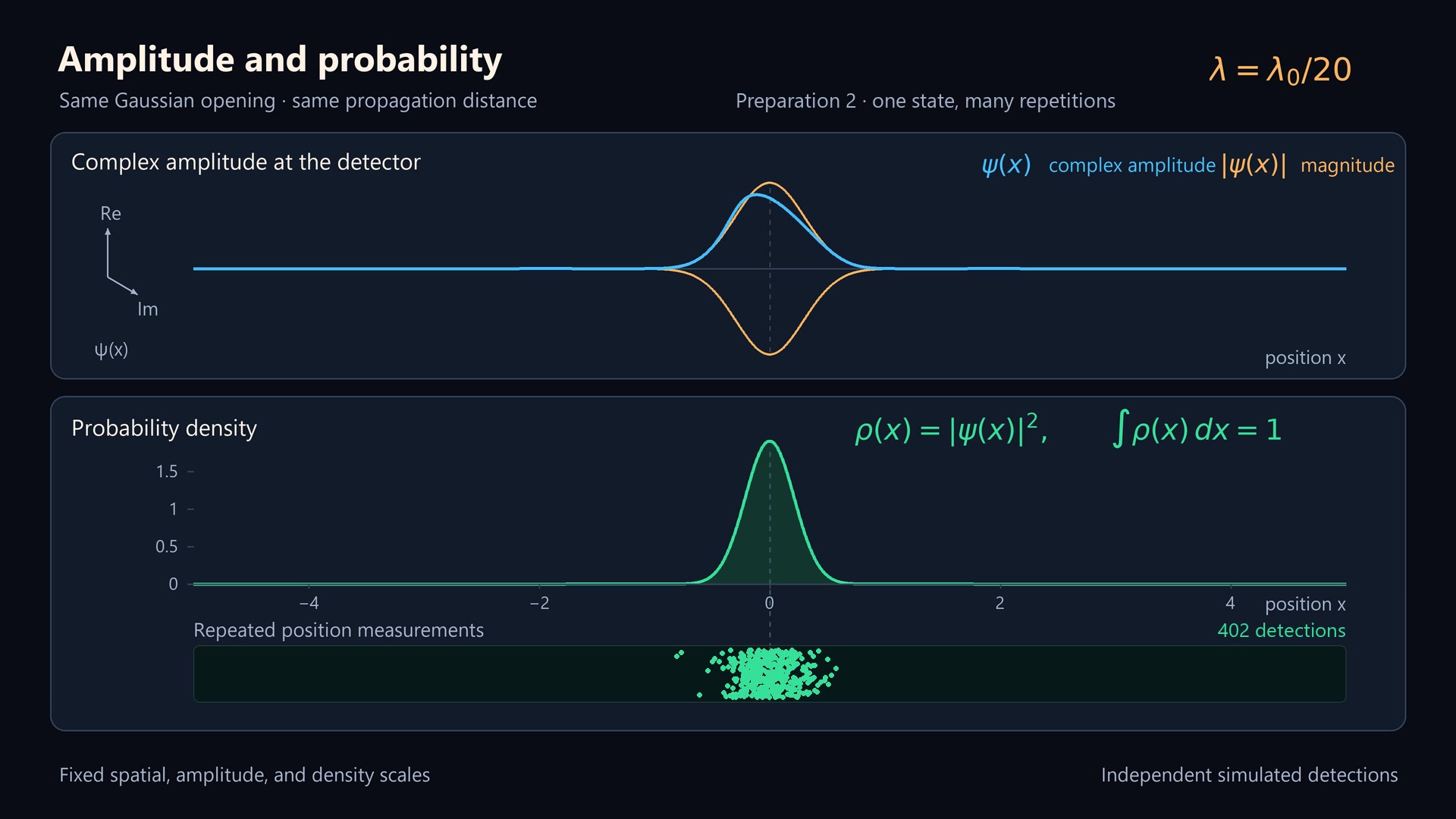
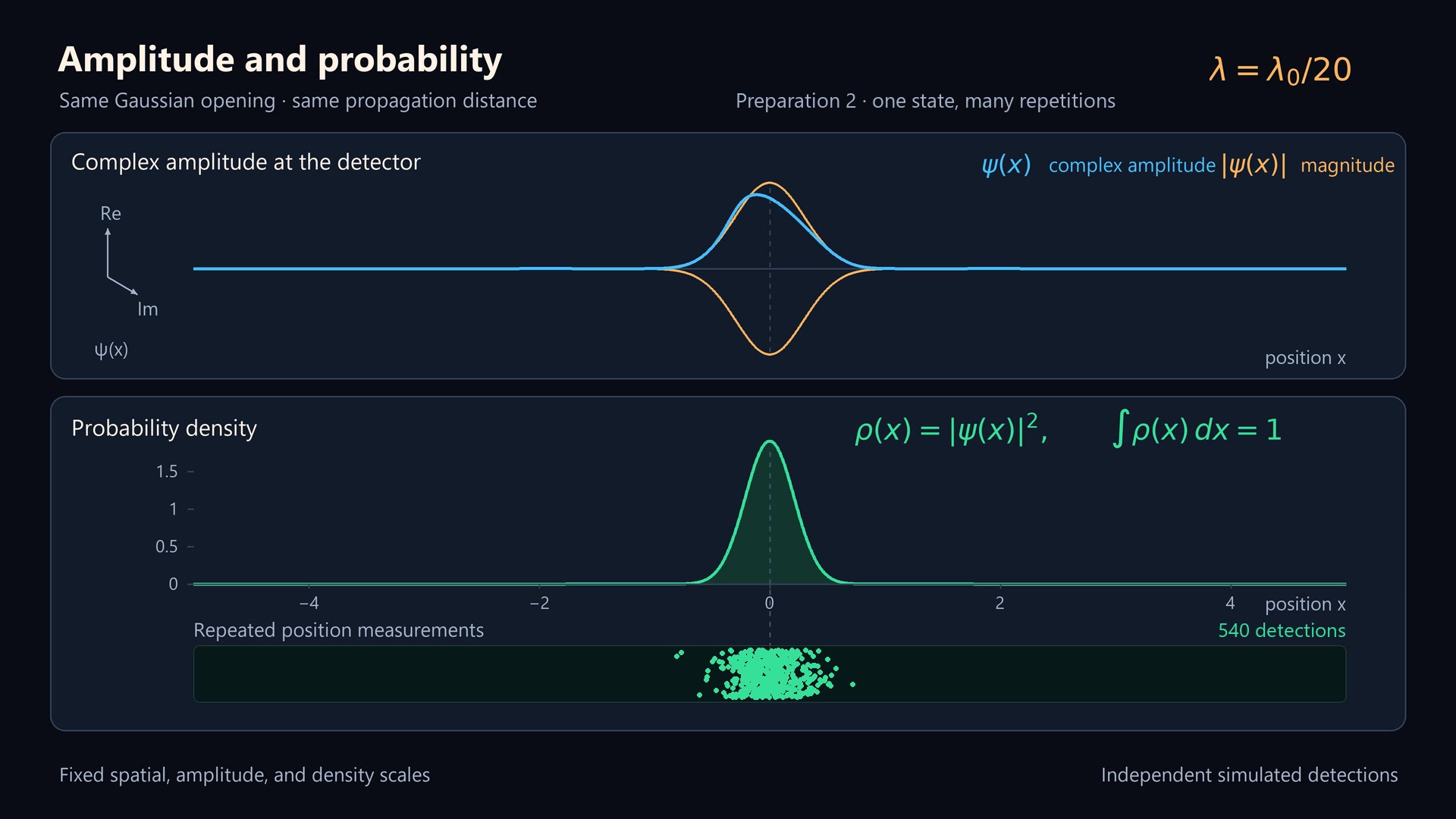
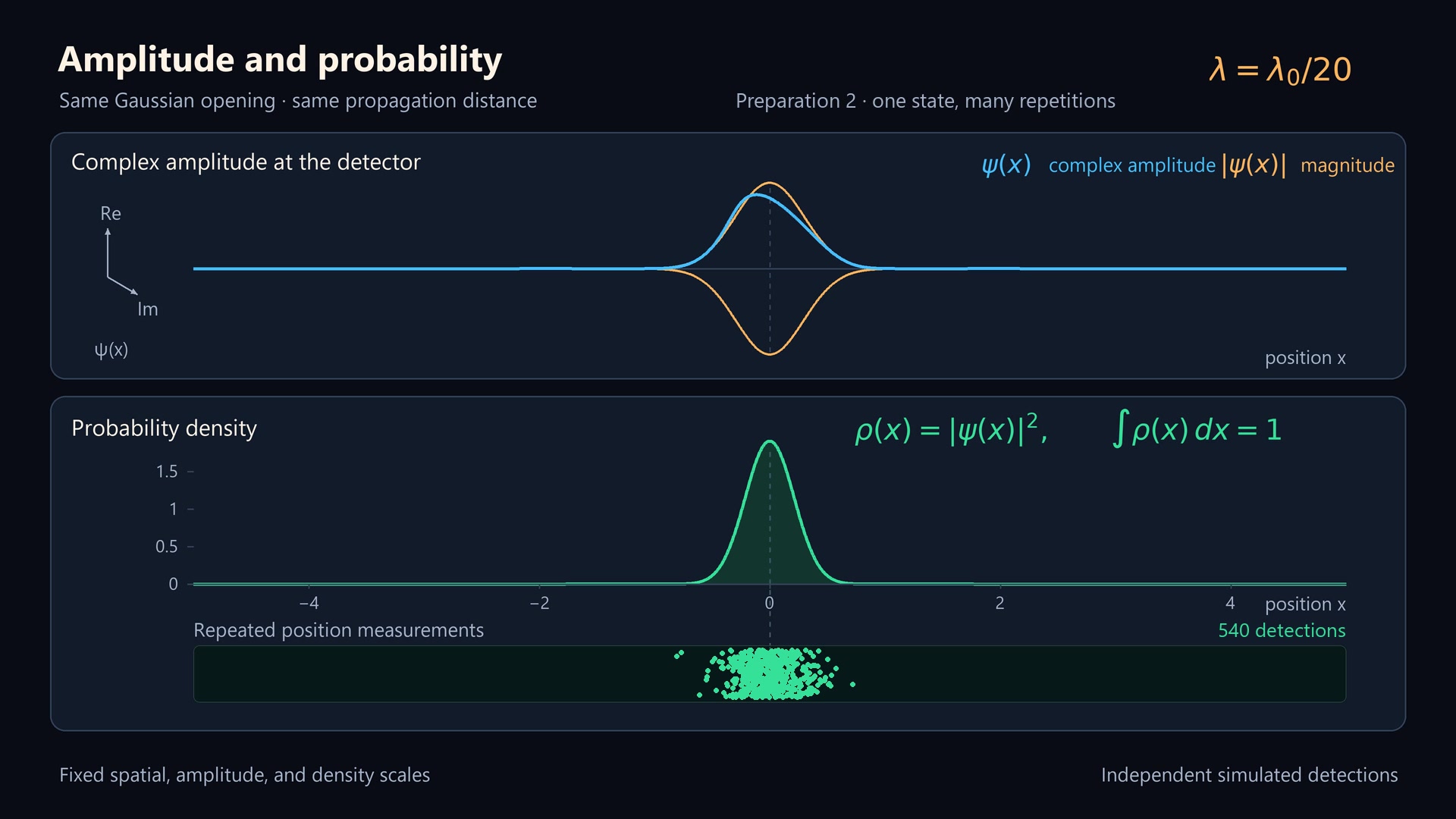
From intensity to position measurement probability density
symmetry-amplitude-probability.mp4
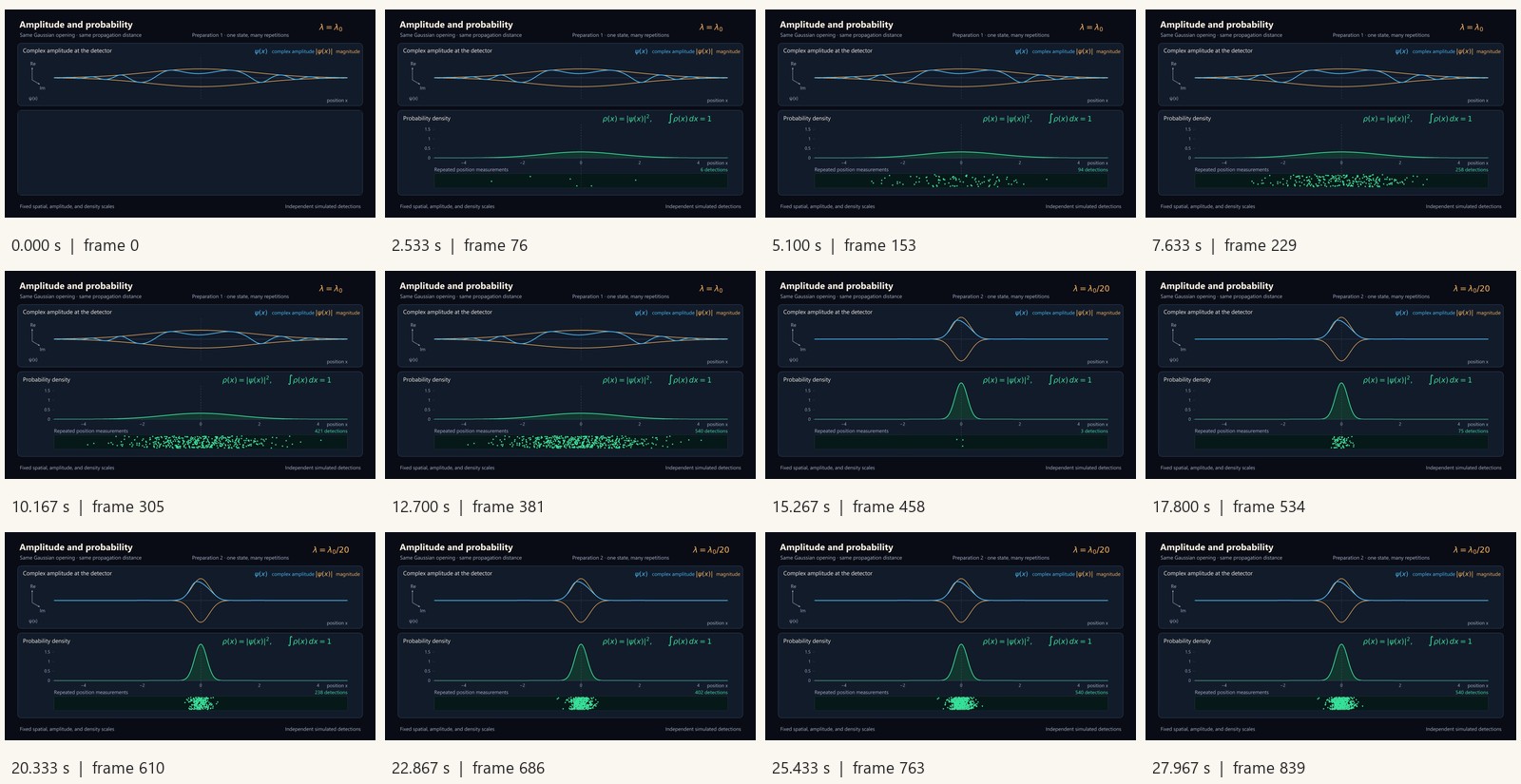
These are sparse samples decoded from the current MP4, not newly rendered illustrations. They can support checks of the sampled states and labels, but cannot establish continuous motion, timing, transitions, or the absence of problems between samples. Use the full MP4 when judging those properties.
1920 × 1080 · 30 fps · 28 s · 840 frames · 12 samples
MP4 SHA-256 1c8983aa042f447817ec993a7139134c5d2c412565f7d32badf6e8f487886adf
Frame manifest · Context markdown · Download complete review packet
Chapter context
Section: From Wave Mechanics to Quantum Mechanics. Excerpts are verbatim; line numbers refer to the included chapter markdown.
Caption
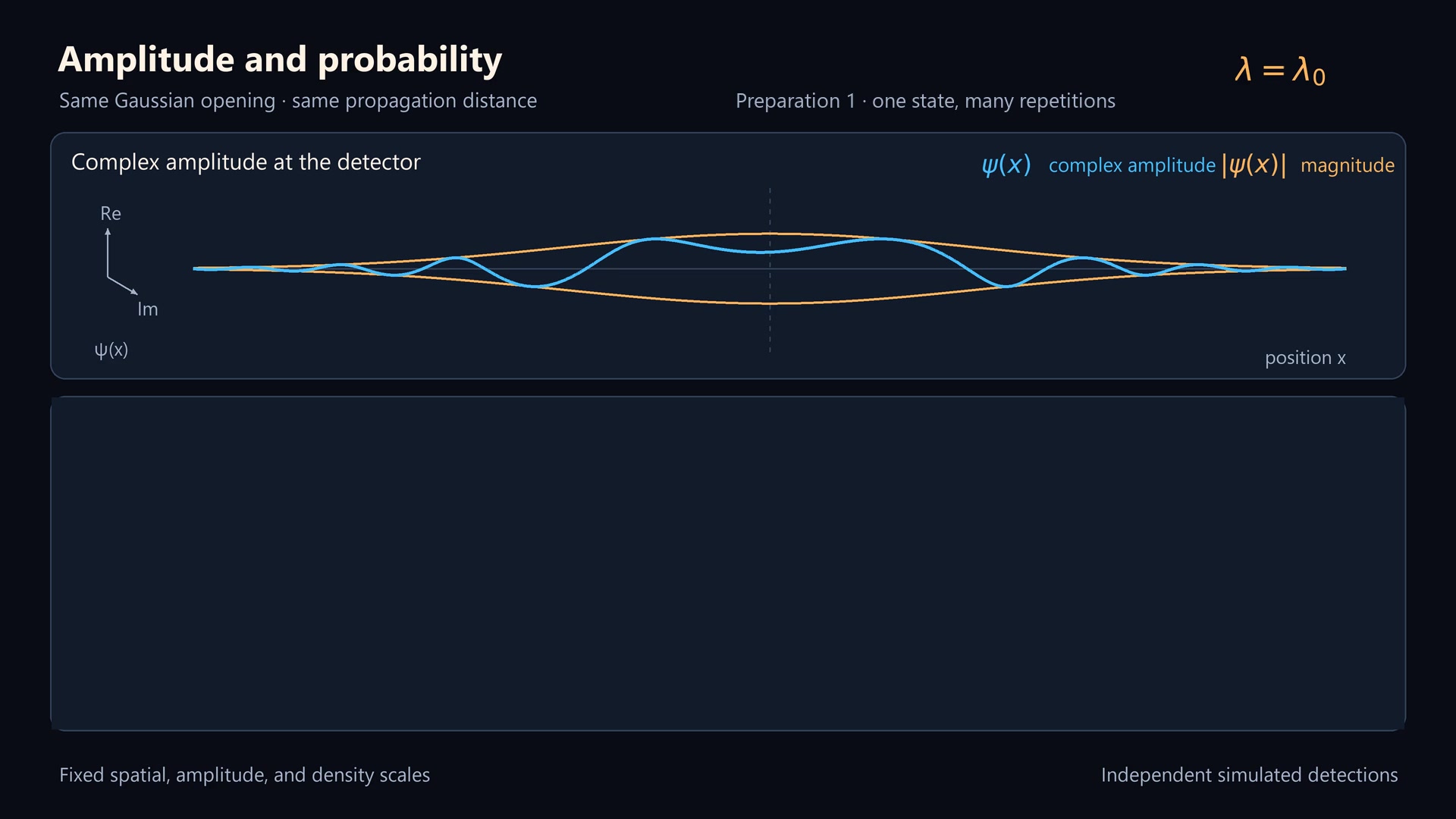
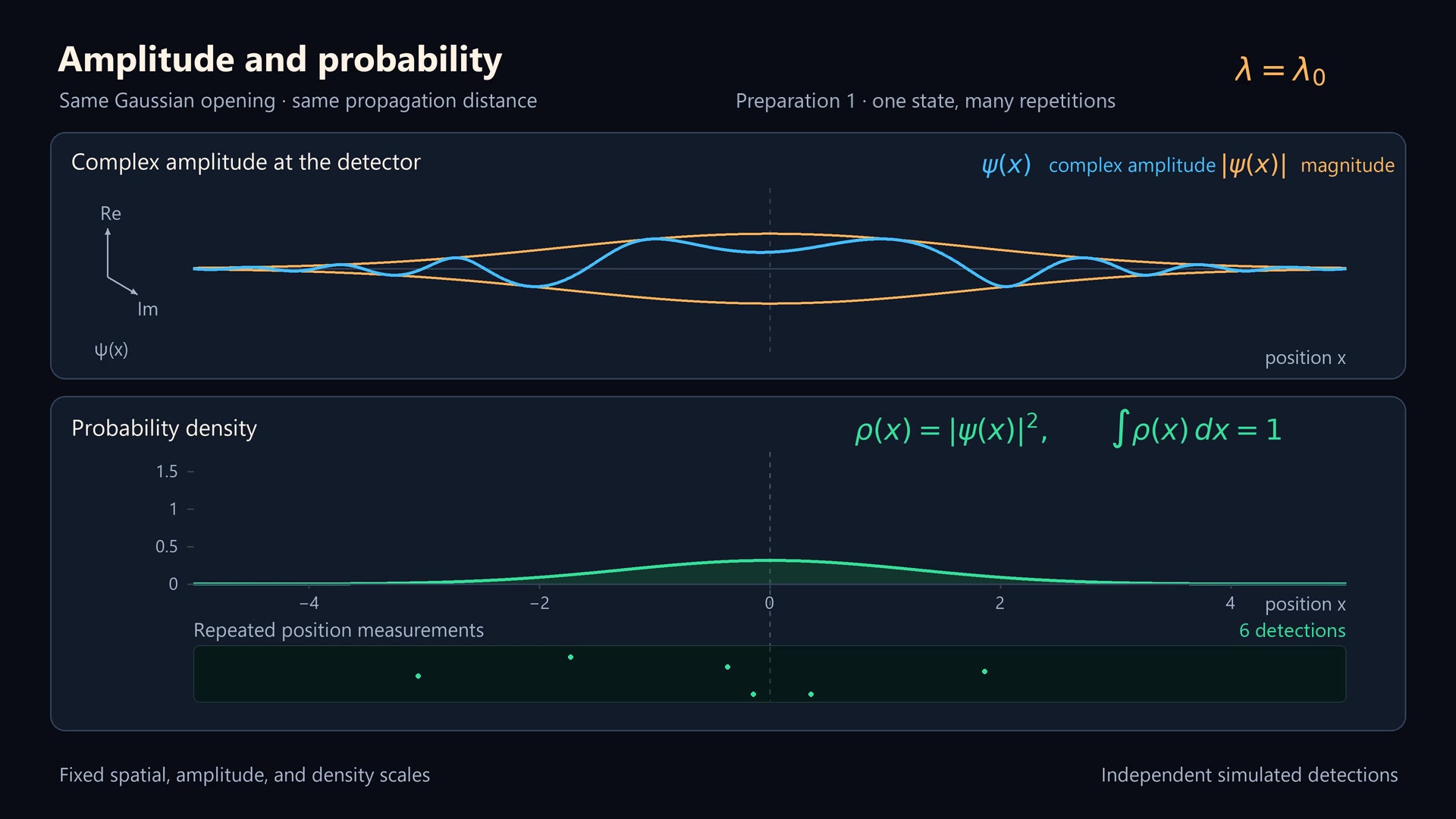
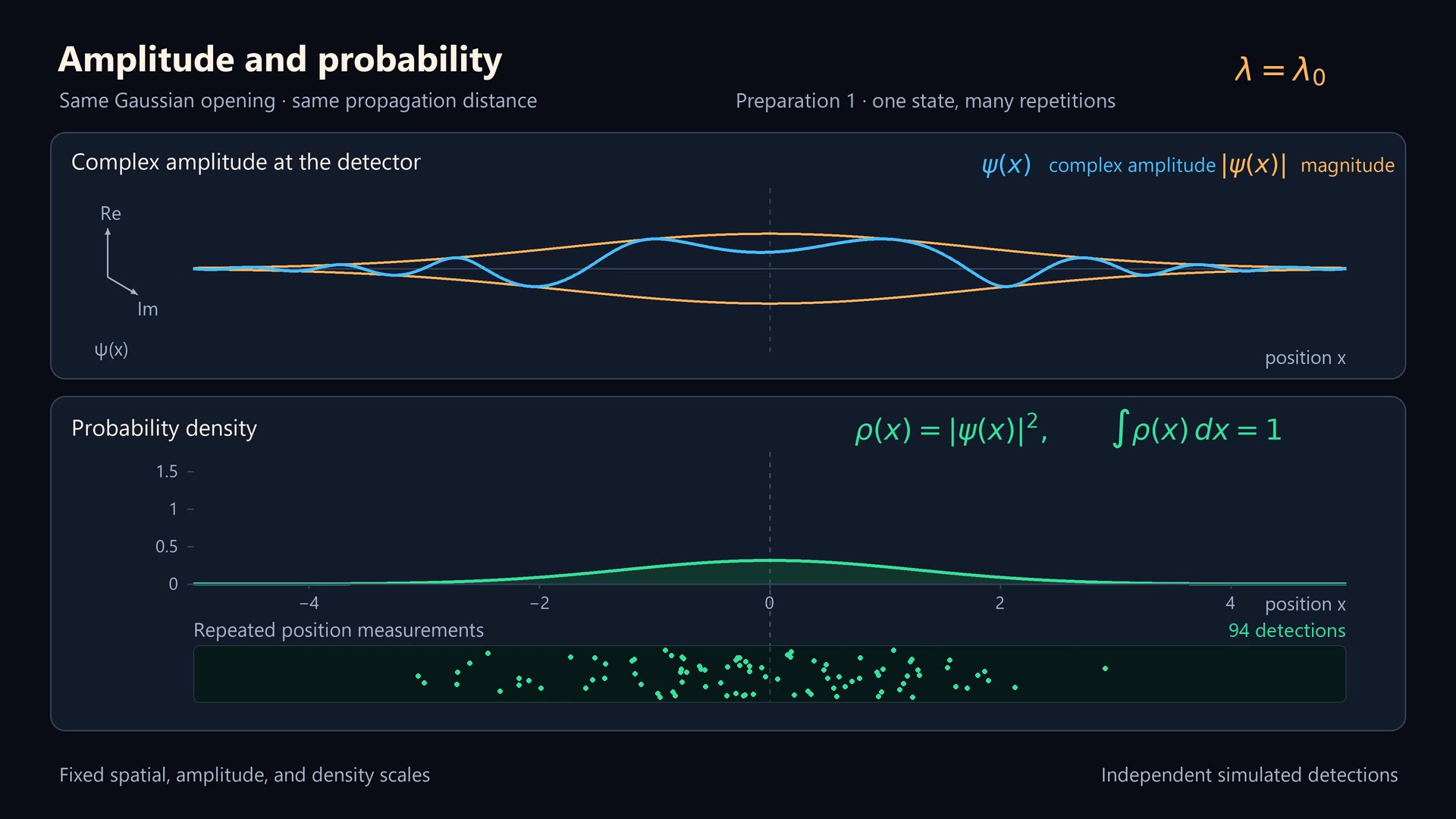
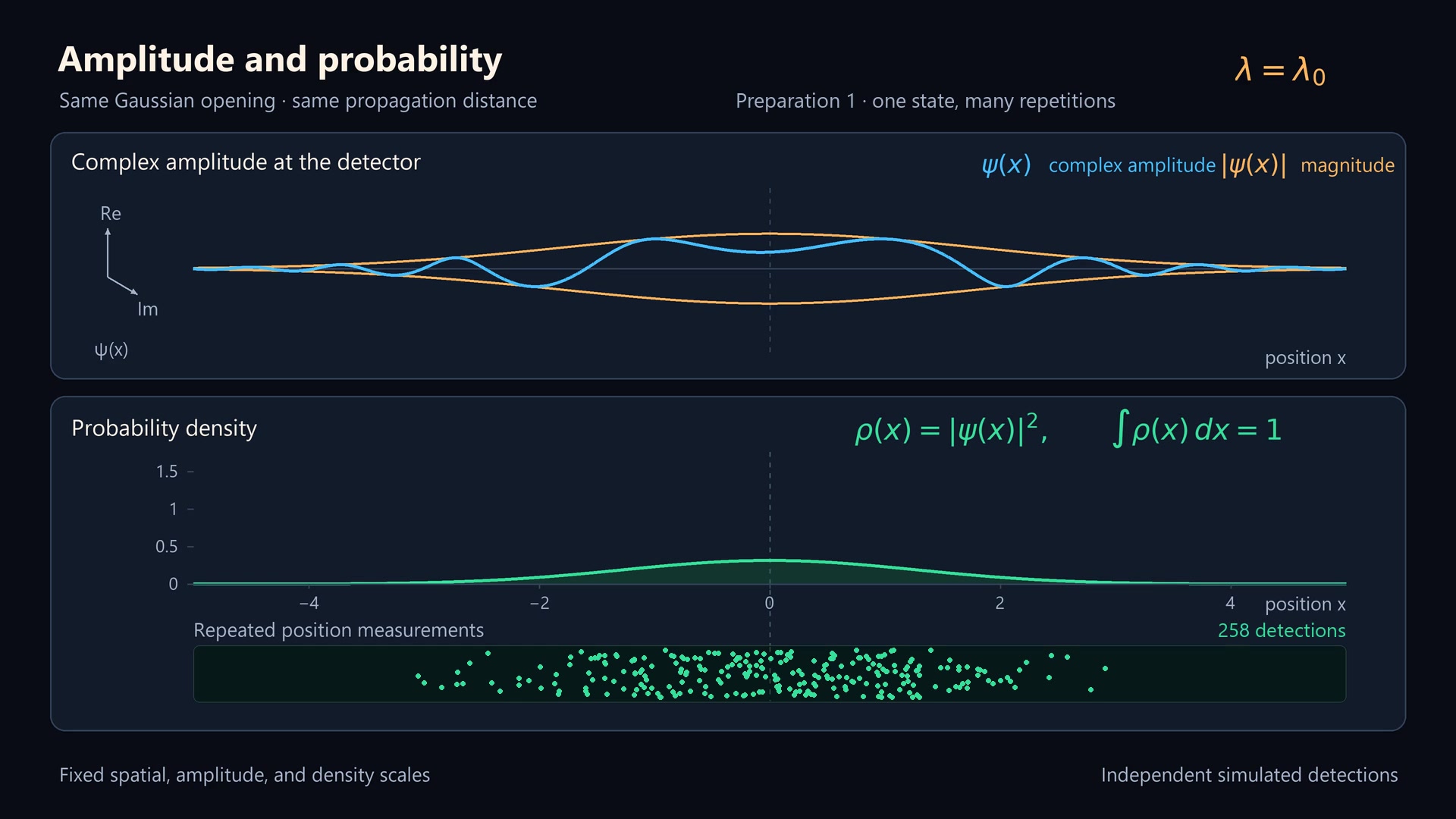
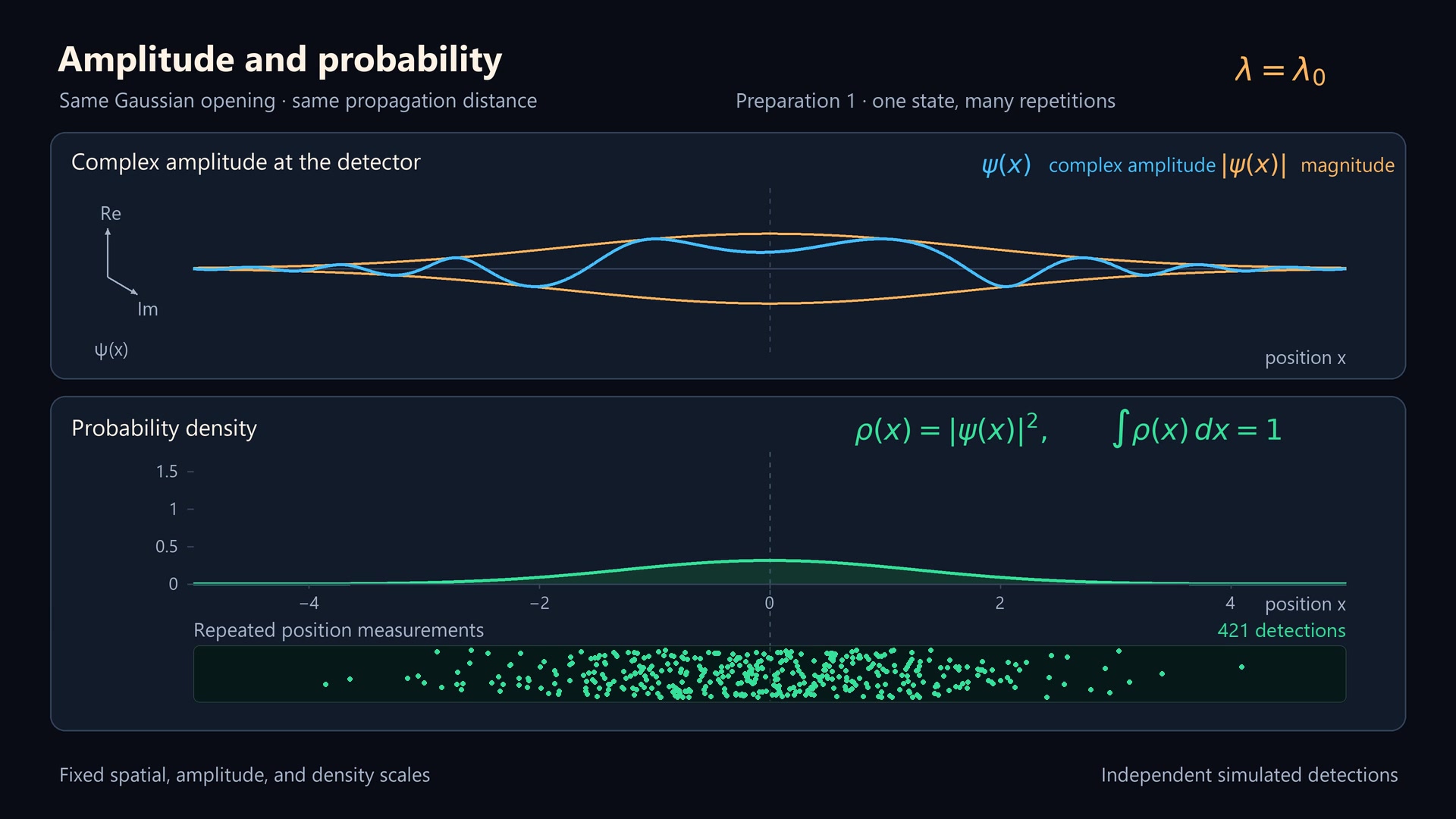
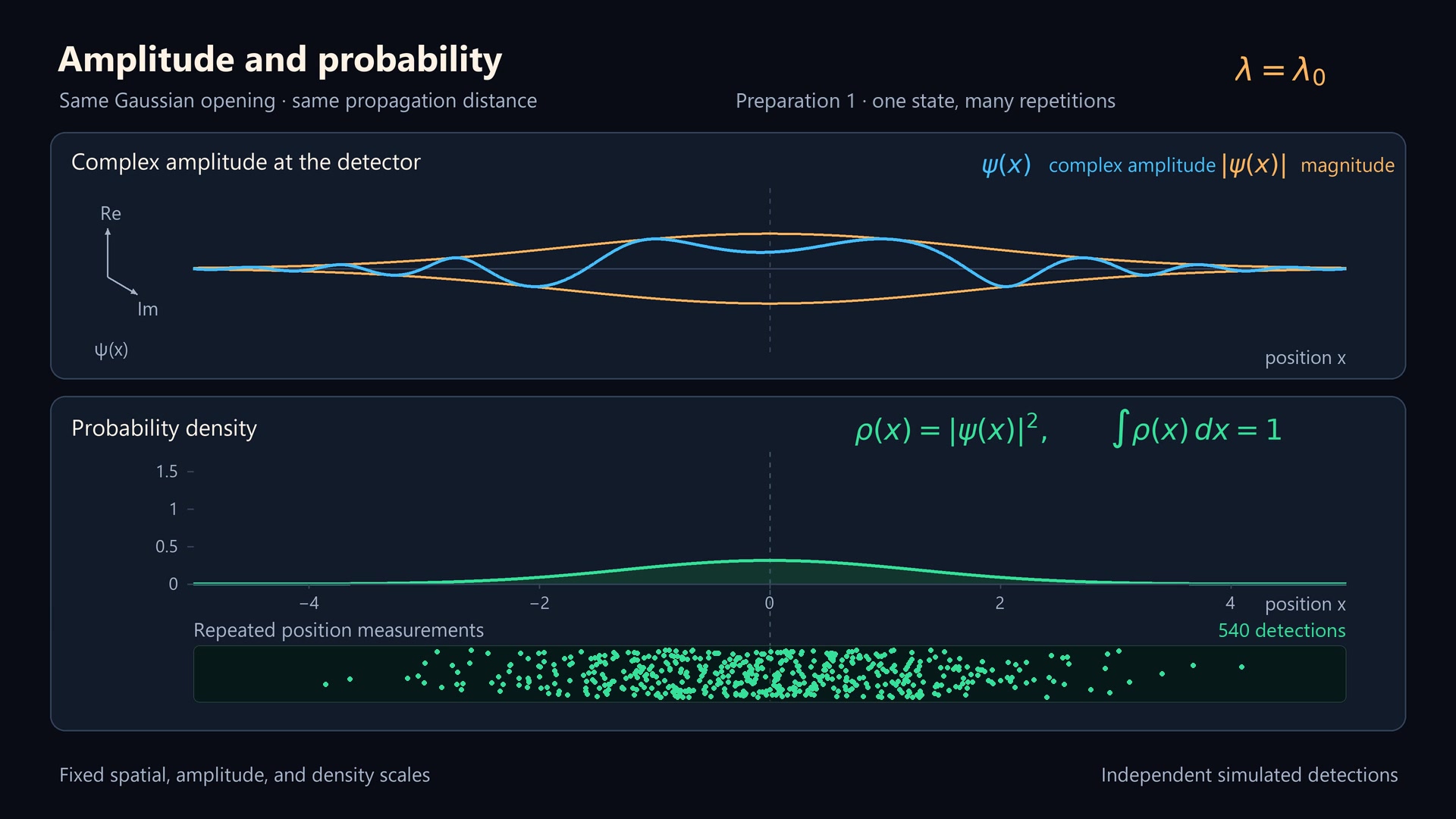
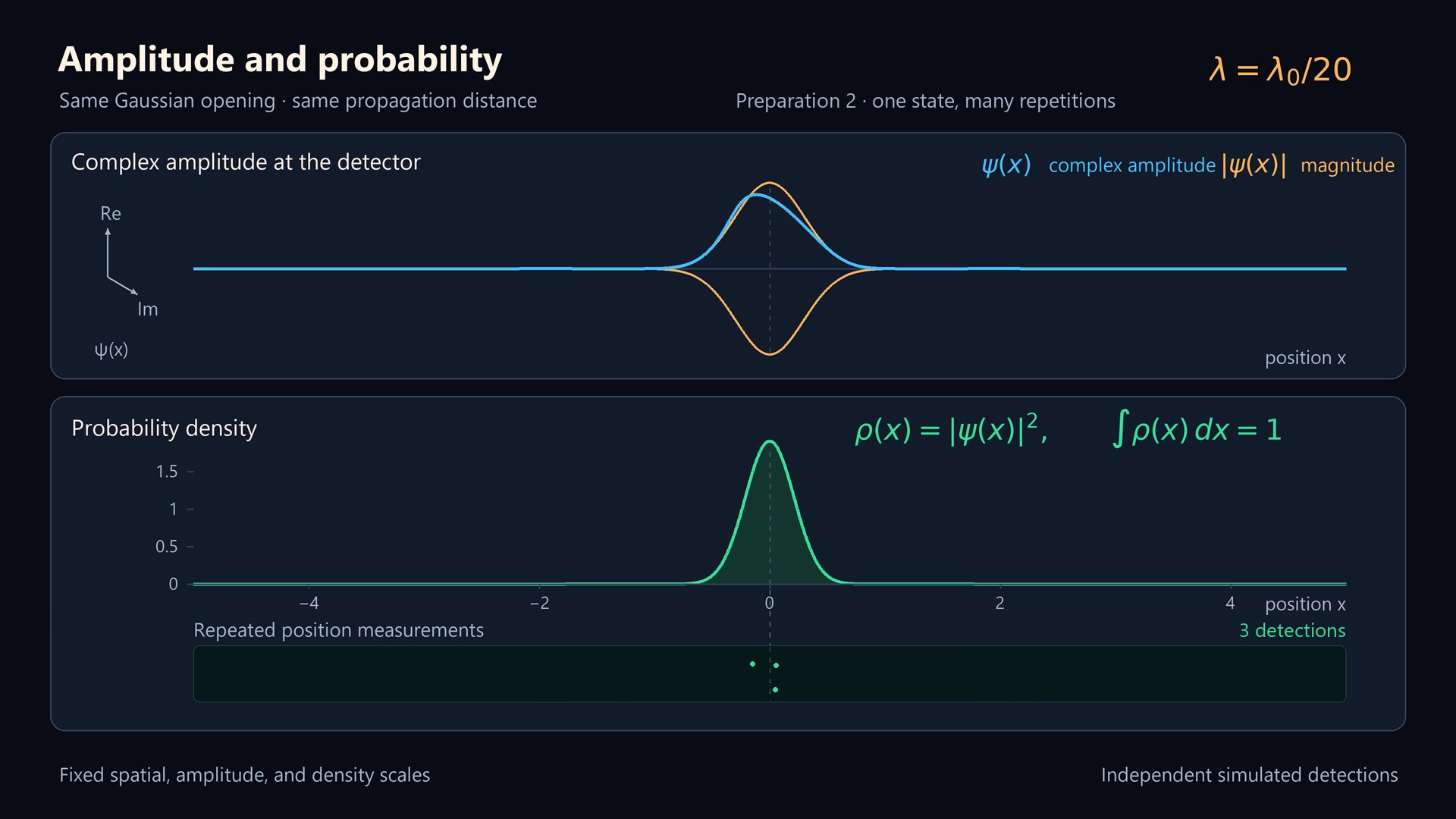
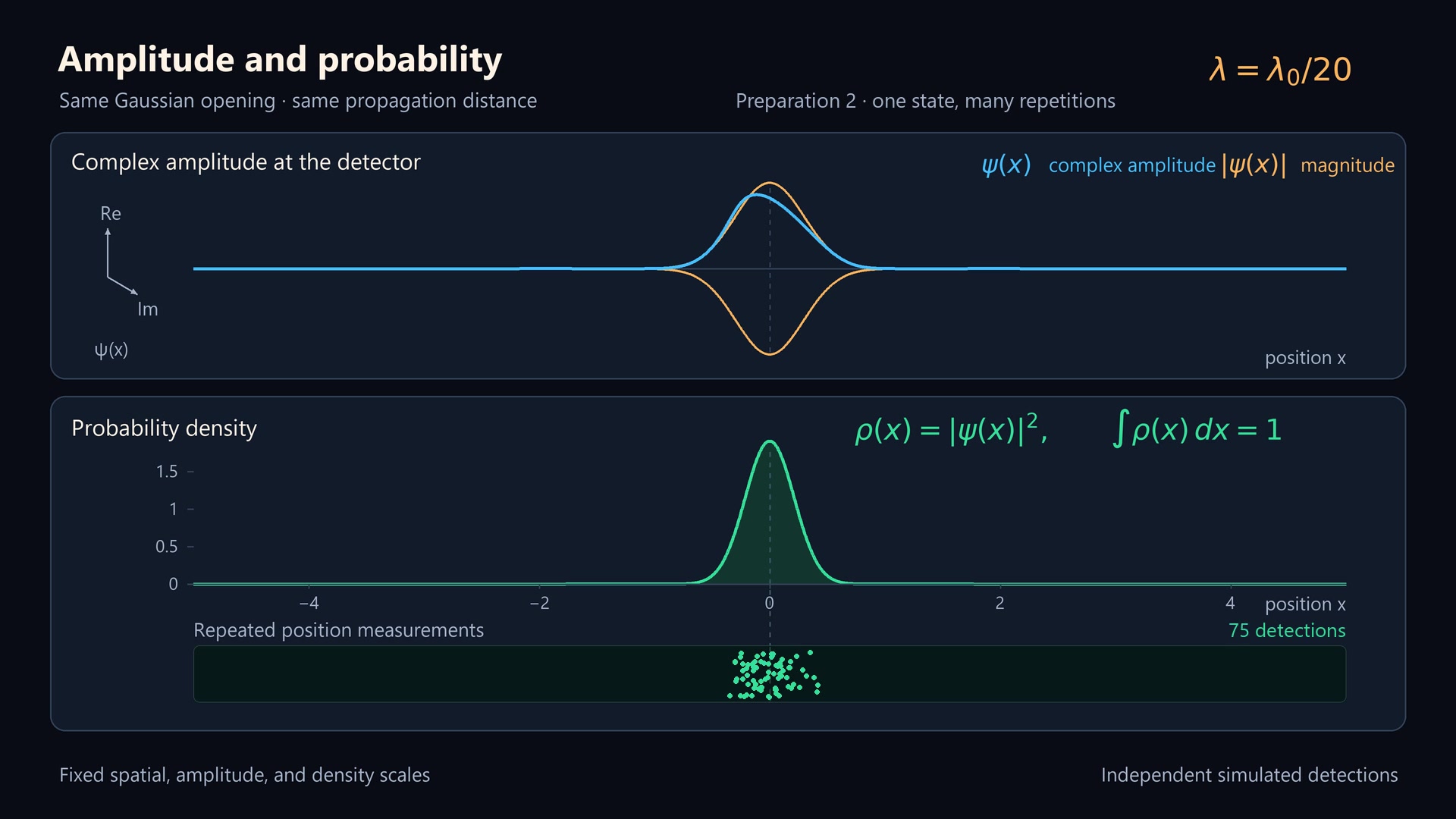
From intensity to position measurement probability density
Image description
A complex amplitude and its squared magnitude predict the distribution of repeated position measurements at two wavelengths
Before the animation
Chapter lines 1231–1235
Chapter lines 1237–1237
We could write the same relationship in the wave-number representation. In either case, the interpretation is as follows. A state is a superposition of the eigenstates in the chosen basis. An ideal measurement leaves the state in a specific eigenstate of the measured operator. The value of the measurement is the eigenvalue of that state. The squared magnitudes of the coefficients multiplying those eigenstates determine the outcome probabilities. They must sum to one for discrete outcomes. For continuous quantities such as position and wave number, they give probability densities that integrate to one. In this view, we may say, loosely, and only if we are so inclined, that the thing that "is" is a wave packet, and the wave-number distribution we measure is given by the squared magnitudes of its Fourier components.
After the animation
Chapter lines 1245–1245
To connect our wave description to mechanics, we need to relate phase to action.
Chapter lines 1247–1247
Action, the quantity extremized by a physically valid path, can be constructed from the structure of spacetime, as articulated in the theory of special relativity, which will be the topic of our next chapter. Crudely speaking, because the quantity to be extremized must be agreed upon by all observers, it is natural that it should be an invariant of symmetry actions on spacetime. This leads to the result that the action is, in free motion, for massive bodies, proportional to an invariant built from translations — the time elapsed along a path as measured in a body's rest frame — times a dual invariant built from time and space translation generators. The former quantity is called proper time while the latter is the body's mass.
Generation source
Main script --render adapts accepted Reel 11 to landscape. It imports detector_state from episodes_quantum and artwork/math helpers from core; neither a portrait MP4 nor a postprocessor is consumed. --verify-video can refresh decoded-video validation without rerendering.
Mapping evidence and limits
Exact STEM/output match. Validation names the normalized paraxial Gaussian model, seeds 73921/73922, wave numbers 8/160, and a video block reporting 840 frames, 30 fps, 1920 x 1080, 28 s. The current MP4 matches that block's SHA-256 (1c8983aa042f447817ec993a7139134c5d2c412565f7d32badf6e8f487886adf).
Source SHA-256 values identify the exact downloadable bytes in this packet. The source mapping and recorded checks explain the likely generation pipeline; they do not prove that these exact source bytes produced the movie. A GitHub link pinned to a commit is provided only when the delivered source bytes exactly match that path at the build's Git HEAD.
- scripts/generate_symmetry_amplitude_probability.py · GitHub at 974f9de35254
SHA-256 4bf9b265921515b60eda56c3b8c7726f54b7576c77cab9cd0e2cd7447561e8e7 - scripts/ccr2_reels/episodes_quantum.py · GitHub at 974f9de35254
SHA-256 b0e163a0e6a1a4f9e67da78cc2150c45bf60fec27a7df89221fe2795e2d2abf3 - scripts/ccr2_reels/core.py · GitHub at 974f9de35254
SHA-256 ea6b4f78ba40628d37cacae2b5cac175cd2442b0afa1d35fabdb4d5081384dd8
Existing generator checks (1 reports)
These are existing author-produced generator reports, copied without changes. Their checks were not rerun for this packet and are not independent certification. A report may describe an earlier generation run; inspect its contents before applying its claims to the current movie.
- symmetry-amplitude-probability-validation.json
SHA-256 1c125b794980d0b210d6e3611c61a665f2ec509f7b74e1a3de0835d80d9e6644
Decoded contact sheet
Extraction method: Twelve evenly spaced decoded frame indices, including first and last. Native-resolution JPEGs from the encoded MP4; timestamps read from FFmpeg showinfo. No source rerendering. Frame indices are zero-based. Sparse samples do not establish continuous motion or capture every transition.. Frame indices are zero-based.
Full-size sampled frames